Ryoji Ikeda is strongly associated with precise audiovisual work and data-driven visual environments, yet the Barbican’s 2026 Portrait weekend focused on music for acoustic ensembles across strings, percussion and voice. I like that shift. An artist closely identified with digital precision can move the same thinking into physical performers and acoustic space. Artistic identity becomes more interesting when the method survives after the familiar tools disappear.
Silencing Part of an Orchestra

When Everyday Objects Become a Cosmos
Sarah Sze builds installations from ordinary objects, images, videos and fragments that can shift in scale from something almost microscopic to something architectural. Her work makes me think about how easily attention moves between those extremes now. We zoom into a screen, step back into a room, then return to a tiny detail. Perhaps scale is no longer only a property of objects. It has become a habit of looking.
https://www.fondationcartier.com/en/collection/artists/sarah-sze
 Fondation Cartier Sarah Sze | Collection of the Fondation Cartier pour l'art contemporain — Fondation Cartier pour l’art contemporain Welcome to the new premises of the Fondation Cartier pour l’art contemporain at 2 Place du Palais-Royal, Paris.
The Image Cannot Hold Still
Lygia Clark’s Sundial can be folded into different configurations or flattened into a plane. Despite its geometric precision, there is no final position that reveals the “correct” sculpture. I like that instability. Museums usually train us to believe an artwork possesses a fixed form that must be protected. Clark instead makes change part of the object’s identity. The sculpture survives precisely because it refuses to remain the same.
A Computer Game After the Game
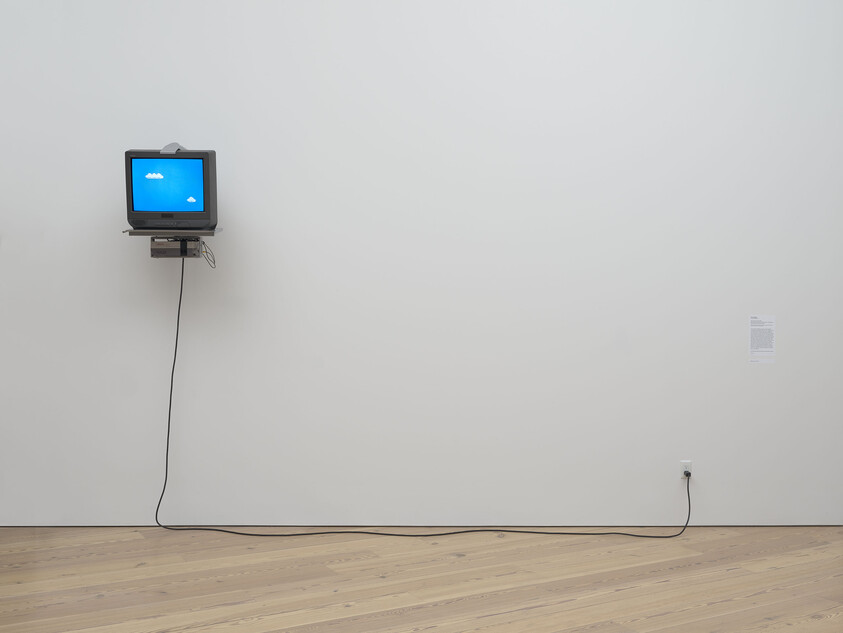
Super Mario Clouds is more than nostalgia for an old Nintendo cartridge. Cory Arcangel exposes the hardware, altered cartridge, cables and projection instead of hiding the mechanism. That matters. Digital images often pretend they have no physical body, yet every cloud on a screen depends on machines, code and electricity. Showing the apparatus makes the apparently weightless image heavy again.
Twenty-Four Hours Inside Cinema
Christian Marclay’s The Clock is built from film fragments showing clocks, watches and references to time, edited so the work follows the actual time of day for twenty-four hours. The clever mechanism is obvious. What interests me more is what happens to thousands of unrelated films when one rule connects them. Narrative disappears, but another structure appears. Editing can create relationships between images that were never meant to meet.
Silencing Part of an Orchestra
Samson Young’s Muted Situation began with a deceptively simple idea: what happens if one layer of an event is deliberately removed from what we hear? In an orchestra, muting pitched sound can reveal breathing, movement and physical effort that music normally hides. I like the thought that silence does not necessarily mean absence. Sometimes removing the thing we expect to hear exposes an entirely different composition underneath it.
https://www.mplus.org.hk/en/magazine/samson-young-unheard-sounds/
 mplus.org.hk Samson Young: Unheard Sounds | M+ Museum Artist Samson Young explains the origins of his Muted Sounds series, in which musicians are instructed to perform without creating music
A Portrait Needs Its Surroundings
Gordon Parks argued that portrait photographers should leave the controlled studio and photograph people where they actually live and work. That sounds simple, but it changes what a portrait can contain. A room, workplace, gesture or background stops being decoration and becomes information about the person. Perhaps a face alone rarely tells us enough. Context can be part of the portrait rather than something to remove from it.
https://www.nga.gov/content/dam/ngaweb/press/exhibition/2024/5842/5842-walltext.pdf
#GordonParks #Photography #PortraitPhotography #DocumentaryPhotography
The Garden That Wasn’t a Garden
Kerry James Marshall’s Many Mansions emerged partly from the contradiction he saw in Chicago public housing projects carrying names such as “Gardens.” The painting places an idealised landscape against the reality suggested by the housing blocks behind it. Names can be tiny pieces of architecture too. Call somewhere a garden and language begins constructing a place that may never actually exist.
https://www.artic.edu/files/aa3ebf14-5f78-489a-a75f-2613336d614d/TX-CR1103.pdf
Hair Becomes a Line
Mona Hatoum made Composition with Circles using her own hair on handmade paper. At first the marks can simply look drawn. Knowing the material changes everything. The line once belonged to a body. Something normally cut away, swept up and discarded becomes evidence of physical presence. It is a remarkably small gesture, yet it makes the boundary between drawing and body difficult to locate.
https://shop.tate.org.uk/mona-hatoum-composition-with-circles-2016-framed/ed1029.html
Drawing That Remembers Erasure
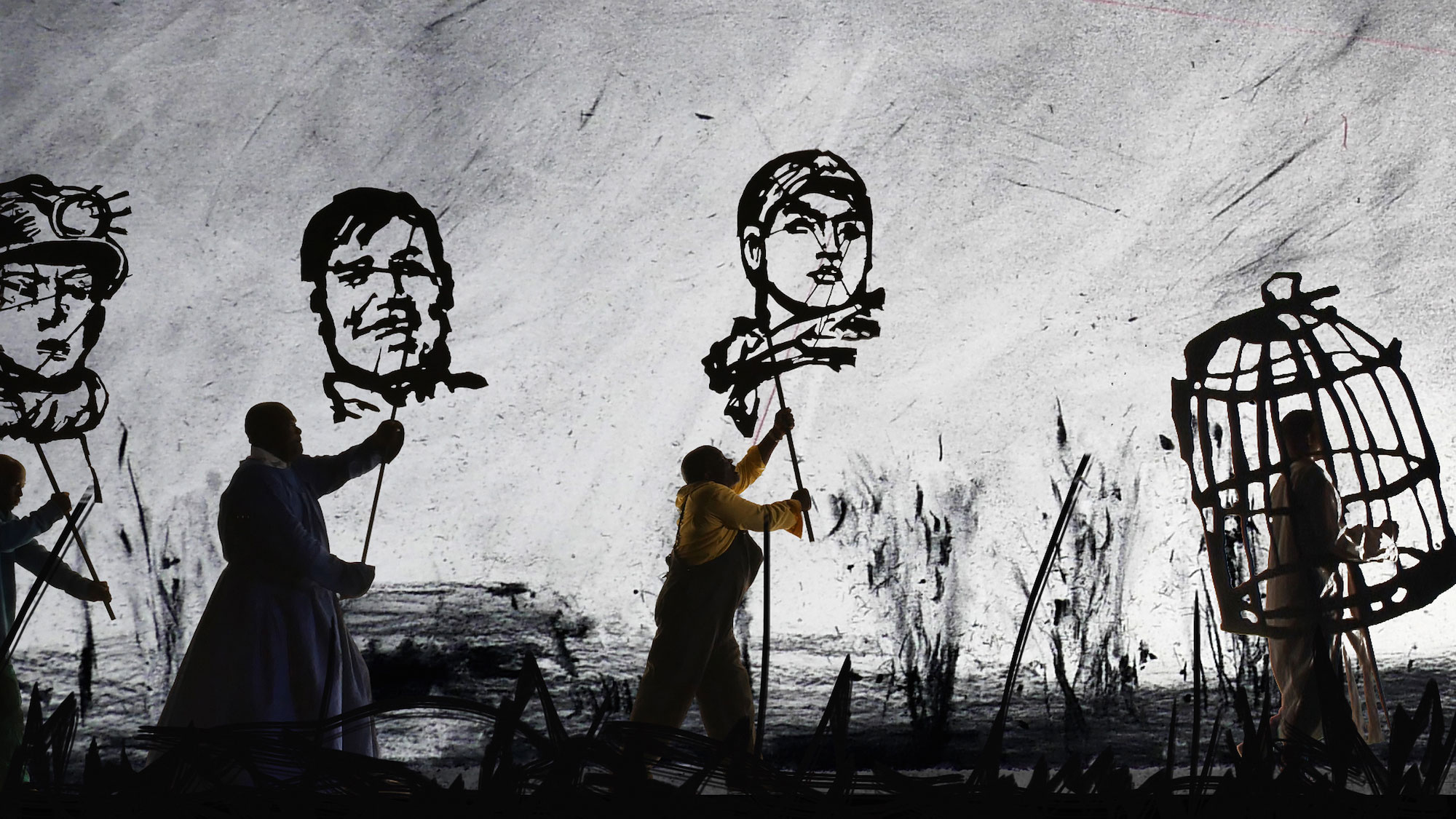
William Kentridge repeatedly draws, erases and redraws charcoal images to make his animations. The previous state never vanishes completely. Smudges remain inside the next frame. That makes movement carry its own history. In a practice concerned with apartheid, colonialism and memory, the technique feels inseparable from the subject. The page remembers what has been removed, even when the image tries to move on.
 Zeitz MOCAA William Kentridge - Zeitz MOCAA The major exhibition, Why Should I Hesitate: Putting Drawings to Work by William Kentridge opens at Zeitz MOCAA in August 2019.
Mario Left, the Clouds Stayed
Cory Arcangel removed almost everything from Super Mario Bros. and left only the blue sky and slowly scrolling clouds. No Mario, coins, enemies or goal remain. A game becomes a quiet moving landscape. What fascinates me is how little information is needed before recognition disappears. Remove enough function from software and the interface stops being a tool. It becomes an image with a memory attached to it.
 Whitney Museum of American Art Cory Arcangel | Super Mario Clouds For this video installation, Cory Arcangel “hacked” a cartridge of Super Mario Brothers, the original version of the blockbuster Nintendo video game released in the United States in 1985. By tweaking the game’s code, the artist erased all of the sound and visual elements except the iconic scrolling clouds. On a formal level, the project is reminiscent of paintings that push representation toward abstraction: how many elements can be removed before the ability to discern the source is lost? Arcangel, who was trained in classical music, considers computers and video game consoles his instruments, and insists on mastering them prior to creative exploration; he will often learn a new programming language in order to develop a work. What might be viewed as nostalgia for the popular entertainments of an earlier era depends, in fact, on a rigorous conceptual approach to computer hard- and software as well as a refusal to participate in contemporary culture’s lightning-fast cycle of technological turnover.