Skip to content

Sound Art

Art Stream
Beatriz Ferreyra

She Composed With Her Ears First

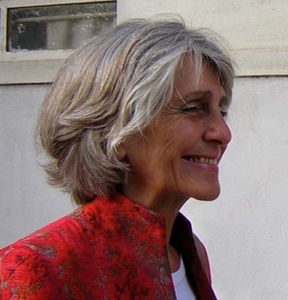
Beatriz Ferreyra entered the Groupe de Recherches Musicales in Paris in 1963 after hearing musique concrète for the first time.

She later worked with Pierre Schaeffer on the Solfège de l’Objet Sonore, but her own description of those early years is refreshingly different from the mythology surrounding institutional electronic music.

Ferreyra has said she arrived without an academic composition background and had to learn tape editing, filtering and recording directly through practice. She was fascinated less by traditional notes than by the physical character of sound itself. She has described hearing sounds as forms and colours, almost as though composing were another kind of painting.

That feels important because electronic music is often taught backwards.

First understand the technology.

Then make something.

Ferreyra’s story begins with fascination.

A sound was interesting enough that she needed to discover how to work with it.

The technical knowledge followed the desire to listen more closely.

That may be why early musique concrète still has something useful to teach producers surrounded by sophisticated software.

A new plug-in does not automatically produce a new way of hearing.

Sometimes the more difficult skill is noticing that an ordinary sound was already interesting before anyone processed it.

https://brahms.ircam.fr/en/composer/beatriz-ferreyra/biography

#BeatrizFerreyra #MusiqueConcrete #ElectroacousticMusic #SoundArt
She Composed With Her Ears First She Composed With Her Ears First Ressources IRCAM Biographie - Béatriz Ferreyra La biographie du compositeur Béatriz Ferreyra
Facebook LinkedIn WhatsApp Threads
More sharing options
X Reddit Pinterest Telegram Email
Avaeken

A Guitar Recording Became a Sculpture

Stephen O’Malley’s Avaeken, released on 21 August 2026, did not begin as a conventional album.

The music originated as a site-specific sound work created in relation to Banks Violette’s exhibition Wish You Were Here. O’Malley installed sound into the gallery environment, continuing a collaboration between the two artists that has repeatedly placed amplified guitar beside sculpture and architecture.

That context changes what a sustained guitar tone means.

On a record, duration happens through speakers while the listener remains outside the music.

Inside a gallery, the same frequency occupies walls, floor, air and body.

Low frequencies become particularly physical. They can make architecture seem temporarily less solid because the room begins responding to the sound.

This is where drone music becomes difficult to separate from sculpture.

A sculpture normally occupies space with material.

O’Malley can occupy the same space with pressure.

Nothing visible has been added, yet the dimensions of the room feel different.

I keep coming back to this because electronic and amplified music are usually discussed through time: rhythm, duration, sequence.

Long tones reveal another possibility.

Sound can also be an architecture.

You do not only listen to it.

For a while, you stand inside it.

https://www.daisrecords.com/blogs/news/stephen-omalleys-avaeken-out-august-21-on-dais-records

#StephenOMalley #DroneMusic #SoundArt #Avaeken

A Guitar Recording Became a Sculpture A Guitar Recording Became a Sculpture Dais Records Stephen O'Malley's 'Avaeken' out August 21 on Dais Records American experimental composer Stephen O'Malley announces Avaeken, two sides of immense, immersive, self-annihilating music, out August 21, 2026 from Dais Records.
Facebook LinkedIn WhatsApp Threads
More sharing options
X Reddit Pinterest Telegram Email
Acoustics

The Room Became the Loudspeaker

Maryanne Amacher did not simply compose sounds for rooms.

She wanted the rooms themselves to behave acoustically.

In her Music for Sound-Joined Rooms installations, she worked with sound transmitted through architectural structures, using walls, floors, corridors and connected spaces to shape what listeners heard and physically felt.

Her own description is wonderful: rooms, walls and corridors that sing.

That idea changes the normal relationship between music and architecture.

Usually we build a composition somewhere else, bring loudspeakers into a room and then try to minimise whatever the architecture does to the mix.

Amacher did almost the reverse.

The building became part of the signal chain.

Earlier, beginning with City-Links in 1967, she had already experimented with microphones transmitting remote environments over telephone lines, effectively connecting distant places into one listening system.

Decades before networked performances became easy, she was treating telecommunications infrastructure as musical material.

What stays with me is the scale of her thinking.

The instrument could be a room.

Or several rooms.

Or a city connected to another city.

Electronic music is often imagined as something generated inside machines.

Amacher kept asking what would happen if the machine was only one component inside a much larger acoustic system that included architecture, distance and the listener’s own ears.

https://www.foundationforcontemporaryarts.org/recipients/maryanne-amacher/

#MaryanneAmacher #SoundArt #Acoustics #ExperimentalMusic

The Room Became the Loudspeaker The Room Became the Loudspeaker foundationforcontemporaryarts.org Maryanne Amacher | FCA Grant Recipient Maryanne Amacher did not simply compose sounds for rooms. She wanted the rooms themselves to behave acoustically. In her Music for Sound-Joined...
Facebook LinkedIn WhatsApp Threads
More sharing options
X Reddit Pinterest Telegram Email
Field Recording

Listening Through the Hands

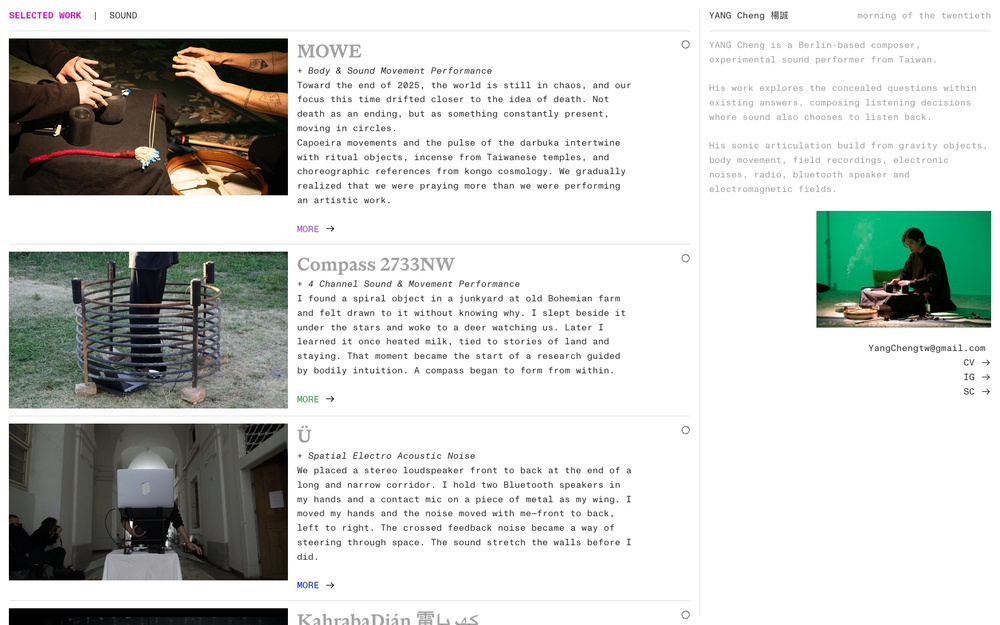
Taiwanese experimental composer Yang Cheng describes abandoning a conventional field-recording setup while travelling around Taiwan. Instead, he attached microphones to his palms and listened through his hands.

That small technical decision completely changes the idea of recording a place for me.

A normal field recorder encourages distance. Point the microphones toward an environment, remain quiet and collect what happens.

A microphone attached to the body cannot pretend the recorder is absent.

Movement becomes part of the recording. Touch becomes part of it. The distance between body and object keeps changing.

Yang also works with radio, Bluetooth speakers, electromagnetic fields, found objects and environmental recordings. But the microphones on the palms are the detail I keep returning to because they turn listening into a physical action.

We usually describe microphones as devices that capture sound.

Here they behave almost like sensory organs.

Perhaps field recording becomes more interesting when it stops asking, “What does this place sound like?” and starts asking, “What does my presence inside this place sound like?”

https://yangcheng.one/

#YangCheng #FieldRecording #TaiwaneseMusic #SoundArt

Listening Through the Hands Listening Through the Hands yangcheng.one YangCheng cargo.site
Facebook LinkedIn WhatsApp Threads
More sharing options
X Reddit Pinterest Telegram Email
Field Recording

Listening Before Making Sound

KMRU’s work repeatedly begins with recording environments. Joseph Kamaru has built compositions from field recordings gathered in Nairobi and many other places, treating apparently minor environmental sounds as material worthy of sustained attention. His practice has expanded into installations, performances and long-form ambient works in which place is not simply captured but reshaped through processing and composition.

I find the order of operations interesting.

Music production usually begins with making a sound: play a synth, strike a drum, choose a sample. Field recording can reverse that relationship. First you listen. The world has already generated the material.

That produces another question: when does documentation become composition?

A recording of traffic, wind or machinery may initially describe a place. Once it is edited, layered, filtered and placed beside another recording, it begins constructing a place that never actually existed.

The microphone therefore becomes more than a device for collecting sound. It can be an instrument for noticing what most of us have trained ourselves to ignore.

https://kmru.info/

#KMRU #FieldRecording #KenyanMusic #SoundArt

Listening Before Making Sound Listening Before Making Sound KMRU’s work repeatedly begins with recording environments. Joseph Kamaru has built compositions from field recordings gathered in Nairobi and many other pl…
Facebook LinkedIn WhatsApp Threads
More sharing options
X Reddit Pinterest Telegram Email