Skip to content

Listening Through the Hands

Ghanaian Art

A Sack That Has Already Travelled

Ibrahim Mahama’s large installations often begin with used jute sacks. The material has a complicated geography. Many sacks are manufactured in Southeast Asia, imported by the Ghana Cocoa Board for cocoa, then reused to carry food, charcoal and other goods. By the time Mahama gathers them, their surfaces already contain stains, markings, repairs and evidence of labour.

He stitches many of them together and uses the resulting textile to cover buildings or create enormous architectural surfaces.

What interests me is that the material arrives with its own history before the artist makes the first decision.

A clean canvas tries to begin at zero.

Mahama’s sacks cannot.

Someone has carried them. Something has leaked onto them. A name or number has been stamped across the fibre.

The artist does not manufacture those traces. He reorganises them.

That makes the surface behave almost like an archive.

Instead of representing global trade through an image, the material has physically participated in it.

Sometimes the strongest documentary material is the thing that survived the journey.

https://www.whitecube.com/artists/ibrahim-mahama

#IbrahimMahama #GhanaianArt #Jute #InstallationArt

A Sack That Has Already Travelled A Sack That Has Already Travelled White Cube Ibrahim Mahama Ibrahim Mahama uses the transformation of materials to explore themes of commodity, migration, globalisation and economic exchange.
Drums Recorded

Drums Recorded in Single Takes

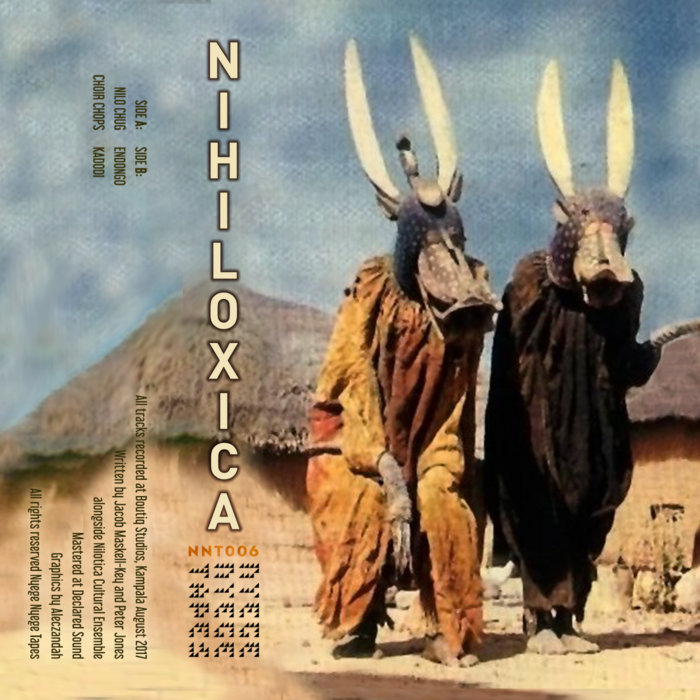
Nihiloxica’s first recordings brought musicians from Uganda’s Nilotika Cultural Ensemble together with electronic musicians Peter Jones and Jacob Maskell-Key. Their 2017 EP was recorded live at Boutiq Studios in Kampala, with each piece captured in a single take. Traditional drums, shakers and long drums sit beside synthesizers and a conventional drum kit.

The single-take detail matters.

Electronic music can be edited almost without limit. Timing can be corrected, sections moved and individual hits replaced.

Recording an ensemble live removes much of that safety net.

The musicians have to build the architecture collectively while the tape is already running.

Nihiloxica later described their work in terms of Bugandan techno, but the interesting part for me is not whether acoustic percussion can sound like techno.

It is that techno’s intensity can emerge without reducing all rhythm to a programmed grid.

Several musicians can create repetition together while every cycle remains slightly different.

A groove does not need mathematical perfection to become hypnotic.

Sometimes the instability is what gives it force.

https://nyegenyegetapes.bandcamp.com/album/nihiloxica

#Nihiloxica #UgandanMusic #Percussion #ElectronicMusic

Drums Recorded in Single Takes Drums Recorded in Single Takes Nyege Nyege Tapes Nihiloxica, by Nihiloxica 4 track album
Bendik Giske

The Saxophone as a Drum Machine

Bendik Giske takes ideas associated with electronic and club music and tries to produce them physically with saxophone, breath and microphones. He has described his approach as playing the building blocks of electronic music live, without layering or looping wherever possible.

That limitation immediately changes the sound.

A sequencer never runs out of breath. A human body does.

Giske uses circular breathing, key noises and contact microphones so that the mechanism of the saxophone becomes audible alongside its conventional tone. Fingers hitting keys can begin to function almost like percussion.

I like how this reverses the normal relationship between acoustic and electronic music.

Instead of processing an instrument until it behaves like a machine, the performer trains his body to approach the repetition and endurance associated with machines.

But the imperfections remain.

Breath changes. Muscles tire. Timing shifts slightly.

Those supposedly unwanted differences may be exactly what keeps repetition alive.

The machine becomes the reference point, but the body refuses to disappear.

https://www.bendikgiske.com/

#BendikGiske #Saxophone #ExperimentalMusic #ClubCulture

The Saxophone as a Drum Machine The Saxophone as a Drum Machine Bendik Giske Bendik Giske Bendik Giske takes ideas associated with electronic and club music and tries to produce them physically with saxophone, breath and microphones...
Experimental Music

One Pulse for Forty Minutes

Oren Ambarchi’s Quixotism unfolds as a single long composition divided into five parts. At its foundation sits double-time electronic percussion by Thomas Brinkmann. Around that pulse, guitar, strings, electronics and other contributions gradually enter and disappear. The transitions can happen so slowly that the listener notices the new state before noticing exactly when the change occurred.

That is what fascinates me.

Most electronic arrangements announce their structure. Breakdown. Drop. New section. Fill. Return.

Quixotism works more like a landscape changing while you walk through it.

The pulse provides continuity, but almost everything around it can evolve.

This makes repetition feel less like looping and more like a measurement device. Because one element remains relatively stable, tiny changes elsewhere suddenly become important.

It is a useful production lesson.

You do not always need another chord progression or another section to create movement.

Sometimes the strongest arrangement decision is to keep one thing almost stubbornly unchanged while the entire world around it moves.

https://www.blacktrufflerecords.com/

#OrenAmbarchi #Quixotism #ExperimentalMusic #Minimalism

One Pulse for Forty Minutes One Pulse for Forty Minutes blacktrufflerecords.com Black Truffle Records | Releases Oren Ambarchi’s Quixotism unfolds as a single long composition divided into five parts. At its foundation sits double-time electronic percussion...
Bolero

Bolero Floating Through a Synthesizer

For “No tiempo,” Lucrecia Dalt began with two things that seem to belong to different musical worlds: a soft rhythmic pattern inspired by bolero and a voice moving through what she described as a swarm of synthesizers. The piece became one of the starting points for her 2022 album ¡Ay!.

That combination interests me because the electronics do not erase the older rhythmic reference.

Bolero carries a strong history of voice, intimacy and physical rhythm. Synthesizers can easily pull music toward abstraction. Dalt allows both tendencies to remain present.

It is tempting in electronic production to replace an existing form completely: make the rhythm harder, quantise it, modernise the sound.

Another possibility is more subtle.

Keep enough of the original gesture that its memory remains, then change the environment surrounding it.

A traditional rhythm does not have to be sampled literally to survive inside electronic music.

Sometimes its shape is enough.

The listener hears something familiar without being able to point directly at the source.

https://pitchfork.com/news/lucrecia-dalt-announces-new-album-ay-shares-video-for-new-song-watch/

#LucreciaDalt #Bolero #ElectronicMusic #ColombianMusic

Bolero Floating Through a Synthesizer Bolero Floating Through a Synthesizer Pitchfork Lucrecia Dalt Announces New Album ¡Ay!, Shares Video for New Song “No tiempo” leads the Colombian musician’s follow-up to 2020’s No era sólida
Field Recording

Listening Through the Hands

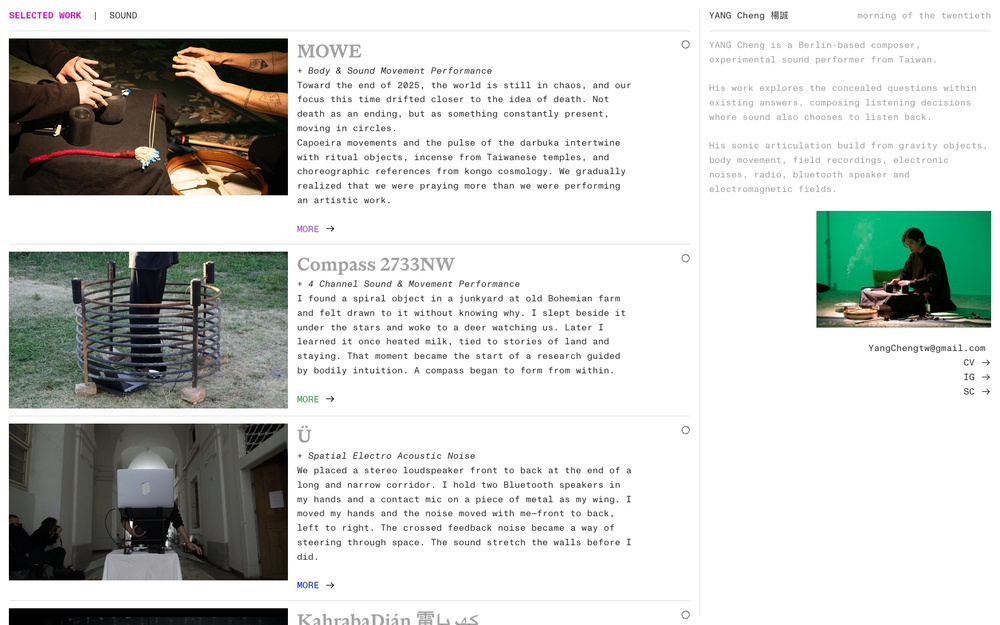
Taiwanese experimental composer Yang Cheng describes abandoning a conventional field-recording setup while travelling around Taiwan. Instead, he attached microphones to his palms and listened through his hands.

That small technical decision completely changes the idea of recording a place for me.

A normal field recorder encourages distance. Point the microphones toward an environment, remain quiet and collect what happens.

A microphone attached to the body cannot pretend the recorder is absent.

Movement becomes part of the recording. Touch becomes part of it. The distance between body and object keeps changing.

Yang also works with radio, Bluetooth speakers, electromagnetic fields, found objects and environmental recordings. But the microphones on the palms are the detail I keep returning to because they turn listening into a physical action.

We usually describe microphones as devices that capture sound.

Here they behave almost like sensory organs.

Perhaps field recording becomes more interesting when it stops asking, “What does this place sound like?” and starts asking, “What does my presence inside this place sound like?”

https://yangcheng.one/

#YangCheng #FieldRecording #TaiwaneseMusic #SoundArt

Listening Through the Hands Listening Through the Hands yangcheng.one YangCheng cargo.site
African Electronica

When Sahel Rhythms Enter the Club

Burkina Electric combine electronic dance production with rhythms from Burkina Faso, including patterns connected with Mossi musical traditions. The group also uses traditional instruments and found sounds recorded in Burkina Faso, while singer Maï Lingani performs in Moré, Dioula, Bissa and French.

What catches my attention is their decision not to build electronic tracks around the rhythmic vocabulary that already dominates global club music.

Electronic production software makes 4/4 remarkably easy. Open a sequencer and the grid almost asks for a kick drum on every beat. That convenience can quietly shape what music gets made.

Burkina Electric begin somewhere else.

If the underlying rhythmic logic changes, the electronics have to adapt rather than simply absorb a regional melody on top of a familiar house groove.

That seems much more interesting than fusion as decoration.

Technology becomes useful not because it standardises musical cultures, but because it can expose how limited our supposedly universal electronic grids sometimes are.

https://cantaloupemusic.com/artists/burkina-electric

#BurkinaElectric #BurkinaFaso #AfricanElectronica #Rhythm

When Sahel Rhythms Enter the Club When Sahel Rhythms Enter the Club Cantaloupe Music Burkina Electric Burkina Electric combine electronic dance production with rhythms from Burkina Faso, including patterns connected with Mossi musical traditions...
Buchla

Playing the Space Itself

Suzanne Ciani’s relationship with the Buchla synthesizer goes beyond generating unusual electronic tones. In her quadraphonic performances, space itself becomes part of the instrument. Four-channel output allows sounds to move around the audience rather than simply sit between a left and right speaker. Ciani has described spatial placement and movement as integral parts of the composition.

That interests me because stereo production trains us to think mainly from the front. Pan something left, move something right, create depth with reverb. Quadraphonic sound changes the geometry completely.

A sequence can rotate around the room. A gesture can disappear behind the listener. Two sounds can occupy physically different territories even when their frequencies overlap.

Ciani’s work makes me think that electronic composition has an additional parameter we often ignore: location.

Pitch, rhythm, timbre and volume can all change over time.

Why not position?

Once sound can move through architecture, the room stops being the container for the music.

It becomes another part of the synthesizer.

https://www.sevwave.com/

#SuzanneCiani #Buchla #QuadraphonicSound #ElectronicMusic

Playing the Space Itself Playing the Space Itself Suzanne Ciani Suzanne Ciani | Diva of the Diode Suzanne is a five-time Grammy award nominated composer, electronic music pioneer, and neo-classical recording artist. -Suzanne Ciani -composer -Buchla -synth pioneer
Himid’s Zanzibar

Painting a Place From Memory

Lubaina Himid’s Zanzibar series is built around several journeys, some physical and some remembered. Himid was born in Zanzibar in 1954 and travelled to England with her mother when she was only four months old after her father died. Decades later she returned to Zanzibar in 1997 and realised that she had already been painting aspects of the island without consciously knowing it.

That idea stays with me.

We often think observation comes first and artwork second. You see a place, then represent it.

Memory can reverse the order.

Colour, sea, rain, shutters or fragments of architecture may appear in paintings before the artist fully understands what they belong to.

Himid describes the series as containing cloves, fishing nets, the sea, malaria and women’s tears. She also listened to a great deal of music while making it.

The paintings therefore do not behave like geographical documents.

They are closer to maps drawn after forgetting most of the roads.

Sometimes the inaccuracies of memory may tell us more about a place than accurate coordinates ever could.

Zanzibar

#LubainaHimid #Zanzibar #Painting #MemoryAndPlace

Painting a Place From Memory Painting a Place From Memory lubainahimid.com Zanzibar – Lubaina Himid Lubaina Himid’s Zanzibar series is built around several journeys, some physical and some remembered. Himid was born in Zanzibar in 1954 and...
Cecilia Vicuna

Writing With Knots Again

Cecilia Vicuña began making her own interpretations of the Andean quipu as a teenager in Chile. Historical quipus used coloured and knotted cords to encode information, but Vicuña treats the idea more freely, describing her works as poems in space. Some are made from enormous lengths of unspun wool that viewers can physically walk among.

That scale changes everything.

A knot normally fits in a hand. Enlarge the idea until threads descend through architecture and the viewer effectively enters the writing.

Vicuña has said that people walking through Quipu Austral become part of the knots themselves. Wind and sunlight can also move the fibres, meaning the work continues changing after installation.

I like the contradiction between ancient memory technology and extreme material fragility.

We tend to imagine information preservation as making something permanent.

Vicuña does something stranger. Meaning survives through an object that can move, fray and eventually disappear.

Perhaps memory does not always need a permanent container.

Sometimes it needs repetition.

https://www.ceciliavicuna.com/quipus

#CeciliaVicuna #Quipu #ChileanArt #TextileInstallation

Writing With Knots Again Writing With Knots Again Cecilia Vicuña Quipus — Cecilia Vicuña Cecilia Vicuña began making her own interpretations of the Andean quipu as a teenager in Chile. Historical quipus used coloured and knotted cords...
Expanded Cinema

When Film Invades the Room

Ho Tzu Nyen’s The Cloud of Unknowing begins as moving image but refuses to remain simply a film on a wall. Created for the Singapore Pavilion at the 2011 Venice Biennale, it was filmed inside a public housing block shortly before demolition. Eight characters encounter different manifestations of a mysterious cloud, with references ranging across Eastern and Western art history.

But the installation extends beyond the image.

Multiple screens, multichannel audio, theatrical lighting and smoke transform the viewing space itself. The cloud can effectively leave the projected world and appear to enter the room occupied by the audience.

That interests me from a VJ and expanded-cinema perspective.

Projection normally creates a clear border: reality here, image there.

Smoke destroys that certainty because projected light suddenly has volume. A beam that was invisible in the air becomes a physical-looking object.

The simplest atmospheric effect can therefore change the grammar of cinema.

The image stops being something we look at.

For a moment, we are standing inside it.

https://www.chanel.com/us/chanel-next-prize/ho-tzu-nyen/

#HoTzuNyen #ExperimentalFilm #VideoInstallation #ExpandedCinema

When Film Invades the Room When Film Invades the Room chanel.com Ho Tzu Nyen’s The Cloud of Unknowing begins as moving image but refuses to remain simply a film on a wall. Created for the Singapore Pavilion at...