Skip to content

Field Recording

Art Stream
Album Composed Between Train

An Album Composed Between Train Stations

Brussels producer Le Motel made much of Pozo de Agua outdoors or while travelling, especially on trains. The album, due on 15 September 2026 through Constellation Tatsu, treats environmental recordings such as water, movement and air with the same compositional weight as more conventional instruments. Those materials drift through ambient electronics and overlapping rhythmic structures rather than sitting behind the music as documentary decoration.

That approach interests me because portable production has changed what a studio means. A laptop and headphones make it possible to compose almost anywhere, but most mobile production still tries to recreate the controlled conditions of a room. Noise is something to isolate yourself from. Le Motel allows the place he is moving through to enter the work.

A train is an especially good studio if you stop expecting silence. It supplies periodic impacts, vibration, changing landscapes and a rhythm that belongs to the journey rather than to the sequencer. Even concentration changes when the physical location keeps moving.

Field recording is sometimes treated as a separate discipline, as though one first collects the world and later turns it into music. Pozo de Agua suggests a softer boundary. Composition can happen while the world is already passing through the microphone.

https://ctatsu.com/

#LeMotel #PozoDeAgua #FieldRecording #AmbientMusic

An Album Composed Between Train Stations An Album Composed Between Train Stations ctatsu.com Constellation Tatsu Home page of Constellation Tatsu, a label from Oakland. adventurous with spiritual artistic sensibilities
Facebook LinkedIn WhatsApp Threads
More sharing options
X Reddit Pinterest Telegram Email
Depeche Mode

Depeche Mode Went Looking for Metal

During the making of Construction Time Again, Depeche Mode discovered sampling and immediately started looking beyond conventional instruments.

For “Pipeline,” Martin Gore, Gareth Jones and the group went into Shoreditch recording metal objects, pipes, steel plates and other found sounds. Engineer Gareth Jones recalls drumsticks and hammers striking objects around a disused railway environment. Gore’s vocal was also recorded outside beneath a railway arch.

The recordings were then brought back into the studio, sampled, edited and reorganised into music.

This is what I find interesting about early sampling.

A sampler did not initially mean access to an enormous prepared library.

The empty memory of the machine created a question:

What should we put into it?

Suddenly the street became an instrument store.

A metal plate was not valuable because it sounded like percussion.

It became percussion because someone heard a useful attack and resonance inside it.

Modern sample libraries reverse that process.

Search “industrial hit” and hundreds of professionally processed choices appear immediately.

That is convenient, but something disappears.

Going outside with a recorder means you do not yet know what the instrument is.

You have to find it.

The sampler then becomes less like a playback device and more like a way of listening to ordinary objects for musical possibilities.

https://www.soundonsound.com/techniques/classic-tracks-depeche-mode-people-are-people

#DepecheMode #Sampling #FieldRecording #MusicProduction

Depeche Mode Went Looking for Metal Depeche Mode Went Looking for Metal soundonsound.com Classic Tracks: Depeche Mode 'People Are People' Released in 1984, 'People Are People' perfectly combined Depeche Mode's love of pop music and experimentalism, and gave them their first US hit single.
Facebook LinkedIn WhatsApp Threads
More sharing options
X Reddit Pinterest Telegram Email
Amon Tobin

Amon Tobin Turned Recordings Into Instruments

Amon Tobin’s relationship with sampling changed dramatically over time.

His earlier work often began with fragments taken from existing records. By Foley Room, he had moved toward recording his own material, gathering sounds from environments that included animals, machines and factories. With ISAM in 2011, he pushed that process further. Field recordings became raw material for synthesis, and those transformed sounds were built into playable instruments from which the music could then be composed.

That distinction is important.

Sampling usually begins with the identity of a recorded sound.

A door closes.

A bee buzzes.

A machine rattles.

Process the recording far enough and that identity can disappear. What remains may be only a grain, envelope, texture or spectral character.

At that point the recording stops behaving like documentation.

It becomes synthesis material.

I find this more interesting than the endless argument about whether a synthesizer sounds “realistic.” Tobin’s method travels in the opposite direction.

Start with reality.

Destroy enough information that it becomes something imaginary.

Then make the imaginary sound playable again.

A microphone can therefore be the first oscillator in a synthesizer that has not yet been built.

https://ninjatune.net/release/amon-tobin/isam

#AmonTobin #ISAM #FieldRecording #SoundDesign

Amon Tobin Turned Recordings Into Instruments Amon Tobin Turned Recordings Into Instruments Ninja Tune ISAM by Amon Tobin Amon Tobin's relationship with sampling changed dramatically over time. His earlier work often began with fragments taken from existing records. By Foley R…
Facebook LinkedIn WhatsApp Threads
More sharing options
X Reddit Pinterest Telegram Email
Field Recording

Listening Through the Hands

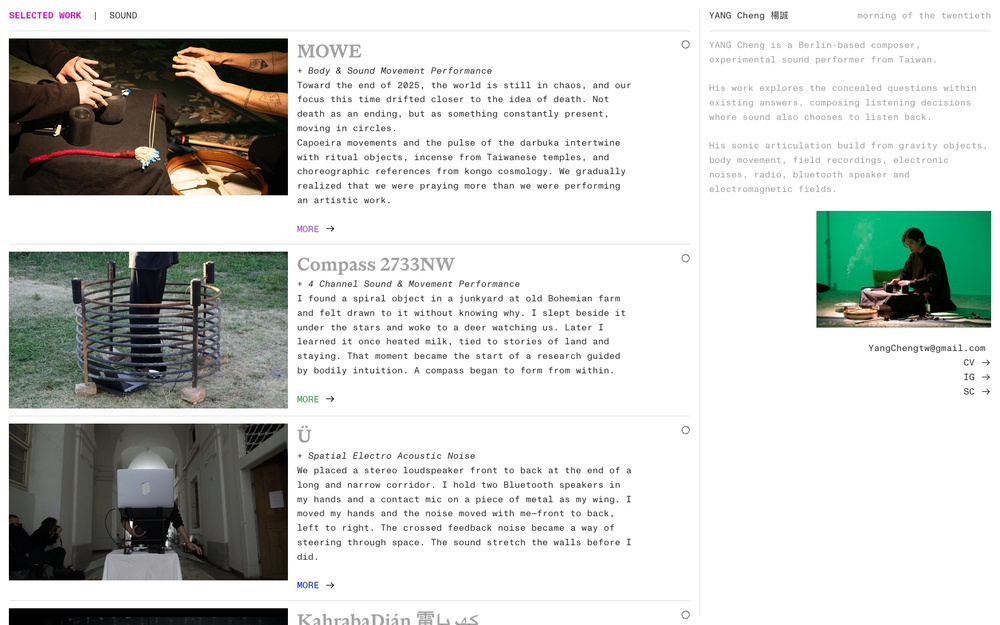
Taiwanese experimental composer Yang Cheng describes abandoning a conventional field-recording setup while travelling around Taiwan. Instead, he attached microphones to his palms and listened through his hands.

That small technical decision completely changes the idea of recording a place for me.

A normal field recorder encourages distance. Point the microphones toward an environment, remain quiet and collect what happens.

A microphone attached to the body cannot pretend the recorder is absent.

Movement becomes part of the recording. Touch becomes part of it. The distance between body and object keeps changing.

Yang also works with radio, Bluetooth speakers, electromagnetic fields, found objects and environmental recordings. But the microphones on the palms are the detail I keep returning to because they turn listening into a physical action.

We usually describe microphones as devices that capture sound.

Here they behave almost like sensory organs.

Perhaps field recording becomes more interesting when it stops asking, “What does this place sound like?” and starts asking, “What does my presence inside this place sound like?”

https://yangcheng.one/

#YangCheng #FieldRecording #TaiwaneseMusic #SoundArt

Listening Through the Hands Listening Through the Hands yangcheng.one YangCheng cargo.site
Facebook LinkedIn WhatsApp Threads
More sharing options
X Reddit Pinterest Telegram Email
Already Playing Ruby Solly’s

Recording a City That Is Already Playing

Ruby Solly’s P?neke treats Wellington not simply as the place where an album was recorded but as an active participant in the composition. Solly, a K?i Tahu, Waitaha and K?ti M?moe musician and taonga p?oro practitioner, connects cello, voice and traditional M?ori instruments with environmental recordings and histories embedded in specific locations.

On “Koukou,” for example, the recording includes a resident ruru, or morepork, heard from the porch of her home. The bird is not added as a decorative nature sample. Its call is tied to family names, memory and the waterways that once shaped the area.

I like the distinction.

A field recording can merely tell us, “this happened outside.”

Or it can belong structurally to why the piece exists at all.

Once place enters composition at that level, removing the environmental sound would not simply produce a cleaner mix. It would remove part of the subject.

The landscape is no longer behind the music.

It is one of the musicians.

https://rubysolly.bandcamp.com/album/p-neke

#RubySolly #TaongaPuoro #AotearoaMusic #FieldRecording

Recording a City That Is Already Playing Recording a City That Is Already Playing Ruby Solly P?neke, by Ruby Solly 11 track album
Facebook LinkedIn WhatsApp Threads
More sharing options
X Reddit Pinterest Telegram Email
Electronic Music

The Subway Became Part of the Synthesizer

When Robert Henke and Gerhard Behles travelled to Hong Kong in 1996 for the International Computer Music Conference, Henke carried a recorder through Hong Kong and Guangzhou. Those field recordings later became part of Monolake’s Hongkong. The closing track, “Mass Transit Railway,” is based on sound captured inside a Hong Kong subway train. The album was produced with instruments including a Prophet VS, Yamaha SY77 and TG77, Ensoniq ASR-10, Waldorf Microwave and an Atari running Notator, alongside a step sequencer Henke wrote in Max.

What interests me is how naturally the city enters the electronic system. The subway recording is not simply atmosphere placed behind a track. It becomes another component in a studio already built from samplers, synthesizers and code.

Sampling a city does something strange to geography. A train journey becomes repeatable. A moment that happened once can be filtered, looped and reorganised twenty years later.

Electronic music can sometimes feel completely synthetic. Hongkong reminds me that a machine-made composition can still contain a very specific street, vehicle and moment in time.

https://www.roberthenke.com/releases/ml-000.html

#Monolake #RobertHenke #FieldRecording #ElectronicMusic

The Subway Became Part of the Synthesizer The Subway Became Part of the Synthesizer roberthenke.com Monolake - Hongkong When Robert Henke and Gerhard Behles travelled to Hong Kong in 1996 for the International Computer Music Conference, Henke carried a recorder through Hong…
Facebook LinkedIn WhatsApp Threads
More sharing options
X Reddit Pinterest Telegram Email
Field Recording

Listening Before Making Sound

KMRU’s work repeatedly begins with recording environments. Joseph Kamaru has built compositions from field recordings gathered in Nairobi and many other places, treating apparently minor environmental sounds as material worthy of sustained attention. His practice has expanded into installations, performances and long-form ambient works in which place is not simply captured but reshaped through processing and composition.

I find the order of operations interesting.

Music production usually begins with making a sound: play a synth, strike a drum, choose a sample. Field recording can reverse that relationship. First you listen. The world has already generated the material.

That produces another question: when does documentation become composition?

A recording of traffic, wind or machinery may initially describe a place. Once it is edited, layered, filtered and placed beside another recording, it begins constructing a place that never actually existed.

The microphone therefore becomes more than a device for collecting sound. It can be an instrument for noticing what most of us have trained ourselves to ignore.

https://kmru.info/

#KMRU #FieldRecording #KenyanMusic #SoundArt

Listening Before Making Sound Listening Before Making Sound KMRU’s work repeatedly begins with recording environments. Joseph Kamaru has built compositions from field recordings gathered in Nairobi and many other pl…
Facebook LinkedIn WhatsApp Threads
More sharing options
X Reddit Pinterest Telegram Email