Super Mario Clouds is more than nostalgia for an old Nintendo cartridge. Cory Arcangel exposes the hardware, altered cartridge, cables and projection instead of hiding the mechanism. That matters. Digital images often pretend they have no physical body, yet every cloud on a screen depends on machines, code and electricity. Showing the apparatus makes the apparently weightless image heavy again.
Cory Arcangel
Mario Left, the Clouds Stayed
Cory Arcangel removed almost everything from Super Mario Bros. and left only the blue sky and slowly scrolling clouds. No Mario, coins, enemies or goal remain. A game becomes a quiet moving landscape. What fascinates me is how little information is needed before recognition disappears. Remove enough function from software and the interface stops being a tool. It becomes an image with a memory attached to it.
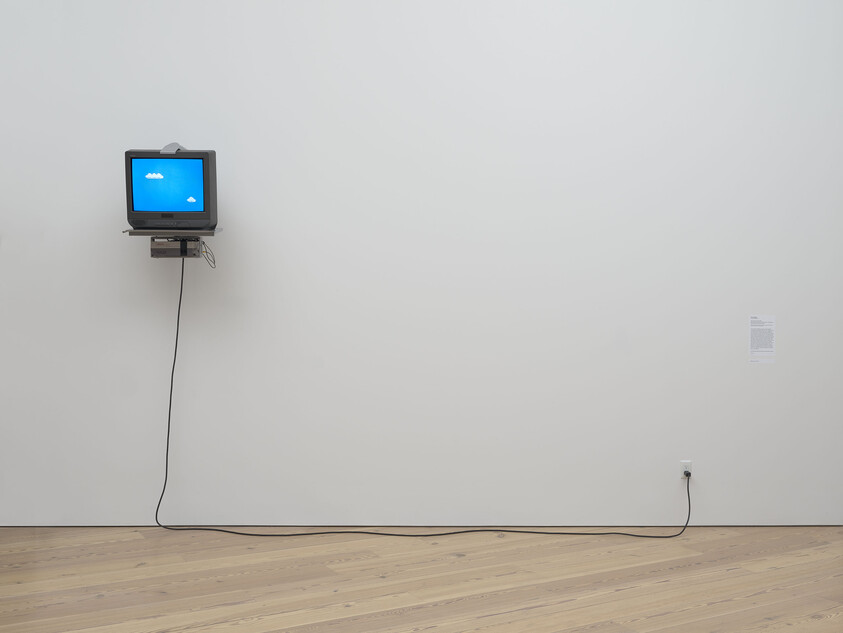 Whitney Museum of American Art Cory Arcangel | Super Mario Clouds For this video installation, Cory Arcangel “hacked” a cartridge of Super Mario Brothers, the original version of the blockbuster Nintendo video game released in the United States in 1985. By tweaking the game’s code, the artist erased all of the sound and visual elements except the iconic scrolling clouds. On a formal level, the project is reminiscent of paintings that push representation toward abstraction: how many elements can be removed before the ability to discern the source is lost? Arcangel, who was trained in classical music, considers computers and video game consoles his instruments, and insists on mastering them prior to creative exploration; he will often learn a new programming language in order to develop a work. What might be viewed as nostalgia for the popular entertainments of an earlier era depends, in fact, on a rigorous conceptual approach to computer hard- and software as well as a refusal to participate in contemporary culture’s lightning-fast cycle of technological turnover.