Skip to content

Painting

Art Stream
Colour

Colour Escapes the Canvas

Estonian painter Kristi Kongi’s Chromatic Drift at Kumu Art Museum refuses to keep colour neatly inside rectangular paintings. Created partly for the museum’s large exhibition hall, the project extends motifs and colour onto floors, walls, windows and outdoor space. Kumu describes colour as central to Kongi’s way of mapping and preserving memories and states of mind. The 2026 exhibition is also significant institutionally: it is the first solo exhibition by an Estonian woman artist in Kumu’s Great Hall.

What interests me is what happens when painting begins treating architecture as part of its surface. A canvas normally ends at its edge. Once colour crosses that boundary, the viewer enters the composition rather than simply standing in front of it. Colour stops behaving like decoration applied to objects and starts organising distance, movement and atmosphere. Perhaps painting becomes spatial not when it imitates three dimensions, but when it changes how we physically move through a room.

https://kumu.ekm.ee/en/syndmus/kristi-kongi-chromatic-drift/
#KristiKongi #EstonianArt #Painting #Colour

Kumu kunstimuuseum Kristi Kongi: Chromatic Drift - Kumu kunstimuuseum The large-scale solo exhibition of the painter Kristi Kongi (1985) offers an immersive spatial experience. In the new works created for this exhibition, colour emerges as the central element, with its fields of meaning unfolding in physical, emotional, and semantic ways.
Addis Ababa

When a Landscape Is Felt Physically

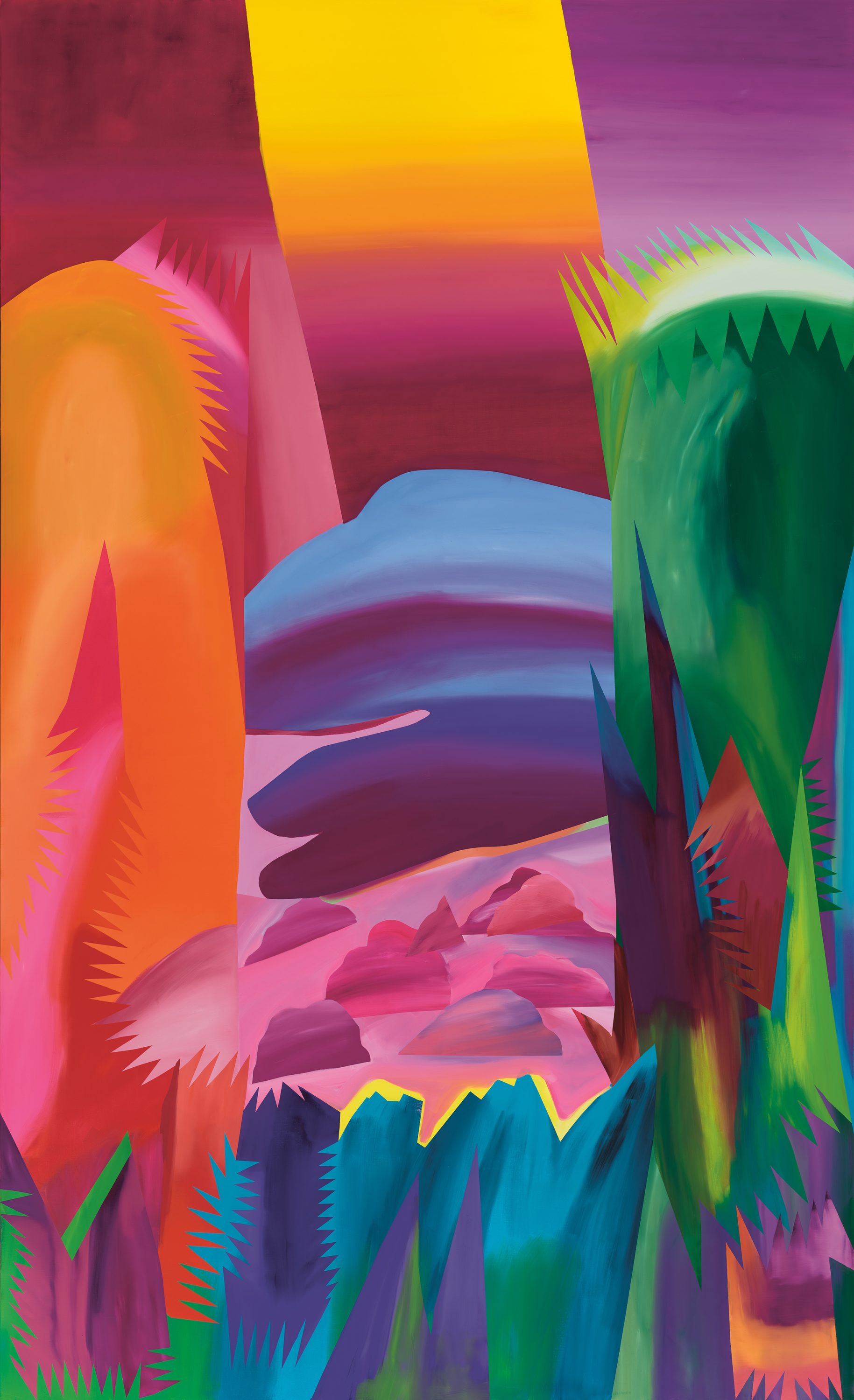
Ethiopian painter Tesfaye Bekele uses grass, flowers, leaves and seasonal change as more than landscape subjects. In Moments of Change, shown at Addis Fine Art in Addis Ababa in early 2026, repeated dots and layered lines produced surfaces that could resemble landscapes, aerial maps or constellations. The works were made with acrylic on canvas and textiles, with fabric connecting the paintings to ideas of bodily vulnerability, effort and care. Bekele grew up in Addis Ababa, studied at the Alle School of Fine Arts and Design and later taught there.

What stays with me is the decision to connect changes in nature with the way time is experienced by a body. We normally measure a season with dates, yet we recognise it through temperature, colour, smell, growth and disappearance. A landscape painting can therefore record much more than a place. It can describe what change feels like before we have found words for it.

https://addisfineart.com/exhibitions/136-moments-of-change-tesfaye-bekele/

#TesfayeBekele #EthiopianArt #Painting #AddisAbaba

Maria Taniguchi

Painting Time One Rectangle at a Time

Maria Taniguchi’s ongoing “brick paintings” are built from thousands of small hand-drawn rectangular cells, individually filled with paint. Some of the canvases become enormous, yet their structure comes from an almost modest repeated action. Afterimage, at Singapore Art Museum until 22 November 2026, is the first monographic exhibition of Taniguchi presented by a Singapore museum and brings these paintings together with sculpture and video. The rectangles are not mechanically printed. Their subtle differences accumulate across days, weeks and sometimes months of work. Taniguchi considers the paintings individual parts of one continuing artwork rather than isolated compositions. I like what that does to repetition. From a distance the surface can appear systematic, almost architectural. Up close, the system becomes a record of labour and duration. Nothing dramatic needs to happen from one cell to the next. Time becomes visible precisely because the gesture changes so little.

https://www.singaporeartmuseum.sg/en/art-events/exhibitions/maria-taniguchi-afterimage

#MariaTaniguchi #PhilippineArt #Painting #SingaporeArt

singaporeartmuseum.sg Maria Taniguchi: Afterimage | Singapore Art Museum Maria Taniguchi: Afterimage is the first monographic exhibition of the acclaimed artist presented by a Singaporean institution.
Accra

Painting a Return Home

Gabriel Selassie Tsagli’s Son of Kafui marks his first exhibition in Accra after living between Ghana and Germany. The paintings grow from memory, family, displacement and his return to the city, with figures emerging through accumulated, scraped and pressed layers of paint. I like that memory is not treated as something precise enough to illustrate. Faces can appear as traces, colour can carry emotion, and a place can remain inside someone even after years elsewhere. Returning home does not necessarily close a circle. It may reveal how much the circle has changed.

https://www.gallery1957.com/exhibitions/141-gabriel-selassie-tsagli-son-of-kafui-gallery-ii-accra/

#GabrielSelassieTsagli #GhanaianArt #Painting #Accra

Gallery 1957 Gabriel Selassie Tsagli - Son of Kafui | 23 Jul - 12 Sep 2026 The exhibition marks Selassie’s first with Gallery 1957, following his residency. Son of Kafui is a deeply personal return—shaped by memory and carried forward through devotion. The exhibition begins in the body’s remembrance of place: a specific mother, a specific city, a specific quality of light that never fully leaves....
Chicago Art

The Garden That Wasn’t a Garden

Kerry James Marshall’s Many Mansions emerged partly from the contradiction he saw in Chicago public housing projects carrying names such as “Gardens.” The painting places an idealised landscape against the reality suggested by the housing blocks behind it. Names can be tiny pieces of architecture too. Call somewhere a garden and language begins constructing a place that may never actually exist.

https://www.artic.edu/files/aa3ebf14-5f78-489a-a75f-2613336d614d/TX-CR1103.pdf

#KerryJamesMarshall #Painting #ChicagoArt #ContemporaryArt