Skip to content

Installation Art

Art Stream
Belmore’s Fountain

Projecting an Image Onto Water

Rebecca Belmore’s Fountain, created for the Canadian Pavilion at the 2005 Venice Biennale, does something deceptively simple with video: the image is projected onto falling water rather than a conventional screen. The work moves between fire, water and blood, placing elemental imagery against an industrial North American landscape.

The physical projection surface changes everything for me. A normal screen is designed to disappear so that we concentrate on the image. Falling water refuses to disappear. It moves, breaks the projected light and reminds us that the image has a body. The medium becomes visible precisely because it cannot hold the picture perfectly still.

Belmore, an Anishinaabe artist, has repeatedly worked with land, bodies, political histories and the material presence of water. In Fountain, water is simultaneously subject, projection surface and moving sculpture. The video cannot be separated cleanly from the substance carrying it.

Digital images often feel weightless. Here light needs something unstable and physical before we can see it.

Fountain

#RebeccaBelmore #VideoArt #IndigenousArt #InstallationArt

Auckland Art

Machines Performing Belief

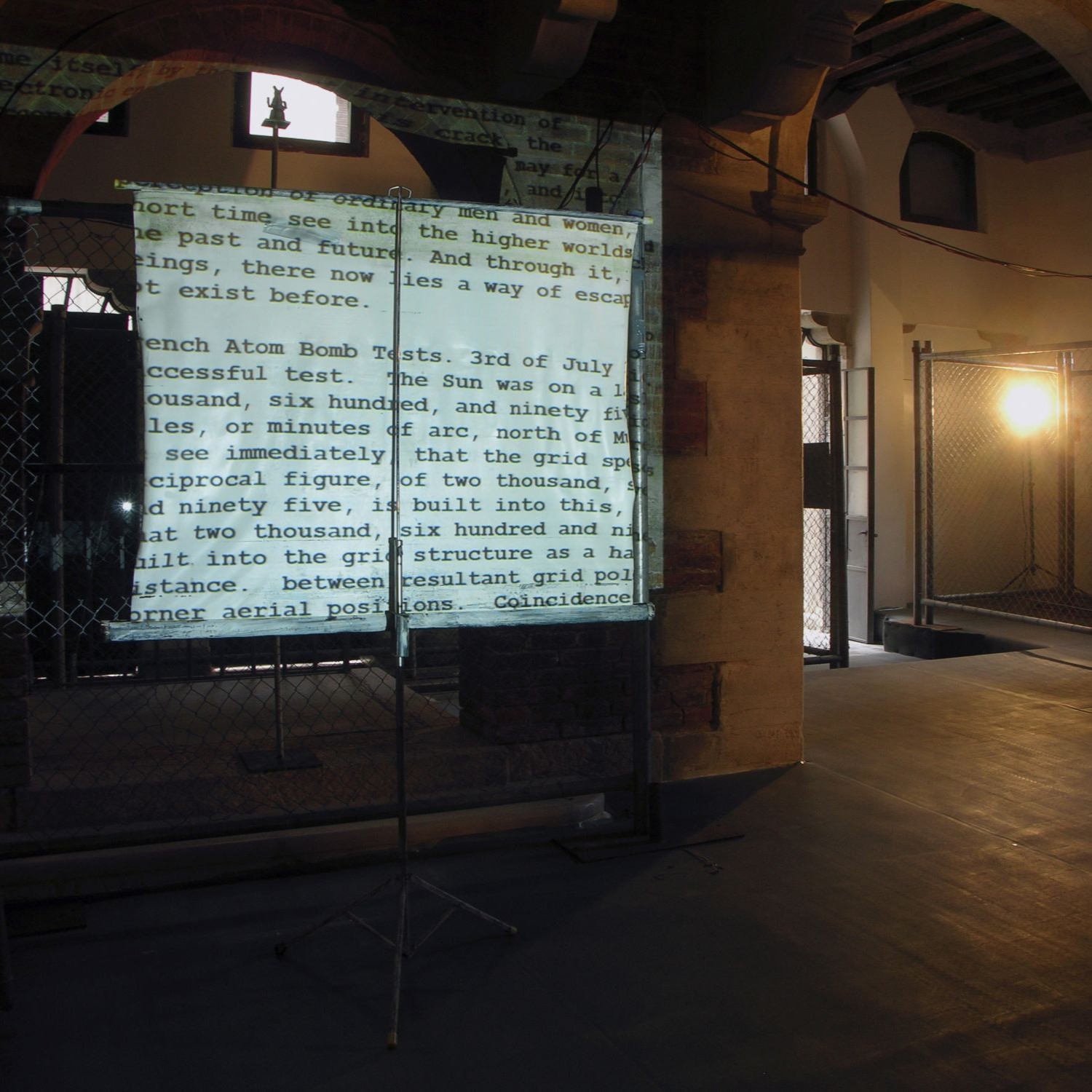
Twenty-one years after representing New Zealand at the Venice Biennale, et al.’s the fundamental practice is being shown in its entirety in Aotearoa for the first time. Five moving autonomous systems, computer-generated voices and sound form what feels like a dystopian orchestra. What interests me is how easily machines can borrow the language of authority. A synthetic voice does not need to understand an idea to repeat it convincingly. The work turns technology into a strange theatre of belief, obedience and doubt.

https://www.aucklandartgallery.com/connect/news-and-media/new-zealands-2005-venice-biennale-presentation-to-be-shown-in-aotearoa-for-the-first-time

#NewZealandArt #MediaArt #InstallationArt #AucklandArt

Auckland Art Gallery Toi o T?maki New Zealand’s 2005 Venice Biennale presentation to be shown in Aotearoa for the first time | Auckland Art Gallery Toi o T?maki New Zealand’s 2005 Venice Biennale presentation to be shown in Aotearoa for the first time.
Fabienne Hess

The People Behind the Museum

Fabienne Hess’s Lo invisible y sus tramas at Museo Amparo turns attention toward museum staff whose work normally disappears behind the exhibition. Images printed on silk move through the space while rarely shown collection pieces sit beside familiar works. I like this reversal of attention. Museums teach us what to look at, but they can also make the labour supporting that act of looking almost invisible. An exhibition does not simply appear on a wall. It is built from hundreds of decisions, gestures and forms of care that usually remain outside the frame.

https://museoamparo.com/exposiciones/piezas/315/lo-invisible-y-sus-tramas

#FabienneHess #MuseoAmparo #MexicanArtScene #InstallationArt

museoamparo.com Fabienne Hess. Lo invisible y sus tramas | Exposiciones | exposiciones actuales | Museo Amparo, Puebla El trabajo del personal del Museo Amparo, que habitualmente es invisible en las galerías, ahora está en los muros. Las jerarquías se alteran: obras ...
Classroom Full of Agreement

A Classroom Full of Agreement

Heri Dono’s Fermentation of the Mind places fibreglass heads on old school desks. Step on a pedal and they nod together while distorted chanting begins. It is funny for a moment, then slightly disturbing. A classroom should create independent thought, yet here agreement has become mechanical. Dono turns propaganda into choreography, using recycled electronics and references to Indonesian shadow-puppet traditions.

https://www.mplus.org.hk/en/exhibitions/heri-dono-fermentation-of-the-mind/

#HeriDono #IndonesianArt #KineticArt #InstallationArt

mplus.org.hk Heri Dono: Fermentation of the Mind | M+ Museum Join us at M+ to explore Heri Dono’s kinetic installation 'Fermentation of the Mind' (1992–1993), which resembles a classroom, featuring rows of old wooden desks topped with white fibreglass heads.
Contemporary Art

Infinity Needs a Small Room

Yayoi Kusama’s mirrored rooms create the impression of endless space using surprisingly limited ingredients: mirrors, light and repetition. Dancing Lights That Flew Up to the Universe is currently part of Guggenheim Pop: 1960 to Now. What stays with me is the contradiction. Infinity is experienced inside a carefully bounded room. Perhaps scale has less to do with physical size than with what an image convinces the mind to continue.

https://www.guggenheim.org/exhibition/guggenheim-pop

#YayoiKusama #InstallationArt #InfinityRoom #ContemporaryArt

The Guggenheim Museums and Foundation Guggenheim Pop: 1960 to Now | The Guggenheim Museums and Foundation From Andy Warhol to Maurizio Cattelan, this exhibition features Pop art from the collection and its enduring influence on contemporary artists.
Contemporary Art

When Everyday Objects Become a Cosmos

Sarah Sze builds installations from ordinary objects, images, videos and fragments that can shift in scale from something almost microscopic to something architectural. Her work makes me think about how easily attention moves between those extremes now. We zoom into a screen, step back into a room, then return to a tiny detail. Perhaps scale is no longer only a property of objects. It has become a habit of looking.

https://www.fondationcartier.com/en/collection/artists/sarah-sze

#SarahSze #InstallationArt #Sculpture #ContemporaryArt

Fondation Cartier Sarah Sze | Collection of the Fondation Cartier pour l'art contemporain — Fondation Cartier pour l’art contemporain Welcome to the new premises of the Fondation Cartier pour l’art contemporain at 2 Place du Palais-Royal, Paris.
Contemporary Art

A Sky Made From Fragments

Sarah Sze’s Tracing Fallen Sky combines steel, marble fragments, projected images and traces of the process that produced it. Physical objects and moving images overlap until it becomes difficult to decide where sculpture ends and image begins. I like that uncertainty. We increasingly experience the world through objects and screens simultaneously. Sze turns that ordinary condition into something we can actually stand inside.

https://www.fondationcartier.com/en/ways-to-visit/parcours-un-monde-reel

#SarahSze #InstallationArt #ContemporaryArt #MovingImage

Fondation Cartier Parcours « Un monde réel » — Fondation Cartier pour l’art contemporain L’un des volets de l’Exposition Générale met en avant les relations entre sciences, fiction et création artistique. Il réunit artistes et chercheurs qui tentent d’imaginer d’autres manières de percevoir et de représenter le réel.
Hong Kong

Music Without the Pianist

Samson Young’s Carillon includes a prepared Disklavier player piano alongside documents, books, tickets and personal objects. I like the contradiction of a piano playing while the performer is absent. Sound makes the archive temporarily physical again. Paper can describe a past, but a mechanical instrument fills the room with an event happening now. Presence survives even when the person producing it has disappeared.

https://www.mplus.org.hk/en/collection/objects/carillon-2019584/

#SamsonYoung #SoundArt #InstallationArt #HongKong

mplus.org.hk Carillon (2017) - Samson Young | Objects | M+ Museum Discover some of the world’s foremost collections of twentieth- and twenty-first-century visual culture.
Contemporary Art

When a Wall Starts Speaking

Shilpa Gupta’s Speaking Wall uses bricks, headphones, a small screen and a sensor. The viewer moves along a line of bricks while a voice responds to their position. A wall normally tells the body where it cannot go. Here the boundary begins giving instructions. That reversal makes the work unsettling: something built to separate becomes strangely intimate because it knows exactly how close you are.

https://www.mplus.org.hk/en/collection/objects/speaking-wall-201762/

#ShilpaGupta #InstallationArt #SoundArt #ContemporaryArt

mplus.org.hk Speaking Wall (2009–2010) - Shilpa Gupta | Objects | M+ Museum Discover some of the world’s foremost collections of twentieth- and twenty-first-century visual culture.