Skip to content

sculpture

Art Stream
Ben Enwonwu

A Nation Cast in Bronze

Ben Enwonwu completed Anyanwu, also known as The Awakening, in 1956 for the new National Museum in Lagos. The elongated bronze female figure was conceived during a period when Nigeria was moving toward independence. Enwonwu described the work in terms of womanhood, growth and the emergence of a nation. His approach combined indigenous aesthetic traditions connected to his Edo-Onitsha heritage with techniques he had encountered through Western art education.

A copy was presented by the Nigerian government to the United Nations in 1966. That change of location interests me. In Lagos, the sculpture could speak to the formation of Nigerian national identity. At the UN headquarters, the same figure entered a much wider political space and could be read as part of Africa’s post-colonial emergence.

Monuments often look permanent once installed, but their meanings keep moving. Bronze remains physically stable while history repeatedly changes what we see in it. Anyanwu is therefore not only an image of awakening. Its own public life has continued to accumulate new contexts long after the sculpture was cast.

Mission and Symbol

#BenEnwonwu #NigerianArt #ModernAfricanArt #Sculpture

Drawing With Empty Space

Drawing With Empty Space

Ruth Asawa described her looped-wire sculptures as a way of taking a two-dimensional line into three-dimensional space. Her technique grew from seeing basket makers work with wire during a 1947 trip to Mexico. Back in the United States she developed that looping process into suspended forms built from ordinary industrial materials such as iron, copper and brass wire. In a work from around 1958 now in SFMOMA’s collection, a continuous mesh expands and contracts into nested lobes while remaining transparent enough for the room to pass visually through it.

That transparency may be the most interesting material in the sculpture. Traditional sculpture often defines a solid mass against surrounding emptiness. Asawa gives the emptiness a shape of its own. Light and shadow complicate it further: the wire produces another changing drawing on nearby surfaces. A sculpture can therefore occupy space without filling it. The object and the air inside it become equally necessary.

Untitled (S.114, Hanging Six-Lobed Continuous Form within a Form with an Open Collar and Spheres in the Second, Third, and Fifth Lobes)

#RuthAsawa #WireSculpture #SanFranciscoArt #Sculpture

SFMOMA Untitled (S.114, Hanging Six-Lobed Continuous Form within a Form with an Open Collar and Spheres in the Second, Third, and Fifth Lobes) Explore the artists and artworks of our time at the San Francisco Museum of Modern Art.
Aurelia Munoz

When Textile Starts to Fly

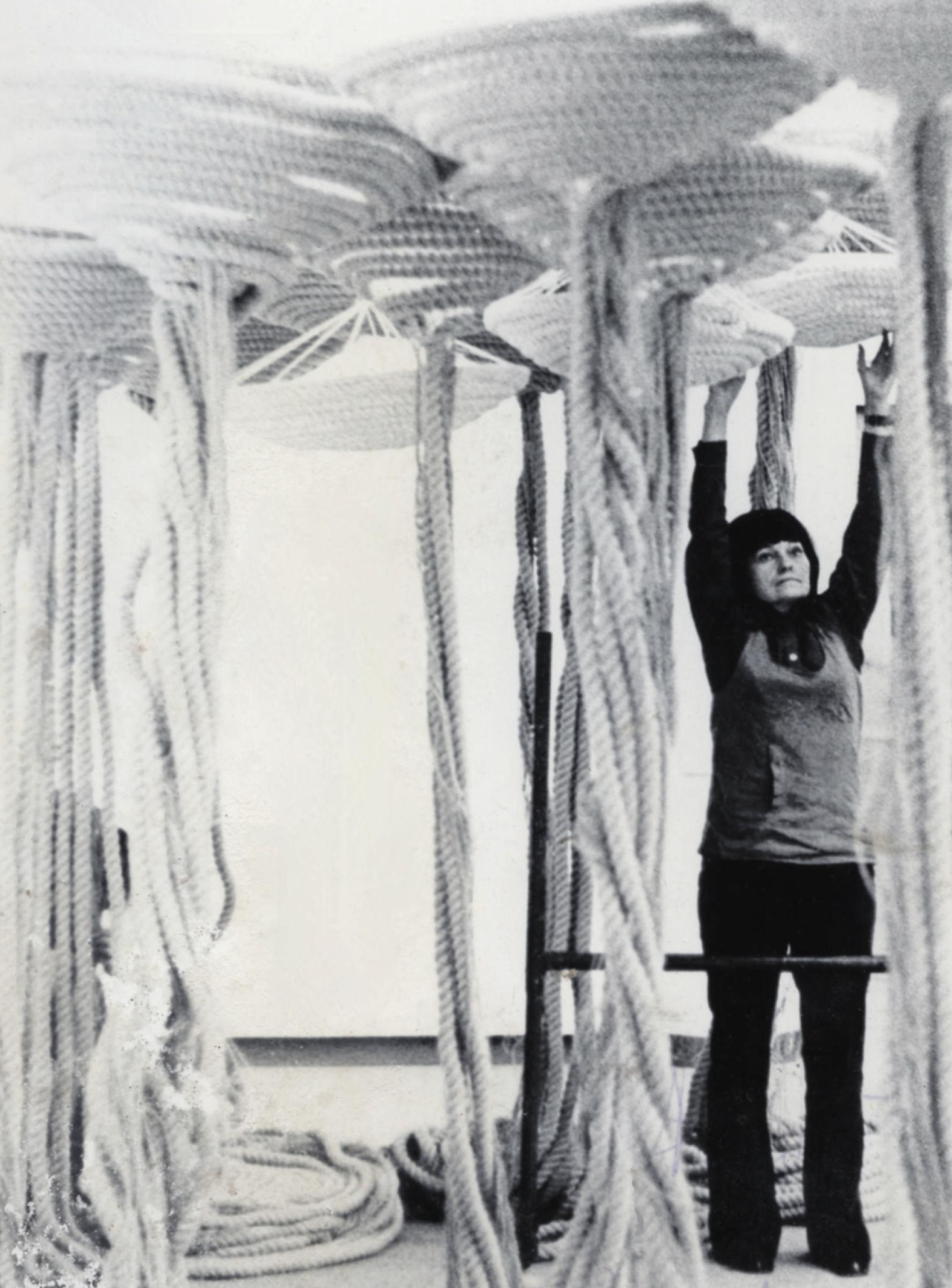
Aurèlia Muñoz pushed fibre beyond the wall. Her macramé structures, bird-kites and handmade-paper works treat weaving less as decoration than as a way of building space. What interests me is how something associated with softness can suddenly behave architecturally, suspended between sculpture and drawing. The knot becomes more than technique. It becomes a way of thinking in three dimensions.

https://www.museoreinasofia.es/en/exhibition/aurelia-munoz/

#AureliaMunoz #TextileArt #Sculpture #SpanishArt

museoreinasofia.es Aurèlia Muñoz The exhibition Aurèlia Muñoz. Beings plots an all-encompassing route through the work of an artist who is pivotal to an understanding of contemporary textile art. Involved in movements such as Nouvelle Tapisserie and the Escuela Catalana del Tapiz (the Catalan Tapestry School), Aurèlia Muñoz (Barcelona, 1926–2011) transcended the spheres of fabric, fibre and craft, her work drawing on a combination of ancestral techniques and contemporary resources to focus on the impact of post-industrial crises in land, water and aerial ecosystems, which emerged as large motifs in her oeuvre.  In this instance, her early collages and assemblages, with Surrealist and gothic influences, and large-scale pictorial embroidery pieces lead into an unseen ensemble of macramé structures from the collections of institutions in Spain, Europe and the USA. Her emblematic kite-sculptures and her final installations, produced with handmade paper, are also central to the show, as is a vast selection of maquettes and drawings displayed for the first time.   The exhibition, with a title referring to one of Muñoz’s core concepts — entes (beings) — spans the fifty or more years of her multifaceted practice, crafting an unprecedented view that seeks to open fresh perspectives on her unique legacy.   The exhibition will also be on view at Museu d’Art Contemporani de Barcelona (MACBA) from 5 November 2026 to 29 March 2027.
Contemporary Art

When Everyday Objects Become a Cosmos

Sarah Sze builds installations from ordinary objects, images, videos and fragments that can shift in scale from something almost microscopic to something architectural. Her work makes me think about how easily attention moves between those extremes now. We zoom into a screen, step back into a room, then return to a tiny detail. Perhaps scale is no longer only a property of objects. It has become a habit of looking.

https://www.fondationcartier.com/en/collection/artists/sarah-sze

#SarahSze #InstallationArt #Sculpture #ContemporaryArt

Fondation Cartier Sarah Sze | Collection of the Fondation Cartier pour l'art contemporain — Fondation Cartier pour l’art contemporain Welcome to the new premises of the Fondation Cartier pour l’art contemporain at 2 Place du Palais-Royal, Paris.
Brazilian Art

The Image Cannot Hold Still

Lygia Clark’s Sundial can be folded into different configurations or flattened into a plane. Despite its geometric precision, there is no final position that reveals the “correct” sculpture. I like that instability. Museums usually train us to believe an artwork possesses a fixed form that must be protected. Clark instead makes change part of the object’s identity. The sculpture survives precisely because it refuses to remain the same.

https://www.moma.org/collection/works/91764

#LygiaClark #Sculpture #BrazilianArt #ParticipatoryArt

Brazilian Art

A Sculpture That Refuses One Shape

Lygia Clark wanted spectators to manipulate her hinged metal sculptures rather than simply look at them. Poetic Shelter belongs to this world of forms that can change through handling. What I find interesting is the loss of a single correct appearance. The artwork does not wait for the viewer in a finished state. Touch becomes part of its structure, and every configuration is temporary.

https://www.moma.org/collection/works/91767

#LygiaClark #BrazilianArt #Sculpture #NeoConcrete

Behind the Red Moon

Metal Learning to Flow

El Anatsui builds enormous hanging forms from thousands of discarded metal bottle tops and fragments. From a distance Behind the Red Moon can resemble woven fabric, although nothing about its material should behave like cloth. That transformation stays with me. Something industrial, repetitive and discarded becomes flexible, fragile-looking and almost weightless. Material carries its previous life into the new one.

https://shop.tate.org.uk/hyundai-commission-2023-el-anatsui-behind-the-red-moon/28591.html

#ElAnatsui #Sculpture #ContemporaryArt #MaterialArt