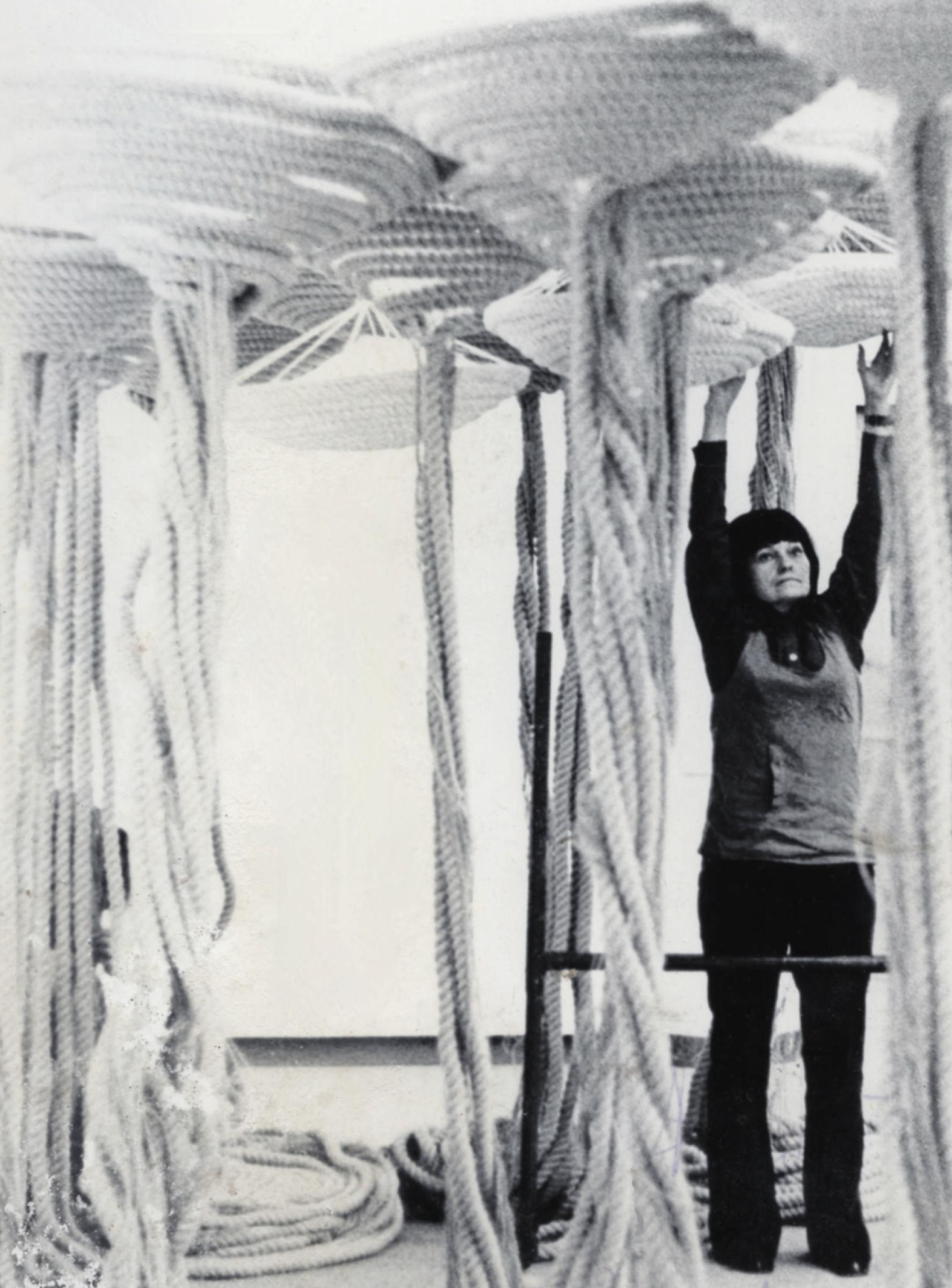
Tapta began in textile art, but gradually pushed weaving away from the wall.
Ropes were twisted, knotted and extended into space. Viewers could move around them and, in some installations, enter the structures themselves. During the 1980s she made an even stranger material shift, replacing woven fibres with neoprene, the synthetic rubber more commonly associated with industrial and protective applications.
Yet the underlying idea remained remarkably consistent.
Tapta called attention to flexible sculpture.
That phrase seems almost contradictory because sculpture has historically been associated with solidity: stone, bronze, wood, objects expected to maintain their shape.
Tapta chose materials that bend.
A neoprene form can sag, curve, lean or respond visually to gravity without pretending to be permanent in the way marble does.
I like that because it changes the relationship between material and authority.
Rigid sculpture often seems to declare exactly what shape it is.
Flexible material leaves open the possibility that another configuration exists.
Tapta spent much of her career teaching in Brussels, yet her international recognition remained more limited than that of many artists exploring related questions of space and material.
Recent exhibitions have started correcting that imbalance.
The work did not become more relevant.
The history around it finally became more flexible.