Skip to content

A Painting Too Large to Ignore

Art That Exists

Art That Exists by Disappearing

Taipei Fine Arts Museum’s online project Vanishing Acts runs through the end of 2026 as part of TFAM Net.Open. The title immediately raises an interesting problem for digital culture: what does disappearance mean when technology is supposed to make copying effortless?

Digital material appears infinitely reproducible, yet it can be surprisingly fragile. Servers close, software becomes incompatible, platforms disappear and links that once connected entire projects eventually return errors. A physical painting can decay, but its deterioration is visible. A digital artwork may remain theoretically perfect until the infrastructure required to experience it simply stops working.

That makes preservation a strange artistic question. Keeping a digital file is not necessarily enough. Sometimes you must preserve software, hardware, network behaviour, instructions or even an obsolete operating environment.

The internet encourages us to think that everything remains available somewhere. Digital art quietly demonstrates the opposite. An artwork can disappear without leaving an empty space on the wall.

https://www.tfam.museum/

#DigitalArt #TaiwanArt #NetArt #MediaArt

Art That Exists by Disappearing Art That Exists by Disappearing Taipei Fine Arts Museum’s online project Vanishing Acts runs through the end of 2026 as part of TFAM Net.Open. The title immediately raises an interesting…
Facebook LinkedIn WhatsApp Threads
More sharing options
X Reddit Pinterest Telegram Email
Belmore’s Fountain

Projecting an Image Onto Water

Rebecca Belmore’s Fountain, created for the Canadian Pavilion at the 2005 Venice Biennale, does something deceptively simple with video: the image is projected onto falling water rather than a conventional screen. The work moves between fire, water and blood, placing elemental imagery against an industrial North American landscape.

The physical projection surface changes everything for me. A normal screen is designed to disappear so that we concentrate on the image. Falling water refuses to disappear. It moves, breaks the projected light and reminds us that the image has a body. The medium becomes visible precisely because it cannot hold the picture perfectly still.

Belmore, an Anishinaabe artist, has repeatedly worked with land, bodies, political histories and the material presence of water. In Fountain, water is simultaneously subject, projection surface and moving sculpture. The video cannot be separated cleanly from the substance carrying it.

Digital images often feel weightless. Here light needs something unstable and physical before we can see it.

Fountain

#RebeccaBelmore #VideoArt #IndigenousArt #InstallationArt

Projecting an Image Onto Water Projecting an Image Onto Water Rebecca Belmore’s Fountain, created for the Canadian Pavilion at the 2005 Venice Biennale, does something deceptively simple with video: the image is proje…
Facebook LinkedIn WhatsApp Threads
More sharing options
X Reddit Pinterest Telegram Email
Chen Chieh Jen

Returning Workers to an Empty Factory

Chen Chieh-Jen made Factory in 2003 after meeting former workers from Taiwan’s Lien Fu garment factory, which had closed in 1996 without paying workers compensation and pension claims. The women had spent years protesting. Chen invited them back into the abandoned workplace and filmed them quietly performing the labour they once carried out there.

The resulting work is deliberately slow and silent. Images of the women inside the empty factory are combined with archival propaganda footage presenting Taiwan’s earlier manufacturing prosperity. That collision interests me because nothing needs to be explained through dramatic narration. The same industrial history looks completely different depending on whether it is told through economic success or through the bodies left behind when production moves elsewhere.

Re-enacting work inside a factory that no longer employs anyone turns labour into something almost ghostlike. The machines, gestures and building still remember a system that has already abandoned them. Silence does not make the political argument weaker. It gives the workers’ presence more weight.

???

#ChenChiehJen #TaiwaneseArt #VideoArt #LabourHistory

Returning Workers to an Empty Factory Returning Workers to an Empty Factory Chen Chieh-Jen made Factory in 2003 after meeting former workers from Taiwan’s Lien Fu garment factory, which had closed in 1996 without paying workers com…
Facebook LinkedIn WhatsApp Threads
More sharing options
X Reddit Pinterest Telegram Email
Ciurlionis

When Painting Starts Thinking Like Music

Mikalojus Konstantinas ?iurlionis is difficult to place neatly inside one discipline because he worked simultaneously as a painter and composer. During a creative period of only about seven years, he produced more than 300 paintings, hundreds of graphic works and sketches, and around 400 musical compositions. His museum in Kaunas preserves most of that legacy.

The connection between the two practices was not merely biographical. ?iurlionis explored how principles associated with music could operate visually, and some of his best-known painting cycles even use musical terms such as Sonata, Fugue and Prelude. His landscapes and imagined spaces often avoid ordinary perspective, moving instead toward layered, rhythmic and almost cosmic structures.

What interests me is that translating music into painting does not require illustrating sound waves or musical instruments. Rhythm can become repetition of shapes. A motif can return like a theme. Visual space can develop tension and release. ?iurlionis shows that the connection between sound and image may exist deepest at the level of structure.

https://ciurlionis.lt/activity/branches/m-k-ciurlionis-national-museum-of-art/expositions/m-k-ciurlionio-kuryba-en/

#Ciurlionis #LithuanianArt #PaintingAndMusic #Symbolism

When Painting Starts Thinking Like Music When Painting Starts Thinking Like Music ciurlionis.lt M. K. ?iurlionis’ Creation The exhibition showcases not only ?iurlionis’ paintings but also his multifaceted creative legacy – music, graphic art, and photography. The artworks are revealed in a new, modern light – the same lighting technology used to preserve masterpieces by Italy’s greatest artists. Visitors can pause and immerse themselves in the ?iurlionis atmosphere while resting in chairs upholstered with Japanese vegan leather. M. K. ?iurlionis – a composer and painter who also explored literature and photography – created over 300 paintings, more than 700 graphic works and sketches, and around 400 musical compositions during his remarkably short yet prolific 7-year creative period. Nearly all of these works are preserved in this museum. His paintings are notable for a uniquely poetic perception of space, often evoking a bird’s-eye view. They carry a cosmic perspective and a sense of deep inner contemplation. ?iurlionis was drawn to questions about the origins and structure of the universe, the spiritual forces that govern the world, nature and its cycles, the meaning of human life, psychological states, the evolution of being, and the possibility of applying musical principles to visual art. Music filled ?iurlionis’ life in countless forms. He composed distinctive original works, harmonized folk songs, led choirs, gave concerts, and published articles on music and culture. His graphic art and sketches offer valuable insight into his creative thought process and the recurring motifs that sparked his imagination. His ink compositions are particularly striking for their virtuoso, jewel-like technique, diverse strokes, and intricate ornamentation. ?iurlionis was a curious and wide-ranging thinker, deeply interested in philosophy, theosophy, cosmology, religions and myths, as well as the latest scientific and technological innovations of his time. It’s no surprise that he also picked up a camera – the photos he took during the summer of 1905 in the Caucasus capture intimate moments of that journey.
Facebook LinkedIn WhatsApp Threads
More sharing options
X Reddit Pinterest Telegram Email
Album Becomes

When an Album Becomes an Instrument

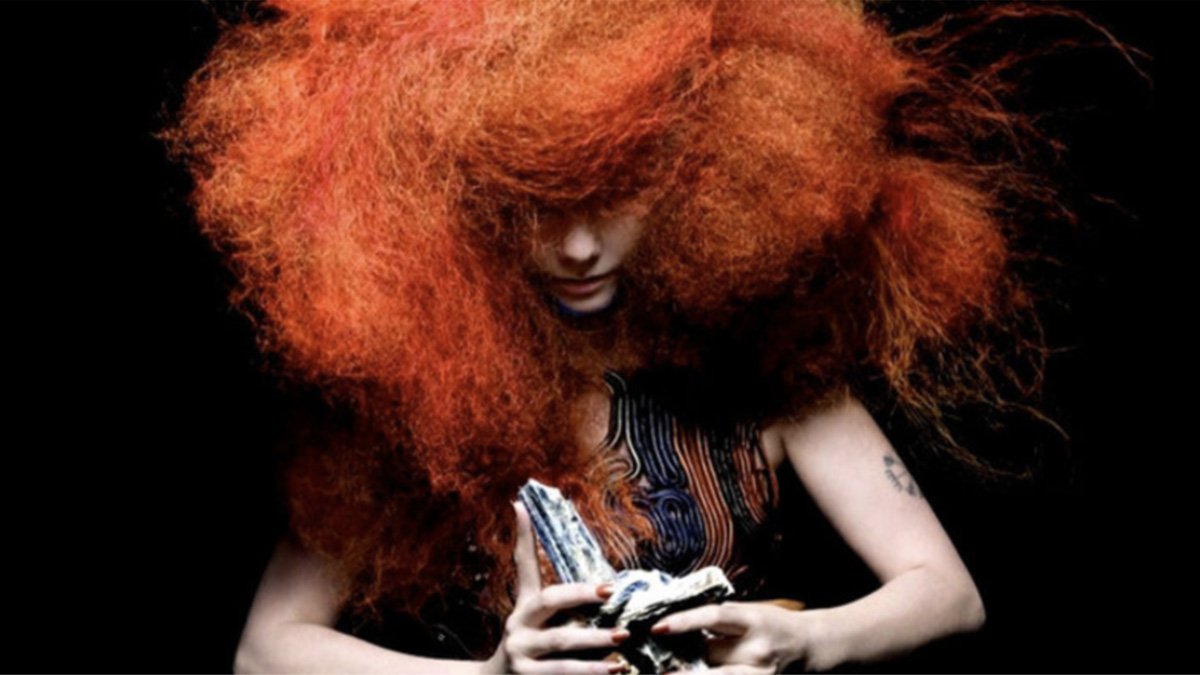
With Biophilia, Björk treated an album as something that could be entered, touched and changed. Released in 2011, the project connected ten songs to interactive apps exploring relationships between musical structures and natural phenomena. The live version pushed that idea into physical space with custom instruments: pendulum harps used gravity to pluck strings, Tesla coils produced pitched electrical arcs, and a modified celeste incorporated bronze gamelan bars. The project also included educational workshops rather than limiting itself to concerts.

What interests me is how Biophilia refuses to decide where the music actually lives. Is it in the recording, the app, the instrument, the physical force producing the sound, or the listener interacting with it? Most albums arrive as finished objects. Here the musical idea becomes a system that can be explored from several directions. Technology is not simply used to decorate the music. It becomes a way of making musical structure visible and playable.

https://www.snibbe.com/apps/biophilia

#Bjork #Biophilia #InteractiveMusic #MusicTechnology

When an Album Becomes an Instrument When an Album Becomes an Instrument Scott Snibbe BJÖRK: BIOPHILIA — Scott Snibbe - Interactive Art Biophilia by Björk is the world’s first app album: a multimedia exploration of music, nature and technology.
Facebook LinkedIn WhatsApp Threads
More sharing options
X Reddit Pinterest Telegram Email
Ignore Pacita Abad’s Flight

A Painting Too Large to Ignore

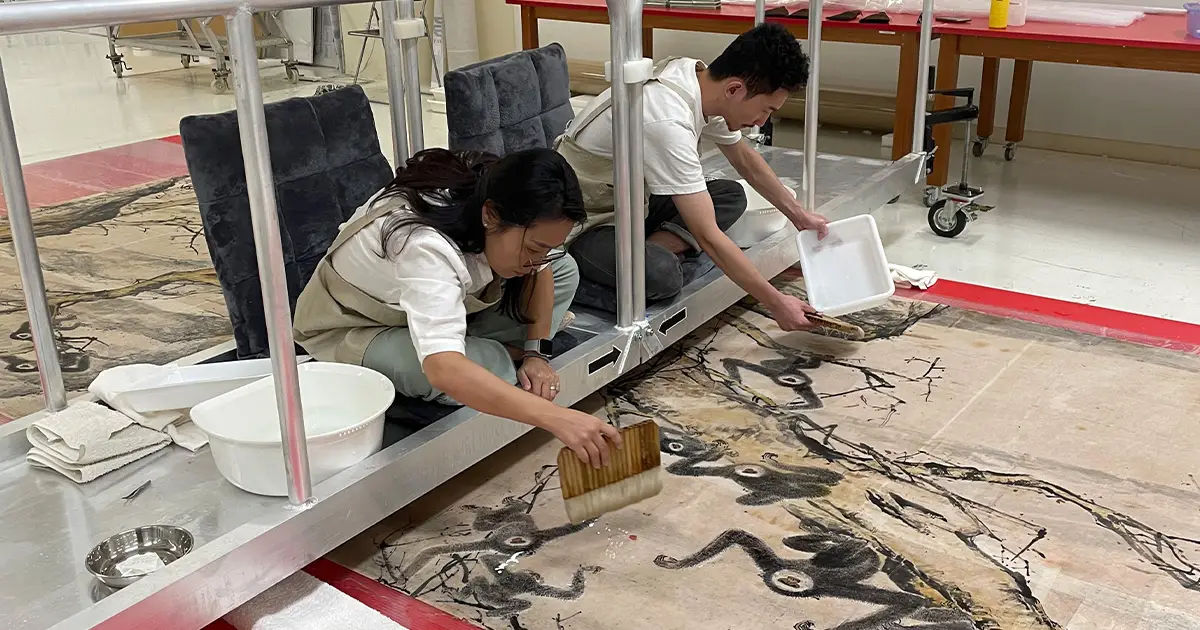
Pacita Abad’s Flight to Freedom grew from her encounters with Cambodian refugees near the Thai border around the period of the Cambodian-Vietnamese conflict. The monumental painting shows a mass of displaced people moving across the landscape, turning migration into something physically difficult to overlook. National Gallery Singapore describes it as one of Abad’s significant social realist works and notes that the Cambodian Refugees series developed from situations she witnessed directly.

Abad later became especially known for colourful stitched and stuffed trapunto paintings, but this earlier work shows another side of her practice. What stays with me is the scale. News photographs of refugees are often consumed quickly, one image among thousands. A painting several metres wide changes that relationship. You cannot absorb the crowd in a glance. Individual figures become part of a collective movement while still resisting disappearance into statistics. Scale becomes an ethical decision about how long an image asks us to look.

https://www.nationalgallery.sg/sg/en/learn-about-art/art-conservation.html

#PacitaAbad #PhilippineArt #SocialRealism #SoutheastAsianArt

A Painting Too Large to Ignore A Painting Too Large to Ignore National Gallery Singapore Art Conservation | National Gallery Singapore At National Gallery Singapore, art conservation is more than a practice — it’s a commitment to preserving our cultural treasures for future generations.
Facebook LinkedIn WhatsApp Threads
More sharing options
X Reddit Pinterest Telegram Email
Barkcloth

Painting With the Bark of a Tree

Samoan siapo begins long before any pattern appears. Makers use the inner bark of the u’a, or paper mulberry tree, scraping and pounding it until thin strips expand into cloth. Separate pieces can then be joined into larger surfaces. Decoration may be drawn freehand or transferred by rubbing the cloth across a relief board called an upeti. Traditional colours can come from soot, tree bark, turmeric, plant seeds and other natural sources. Siapo is still exchanged at ceremonies, weddings and funerals.

I like how difficult it is to separate image from material here. The surface is not a neutral support waiting for an artist to begin. Growing, harvesting, pounding, joining and dye-making are already part of what the finished pattern contains. Even the repeated motifs often refer back to plants and animals. In digital work we can choose a colour with one click and forget where colour comes from. Siapo makes the opposite visible: an image can begin in a tree, an earth pigment and hours of physical preparation before the first deliberate mark appears.

https://collections.tepapa.govt.nz/object/84881

#Siapo #SamoanArt #Barkcloth #PacificArt

Painting With the Bark of a Tree Painting With the Bark of a Tree collections.tepapa.govt.nz Siapo (tapa cloth) Find out more about Siapo (tapa cloth) at Collections Online - Museum of New Zealand Te Papa Tongarewa
Facebook LinkedIn WhatsApp Threads
More sharing options
X Reddit Pinterest Telegram Email
Album With Almost

An Album With Almost No Ground

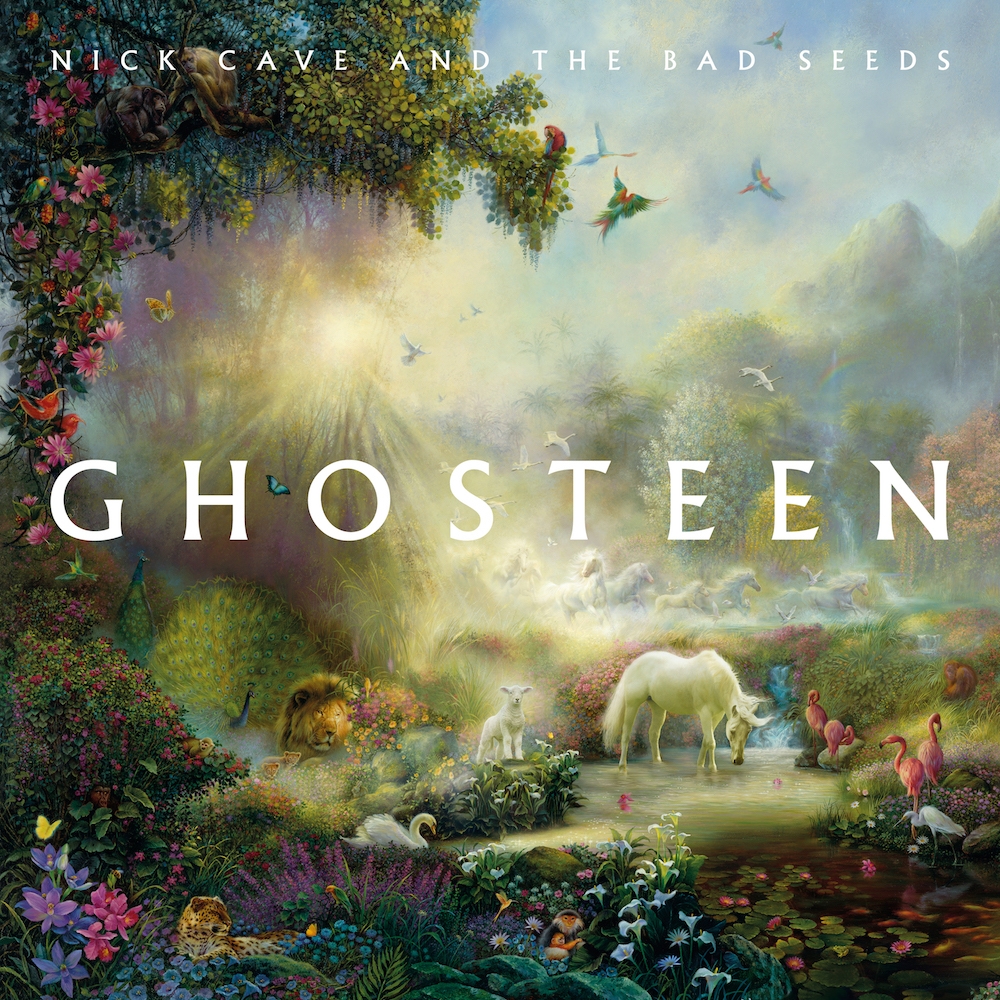
Nick Cave & The Bad Seeds recorded Ghosteen during 2018 and early 2019 across studios in Malibu, Los Angeles, Brighton and Berlin. Its instrumentation includes piano, synthesizers, loops, flute, violin, bass, percussion, vibraphone and guitar, yet much of the album feels unusually weightless. Cave divided it into two parts, describing the first group of songs as “the children” and the second as “their parents.” The record arrived in 2019 after a period in which grief had become inseparable from his writing.

What I keep noticing is how the arrangements often avoid giving the songs a firm floor. Synthesizers and sustained textures can float around the voice rather than locking everything into a conventional rock structure. Even with drums and bass available, space becomes one of the dominant musical materials. That makes Ghosteen interesting from a production perspective as well as an emotional one. Removing weight can sometimes make music feel larger. The arrangement does not need to tell us what grief sounds like. It creates a space where certainty itself seems difficult to hold.

Ghosteen

#NickCave #Ghosteen #MusicProduction #AustralianMusic

An Album With Almost No Ground An Album With Almost No Ground Nick Cave Ghosteen - Digital | Nick Cave Buy from the Official Website. A transcendent double album from Nick Cave & The Bad Seeds, exploring loss and hope.
Facebook LinkedIn WhatsApp Threads
More sharing options
X Reddit Pinterest Telegram Email
Afro Uruguayan Culture

Three Drums, One Moving City

Candombe is inseparable from the sound of drums moving through Montevideo. The Uruguayan tradition combines music and dance and carries a strong African heritage. Three historic neighbourhoods, Barrio Sur, Palermo and Cordón, developed their own approaches to the drum rhythm, and the annual Desfile de las Llamadas brings comparsas into the streets. Yet candombe does not exist only during the parade. Rehearsals and neighbourhood gatherings continue throughout the year.

What interests me is what happens when rhythm is not confined to a stage. A procession changes acoustics constantly. Buildings reflect the drums differently, spectators move alongside the players, distance alters which parts of the pattern become dominant. The city itself becomes part of the mix. That makes candombe difficult to reduce to an audio recording alone. The recording preserves rhythm, but not the experience of hearing it approach from another street, grow physically larger and then disappear again. Music can occupy architecture without ever needing a concert hall.

CANDOMBE

#Candombe #UruguayanMusic #Montevideo #AfroUruguayanCulture

Three Drums, One Moving City Three Drums, One Moving City Candombe is inseparable from the sound of drums moving through Montevideo. The Uruguayan tradition combines music and dance and carries a strong African he…
Facebook LinkedIn WhatsApp Threads
More sharing options
X Reddit Pinterest Telegram Email
Clock Maria Taniguchi’s

Painting Time Without Painting a Clock

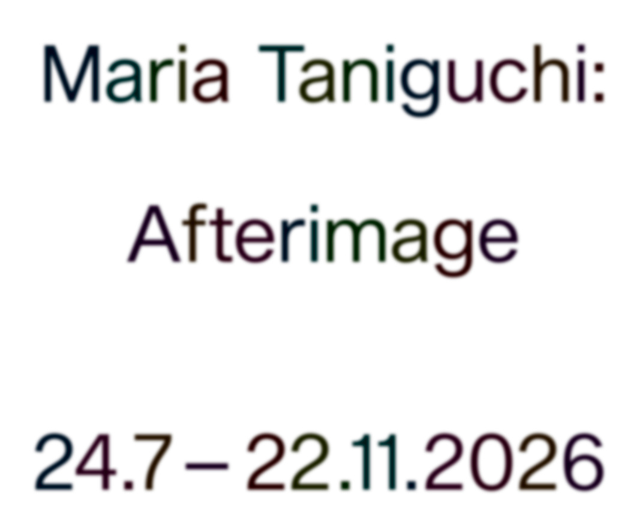
Maria Taniguchi’s “brick paintings” are made from thousands of hand-drawn rectangular cells, each individually filled. She began the ongoing body of work in 2008, and individual canvases can require days, weeks or months of repetitive labour. At Singapore Art Museum’s 2026 exhibition Afterimage, these paintings appear alongside sculpture and video, making repetition, material and duration visible across several media. Taniguchi considers the paintings less as isolated objects than as parts of one continuing artwork.

I find that idea more interesting than the apparent grid itself. From a distance the paintings can look systematic, even machine-like. Close attention reveals slight changes created by a human hand repeating a task for an extraordinary amount of time. Nothing in the image represents time directly, yet time is everywhere in it. The surface is almost an accumulation of hours. Instead of depicting duration, Taniguchi makes duration become material.

https://www.singaporeartmuseum.sg/en/art-events/exhibitions/maria-taniguchi-afterimage

#MariaTaniguchi #PhilippineArt #ContemporaryPainting #SingaporeArt

Painting Time Without Painting a Clock Painting Time Without Painting a Clock singaporeartmuseum.sg Maria Taniguchi: Afterimage | Singapore Art Museum Maria Taniguchi: Afterimage is the first monographic exhibition of the acclaimed artist presented by a Singaporean institution.
Facebook LinkedIn WhatsApp Threads
More sharing options
X Reddit Pinterest Telegram Email
Afrobeat

Afrobeat Was Built as a System

Fela Kuti did not arrive at Afrobeat as a fixed genre waiting to be named. His musical path moved through jazz, highlife and soul, with musicians from West African and Caribbean backgrounds entering his early groups. His official archive places an important turning point in 1968, when he began publicly using the term “Afro Beat” as his music absorbed stronger soul influences. By the early 1970s, long grooves, horns, percussion, call-and-response vocals and political lyrics had become part of a musical language inseparable from his confrontation with Nigerian military power.

What fascinates me is that Afrobeat is difficult to reduce to one signature sound. It works more like a system. Bass, drums, guitars and horns repeat patterns for long periods, allowing tiny changes to become significant. The groove can feel almost immovable while the music remains intensely alive. Political force and dance are not competing functions here. The body is part of how the message travels.

https://felakuti.com/about

#FelaKuti #Afrobeat #NigerianMusic #MusicHistory

Afrobeat Was Built as a System Afrobeat Was Built as a System Fela Kuti About - Fela Kuti The official website for Fela Kuti: his legacy, catalog, and shop.
Facebook LinkedIn WhatsApp Threads
More sharing options
X Reddit Pinterest Telegram Email