Skip to content

Afrobeat Was Built as a System

Ignore Pacita Abad’s Flight

A Painting Too Large to Ignore

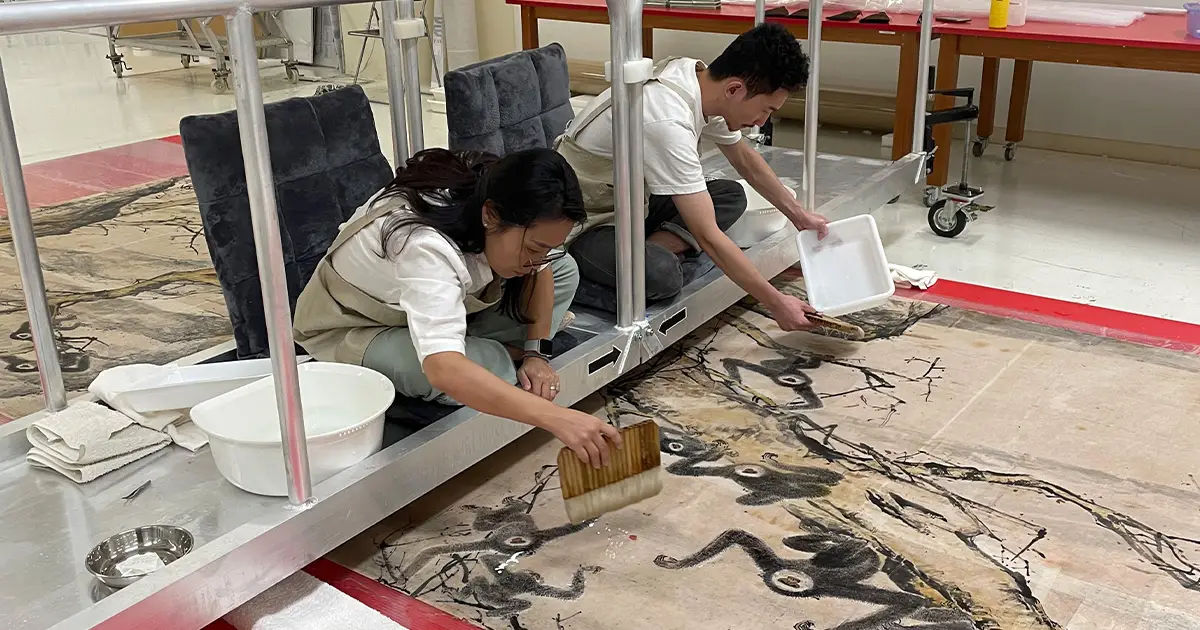
Pacita Abad’s Flight to Freedom grew from her encounters with Cambodian refugees near the Thai border around the period of the Cambodian-Vietnamese conflict. The monumental painting shows a mass of displaced people moving across the landscape, turning migration into something physically difficult to overlook. National Gallery Singapore describes it as one of Abad’s significant social realist works and notes that the Cambodian Refugees series developed from situations she witnessed directly.

Abad later became especially known for colourful stitched and stuffed trapunto paintings, but this earlier work shows another side of her practice. What stays with me is the scale. News photographs of refugees are often consumed quickly, one image among thousands. A painting several metres wide changes that relationship. You cannot absorb the crowd in a glance. Individual figures become part of a collective movement while still resisting disappearance into statistics. Scale becomes an ethical decision about how long an image asks us to look.

https://www.nationalgallery.sg/sg/en/learn-about-art/art-conservation.html

#PacitaAbad #PhilippineArt #SocialRealism #SoutheastAsianArt
A Painting Too Large to Ignore A Painting Too Large to Ignore National Gallery Singapore Art Conservation | National Gallery Singapore At National Gallery Singapore, art conservation is more than a practice — it’s a commitment to preserving our cultural treasures for future generations.
Facebook LinkedIn WhatsApp Threads
More sharing options
X Reddit Pinterest Telegram Email
Barkcloth

Painting With the Bark of a Tree

Samoan siapo begins long before any pattern appears. Makers use the inner bark of the u’a, or paper mulberry tree, scraping and pounding it until thin strips expand into cloth. Separate pieces can then be joined into larger surfaces. Decoration may be drawn freehand or transferred by rubbing the cloth across a relief board called an upeti. Traditional colours can come from soot, tree bark, turmeric, plant seeds and other natural sources. Siapo is still exchanged at ceremonies, weddings and funerals.

I like how difficult it is to separate image from material here. The surface is not a neutral support waiting for an artist to begin. Growing, harvesting, pounding, joining and dye-making are already part of what the finished pattern contains. Even the repeated motifs often refer back to plants and animals. In digital work we can choose a colour with one click and forget where colour comes from. Siapo makes the opposite visible: an image can begin in a tree, an earth pigment and hours of physical preparation before the first deliberate mark appears.

https://collections.tepapa.govt.nz/object/84881

#Siapo #SamoanArt #Barkcloth #PacificArt

Painting With the Bark of a Tree Painting With the Bark of a Tree collections.tepapa.govt.nz Siapo (tapa cloth) Find out more about Siapo (tapa cloth) at Collections Online - Museum of New Zealand Te Papa Tongarewa
Facebook LinkedIn WhatsApp Threads
More sharing options
X Reddit Pinterest Telegram Email
Album With Almost

An Album With Almost No Ground

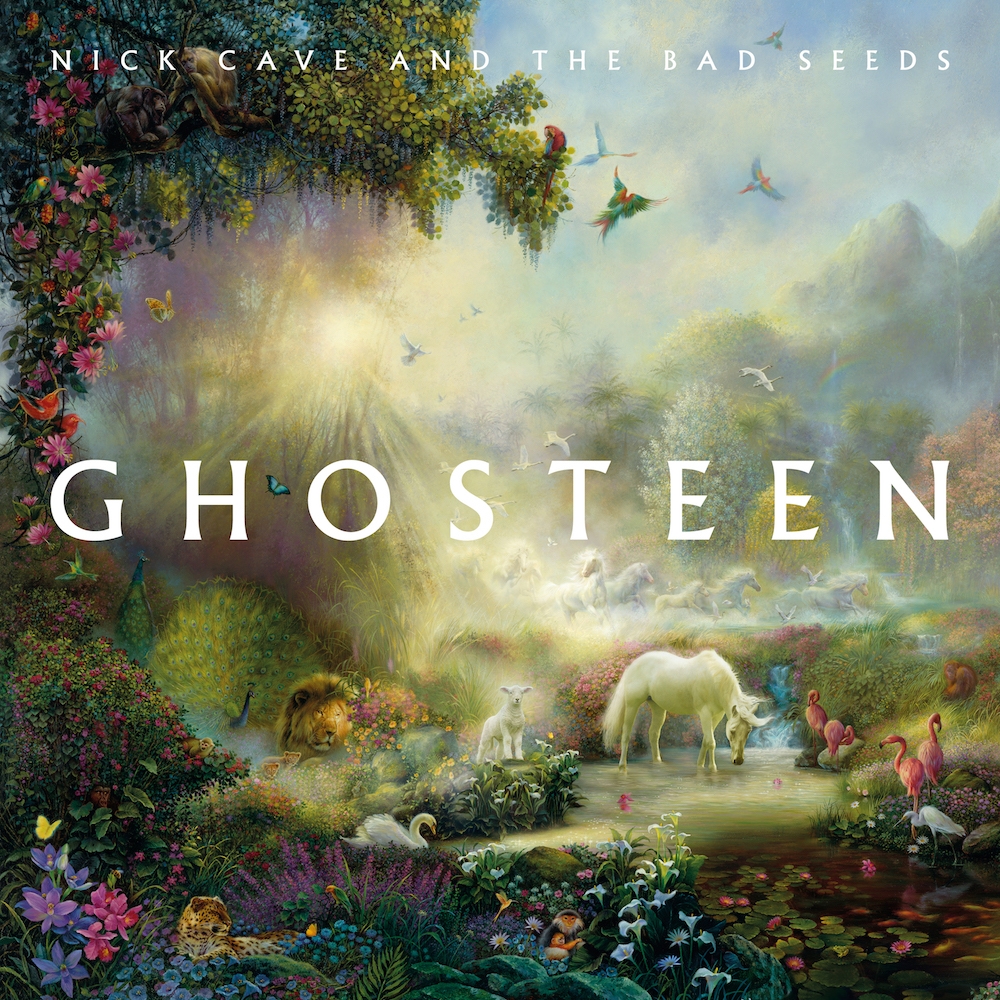
Nick Cave & The Bad Seeds recorded Ghosteen during 2018 and early 2019 across studios in Malibu, Los Angeles, Brighton and Berlin. Its instrumentation includes piano, synthesizers, loops, flute, violin, bass, percussion, vibraphone and guitar, yet much of the album feels unusually weightless. Cave divided it into two parts, describing the first group of songs as “the children” and the second as “their parents.” The record arrived in 2019 after a period in which grief had become inseparable from his writing.

What I keep noticing is how the arrangements often avoid giving the songs a firm floor. Synthesizers and sustained textures can float around the voice rather than locking everything into a conventional rock structure. Even with drums and bass available, space becomes one of the dominant musical materials. That makes Ghosteen interesting from a production perspective as well as an emotional one. Removing weight can sometimes make music feel larger. The arrangement does not need to tell us what grief sounds like. It creates a space where certainty itself seems difficult to hold.

Ghosteen

#NickCave #Ghosteen #MusicProduction #AustralianMusic

An Album With Almost No Ground An Album With Almost No Ground Nick Cave Ghosteen - Digital | Nick Cave Buy from the Official Website. A transcendent double album from Nick Cave & The Bad Seeds, exploring loss and hope.
Facebook LinkedIn WhatsApp Threads
More sharing options
X Reddit Pinterest Telegram Email
Afro Uruguayan Culture

Three Drums, One Moving City

Candombe is inseparable from the sound of drums moving through Montevideo. The Uruguayan tradition combines music and dance and carries a strong African heritage. Three historic neighbourhoods, Barrio Sur, Palermo and Cordón, developed their own approaches to the drum rhythm, and the annual Desfile de las Llamadas brings comparsas into the streets. Yet candombe does not exist only during the parade. Rehearsals and neighbourhood gatherings continue throughout the year.

What interests me is what happens when rhythm is not confined to a stage. A procession changes acoustics constantly. Buildings reflect the drums differently, spectators move alongside the players, distance alters which parts of the pattern become dominant. The city itself becomes part of the mix. That makes candombe difficult to reduce to an audio recording alone. The recording preserves rhythm, but not the experience of hearing it approach from another street, grow physically larger and then disappear again. Music can occupy architecture without ever needing a concert hall.

CANDOMBE

#Candombe #UruguayanMusic #Montevideo #AfroUruguayanCulture

Three Drums, One Moving City Three Drums, One Moving City Candombe is inseparable from the sound of drums moving through Montevideo. The Uruguayan tradition combines music and dance and carries a strong African he…
Facebook LinkedIn WhatsApp Threads
More sharing options
X Reddit Pinterest Telegram Email
Clock Maria Taniguchi’s

Painting Time Without Painting a Clock

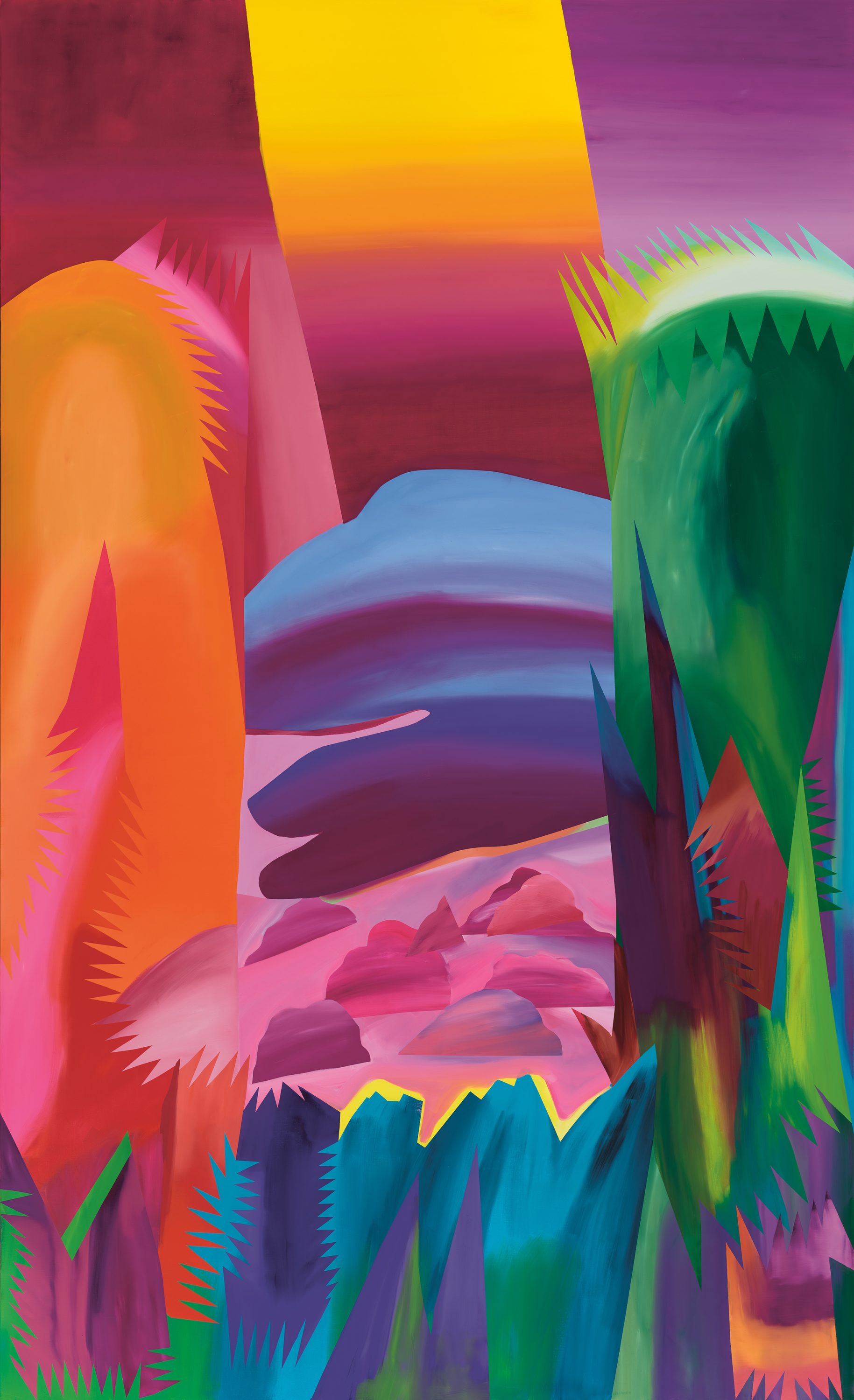
Maria Taniguchi’s “brick paintings” are made from thousands of hand-drawn rectangular cells, each individually filled. She began the ongoing body of work in 2008, and individual canvases can require days, weeks or months of repetitive labour. At Singapore Art Museum’s 2026 exhibition Afterimage, these paintings appear alongside sculpture and video, making repetition, material and duration visible across several media. Taniguchi considers the paintings less as isolated objects than as parts of one continuing artwork.

I find that idea more interesting than the apparent grid itself. From a distance the paintings can look systematic, even machine-like. Close attention reveals slight changes created by a human hand repeating a task for an extraordinary amount of time. Nothing in the image represents time directly, yet time is everywhere in it. The surface is almost an accumulation of hours. Instead of depicting duration, Taniguchi makes duration become material.

https://www.singaporeartmuseum.sg/en/art-events/exhibitions/maria-taniguchi-afterimage

#MariaTaniguchi #PhilippineArt #ContemporaryPainting #SingaporeArt

Painting Time Without Painting a Clock Painting Time Without Painting a Clock singaporeartmuseum.sg Maria Taniguchi: Afterimage | Singapore Art Museum Maria Taniguchi: Afterimage is the first monographic exhibition of the acclaimed artist presented by a Singaporean institution.
Facebook LinkedIn WhatsApp Threads
More sharing options
X Reddit Pinterest Telegram Email
Afrobeat

Afrobeat Was Built as a System

Fela Kuti did not arrive at Afrobeat as a fixed genre waiting to be named. His musical path moved through jazz, highlife and soul, with musicians from West African and Caribbean backgrounds entering his early groups. His official archive places an important turning point in 1968, when he began publicly using the term “Afro Beat” as his music absorbed stronger soul influences. By the early 1970s, long grooves, horns, percussion, call-and-response vocals and political lyrics had become part of a musical language inseparable from his confrontation with Nigerian military power.

What fascinates me is that Afrobeat is difficult to reduce to one signature sound. It works more like a system. Bass, drums, guitars and horns repeat patterns for long periods, allowing tiny changes to become significant. The groove can feel almost immovable while the music remains intensely alive. Political force and dance are not competing functions here. The body is part of how the message travels.

https://felakuti.com/about

#FelaKuti #Afrobeat #NigerianMusic #MusicHistory

Afrobeat Was Built as a System Afrobeat Was Built as a System Fela Kuti About - Fela Kuti The official website for Fela Kuti: his legacy, catalog, and shop.
Facebook LinkedIn WhatsApp Threads
More sharing options
X Reddit Pinterest Telegram Email
Colour

Colour Escapes the Canvas

Estonian painter Kristi Kongi’s Chromatic Drift at Kumu Art Museum refuses to keep colour neatly inside rectangular paintings. Created partly for the museum’s large exhibition hall, the project extends motifs and colour onto floors, walls, windows and outdoor space. Kumu describes colour as central to Kongi’s way of mapping and preserving memories and states of mind. The 2026 exhibition is also significant institutionally: it is the first solo exhibition by an Estonian woman artist in Kumu’s Great Hall.

What interests me is what happens when painting begins treating architecture as part of its surface. A canvas normally ends at its edge. Once colour crosses that boundary, the viewer enters the composition rather than simply standing in front of it. Colour stops behaving like decoration applied to objects and starts organising distance, movement and atmosphere. Perhaps painting becomes spatial not when it imitates three dimensions, but when it changes how we physically move through a room.

https://kumu.ekm.ee/en/syndmus/kristi-kongi-chromatic-drift/

#KristiKongi #EstonianArt #Painting #Colour

Colour Escapes the Canvas Colour Escapes the Canvas Kumu kunstimuuseum Kristi Kongi: Chromatic Drift - Kumu kunstimuuseum The large-scale solo exhibition of the painter Kristi Kongi (1985) offers an immersive spatial experience. In the new works created for this exhibition, colour emerges as the central element, with its fields of meaning unfolding in physical, emotional, and semantic ways.
Facebook LinkedIn WhatsApp Threads
More sharing options
X Reddit Pinterest Telegram Email
Contemporary Art

A Nation Drawn While It Was Changing

The National Gallery of Australia’s Bilong Papua New Guinea looked at fifty years of independence through art rather than through a conventional political timeline. Papua New Guinea became independent on 16 September 1975 after periods of British, German and Australian colonial rule. The exhibition placed contemporary works beside cultural forms and showed how artists have addressed independence, ancestral knowledge, Christianity, technology and rapid social change. Figures such as Mathias Kauage and Timothy Akis helped shape a modern visual language that could absorb new materials without abandoning local cultural references.

Papua New Guinea contains extraordinary linguistic and cultural diversity. That makes the idea of a single national image complicated from the beginning. What interests me is how artists can participate in creating national identity without making everyone look the same. Art can connect different histories while allowing their differences to remain visible. Perhaps a nation becomes more convincing when its image is allowed to stay unfinished.

https://nga.gov.au/stories-ideas/bilong-papua-new-guinea/

#PapuaNewGuineaArt #PacificArt #ContemporaryArt #CulturalIdentity

A Nation Drawn While It Was Changing A Nation Drawn While It Was Changing The National Gallery of Australia’s Bilong Papua New Guinea looked at fifty years of independence through art rather than through a conventional political…
Facebook LinkedIn WhatsApp Threads
More sharing options
X Reddit Pinterest Telegram Email
ARAVARA

Time Is Not Neutral

ARAVARA at the National Gallery of Jamaica is an audiovisual exhibition built around a deceptively difficult subject: time. Curated by Yina Jiménez Suriel and developed with KADIST, it brings together ten works by ten artists and is being presented through several Caribbean locations. The exhibition considers recurrence, repetition and historical layering, asking how promises of progress made in earlier periods continue to shape present realities. At the Kingston presentation, moving image and sound become ways of looking at history without assuming that time simply moves forward in a clean line.

I like that idea because museums themselves often organise history chronologically. One year follows another, giving the impression that the past has been completed. But political ideas, social structures and unfinished promises can return in altered forms. Perhaps history behaves less like a timeline and more like an image repeatedly edited without ever deleting all the previous layers.

National Gallery of Jamaica and KADIST Present ARAVARA: June 28, 2026

#ARAVARA #CaribbeanArt #VideoArt #JamaicaArt

Time Is Not Neutral Time Is Not Neutral National Gallery of Jamaica National Gallery of Jamaica and KADIST Present ARAVARA: June 28, 2026 The National Gallery of Jamaica (NGJ), in collaboration with KADIST, is pleased to present ARAVARA, an audiovisual exhibition curated by Dominican curator Yina Jiménez Suriel. The exhibition opens …
Facebook LinkedIn WhatsApp Threads
More sharing options
X Reddit Pinterest Telegram Email
Addis Ababa

When a Landscape Is Felt Physically

Ethiopian painter Tesfaye Bekele uses grass, flowers, leaves and seasonal change as more than landscape subjects. In Moments of Change, shown at Addis Fine Art in Addis Ababa in early 2026, repeated dots and layered lines produced surfaces that could resemble landscapes, aerial maps or constellations. The works were made with acrylic on canvas and textiles, with fabric connecting the paintings to ideas of bodily vulnerability, effort and care. Bekele grew up in Addis Ababa, studied at the Alle School of Fine Arts and Design and later taught there.

What stays with me is the decision to connect changes in nature with the way time is experienced by a body. We normally measure a season with dates, yet we recognise it through temperature, colour, smell, growth and disappearance. A landscape painting can therefore record much more than a place. It can describe what change feels like before we have found words for it.

https://addisfineart.com/exhibitions/136-moments-of-change-tesfaye-bekele/

#TesfayeBekele #EthiopianArt #Painting #AddisAbaba

When a Landscape Is Felt Physically When a Landscape Is Felt Physically Ethiopian painter Tesfaye Bekele uses grass, flowers, leaves and seasonal change as more than landscape subjects. In Moments of Change, shown at Addis Fine…
Facebook LinkedIn WhatsApp Threads
More sharing options
X Reddit Pinterest Telegram Email
City Music Born Between

A City Music Born Between Worlds

Rebetiko emerged in the urban centres and port cities of Greece during the early twentieth century, initially among working-class and marginalised communities. Its musical language did not grow from a single source. UNESCO describes a tradition shaped through exchanges among Greeks from Asia Minor and the Aegean and the Turkish, Jewish, Armenian, Balkan and Levantine communities of the former Ottoman world. Songs were originally transmitted mainly by listening, playing and learning directly from older musicians. Recordings, cinema, conservatories and universities later created additional ways of passing the repertoire on.

What interests me is how easily a music that begins on society’s margins can later become part of a country’s cultural identity. Rebetiko did not become valuable because somebody preserved it unchanged. It kept absorbing new surroundings, performers and technologies. Its history suggests that tradition may be strongest when it is flexible enough to travel without forgetting where it came from.

https://ich.unesco.org/en/RL/rebetiko-01291

#Rebetiko #GreekMusic #UrbanFolkMusic #MusicHistory

A City Music Born Between Worlds A City Music Born Between Worlds ich.unesco.org Rebetiko - UNESCO Intangible Cultural Heritage Rebetiko is a musical and cultural expression directly linked to song and dance that initially spread among the urban lower and working-class populations in the early twentieth century. Rebetiko songs are now a standardized repertoire in almost every social occasion involving music and dance. The element is performed in public and performers encourage audience participation. The practice is open t...
Facebook LinkedIn WhatsApp Threads
More sharing options
X Reddit Pinterest Telegram Email