Skip to content

Philippine Art

Art Stream
Ignore Pacita Abad’s Flight

A Painting Too Large to Ignore

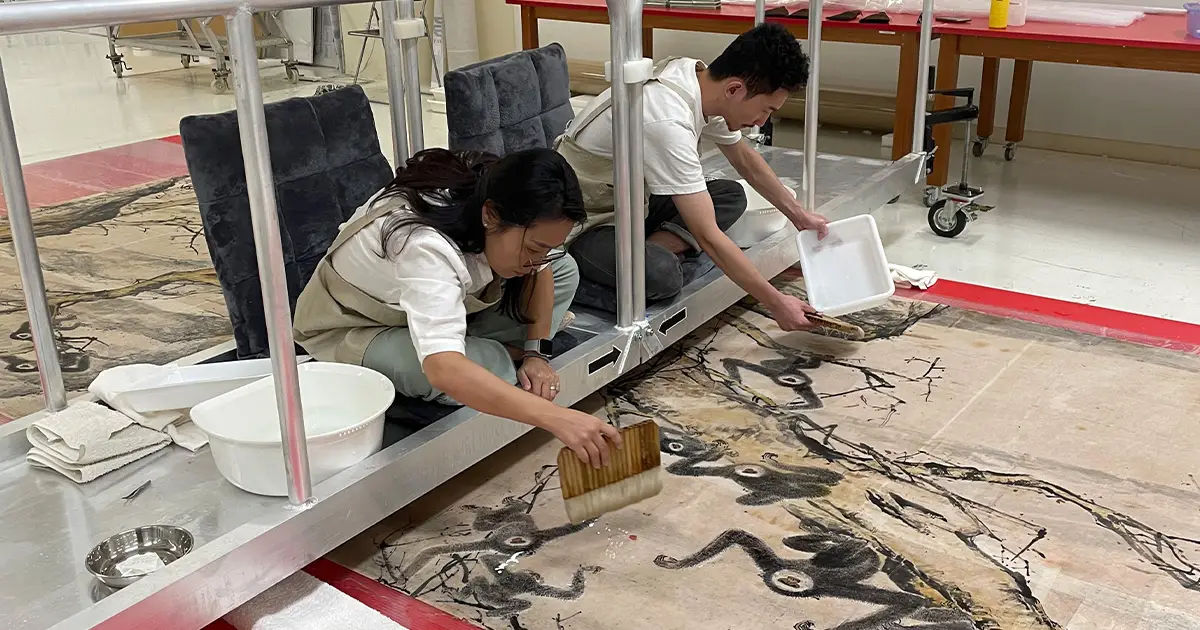
Pacita Abad’s Flight to Freedom grew from her encounters with Cambodian refugees near the Thai border around the period of the Cambodian-Vietnamese conflict. The monumental painting shows a mass of displaced people moving across the landscape, turning migration into something physically difficult to overlook. National Gallery Singapore describes it as one of Abad’s significant social realist works and notes that the Cambodian Refugees series developed from situations she witnessed directly.

Abad later became especially known for colourful stitched and stuffed trapunto paintings, but this earlier work shows another side of her practice. What stays with me is the scale. News photographs of refugees are often consumed quickly, one image among thousands. A painting several metres wide changes that relationship. You cannot absorb the crowd in a glance. Individual figures become part of a collective movement while still resisting disappearance into statistics. Scale becomes an ethical decision about how long an image asks us to look.

https://www.nationalgallery.sg/sg/en/learn-about-art/art-conservation.html

#PacitaAbad #PhilippineArt #SocialRealism #SoutheastAsianArt
A Painting Too Large to Ignore A Painting Too Large to Ignore National Gallery Singapore Art Conservation | National Gallery Singapore At National Gallery Singapore, art conservation is more than a practice — it’s a commitment to preserving our cultural treasures for future generations.
Facebook LinkedIn WhatsApp Threads
More sharing options
X Reddit Pinterest Telegram Email
Clock Maria Taniguchi’s

Painting Time Without Painting a Clock

Maria Taniguchi’s “brick paintings” are made from thousands of hand-drawn rectangular cells, each individually filled. She began the ongoing body of work in 2008, and individual canvases can require days, weeks or months of repetitive labour. At Singapore Art Museum’s 2026 exhibition Afterimage, these paintings appear alongside sculpture and video, making repetition, material and duration visible across several media. Taniguchi considers the paintings less as isolated objects than as parts of one continuing artwork.

I find that idea more interesting than the apparent grid itself. From a distance the paintings can look systematic, even machine-like. Close attention reveals slight changes created by a human hand repeating a task for an extraordinary amount of time. Nothing in the image represents time directly, yet time is everywhere in it. The surface is almost an accumulation of hours. Instead of depicting duration, Taniguchi makes duration become material.

https://www.singaporeartmuseum.sg/en/art-events/exhibitions/maria-taniguchi-afterimage

#MariaTaniguchi #PhilippineArt #ContemporaryPainting #SingaporeArt

Painting Time Without Painting a Clock Painting Time Without Painting a Clock singaporeartmuseum.sg Maria Taniguchi: Afterimage | Singapore Art Museum Maria Taniguchi: Afterimage is the first monographic exhibition of the acclaimed artist presented by a Singaporean institution.
Facebook LinkedIn WhatsApp Threads
More sharing options
X Reddit Pinterest Telegram Email