Skip to content

The Bow Remembers a Voice

Laurie Anderson

The Bow Remembers a Voice

Laurie Anderson’s Tape Bow Violin replaces the bow’s horsehair with prerecorded magnetic tape. A playback head mounted on the instrument reads the tape as the bow passes across it. Instead of setting a string into vibration, the gesture retrieves fragments of stored sound.

The physical action resembles violin playing, but its musical logic is closer to scrubbing through audio. Direction, speed and pressure affect how the recorded material is heard. A spoken voice can become a repeated syllable, a stretched texture or a brief burst that no longer behaves like language. The bow is both a performance tool and a piece of memory being moved by hand.

Digital controllers can imitate this relationship with greater accuracy, yet the tape version keeps the mechanism legible. The audience can see that sound is attached to a strip, that the strip must travel across a head, and that a phrase has a physical length. The instrument turns playback into a visible gesture. It also makes recording less final: a fixed voice can be interrupted, reversed and phrased again every time the bow moves.

https://www.modernamuseet.se/en/stockholm/exhibitions/laurie-anderson/

#LaurieAnderson #TapeBowViolin #MagneticTape #PerformanceArt

The Bow Remembers a Voice The Bow Remembers a Voice Moderna Museet Laurie Anderson | Moderna Museet i Stockholm Laurie Anderson is a legendary figure in American avant-garde art, experimental music and independent culture. In this exhibition, Laurie Anderson explores the potential for presenting a narrative in the museum space. Here, totally new productions meet earlier works, in a contemplation on time and being, silence and noise.
Facebook LinkedIn WhatsApp Threads
More sharing options
X Reddit Pinterest Telegram Email
Burial

Burial Worked Outside the Grid

In his 2007 interview with The Wire, Burial confirmed that he made Untrue in Sound Forge, editing waveforms without a conventional sequencer. He described recognising drum patterns by how they looked, arranging them into irregular, skeletal shapes rather than aligning coloured blocks on a grid. Some percussion came from video games, falling shell casings and the small ignition sound of a lighter.

The method explains something that technical analysis can miss. The rhythms do not feel loose because timing was neglected. They feel loose because each sound was placed inside a visual and emotional judgement rather than corrected against a fixed rhythmic display. Soft garage drums thread the voices and atmospheres together. They do not need to dominate the mix to establish motion.

There is no useful lesson here about expensive tools being bad or primitive tools being automatically more authentic. Sound Forge simply narrowed the available actions. Burial could cut, move, layer and listen, but he could not rely on a familiar sequencer to display the music as an orderly arrangement. That limitation encouraged a private notation made from waveform shapes, memory and feel. Untrue sounds carefully constructed, yet it never seems completely pinned down. Its precision belongs to the ear rather than the grid.

https://www.thewire.co.uk/in-writing/interviews/burial_unedited-transcript

#Burial #Untrue #UKGarage #MusicProduction #SoundForge

Burial Worked Outside the Grid Burial Worked Outside the Grid The Wire Magazine - Adventures In Modern Music Burial: Unedited Transcript - The Wire In his 2007 interview with The Wire, Burial confirmed that he made Untrue in Sound Forge, editing waveforms without a conventional sequencer. He described…
Facebook LinkedIn WhatsApp Threads
More sharing options
X Reddit Pinterest Telegram Email
Electronic Music

A Machine That Suggested Music

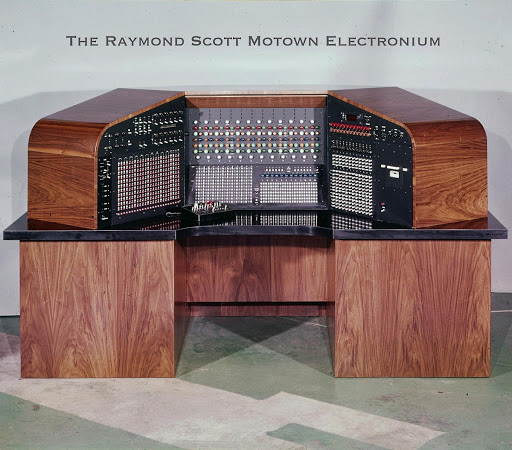
Raymond Scott’s Electronium was not simply an early synthesizer. It was conceived as a system that could generate and perform musical material automatically, using electronic circuits and algorithmic processes. Scott described the relationship as a collaboration between a person and a machine. The operator did not have to enter a finished score and press play. The machine could propose musical events while the composer adjusted, selected and redirected them.

That makes the Electronium difficult to place in the usual history of electronic instruments. A keyboard waits for instructions. A tape machine reproduces decisions already made. A sequencer repeats information placed into it. Scott was trying to build something less obedient: an instrument with enough internal behaviour to surprise its maker without removing the maker from the process.

The surviving machine was never turned into a stable commercial product, and descriptions of its capabilities changed as Scott continued developing it. That incompleteness is part of the story rather than a flaw to hide. Musical tools are often presented as finished solutions, while actual creative practice is full of unstable patches, provisional controls and systems that are never quite complete. The Electronium makes that unfinished state visible. Its most durable contribution may be the model of the studio as a place where composition can emerge through negotiation with a system, not only through commands given to it.

https://artsandculture.google.com/story/the-electronium%E2%80%94a-cockpit-of-dreams-raymondscottarchives/vgVRMrpuDa3FnQ?hl=en

#RaymondScott #Electronium #ElectronicMusic #MusicTechnology

A Machine That Suggested Music A Machine That Suggested Music Google Arts & Culture The Electronium—A Cockpit of Dreams - Google Arts & Culture The Electronium, conceived as a collaboration between man and machine, could instantaneously compose and perform music automatically using algorithms that were precursors of artificial intelligence. It is undoubtedly the magnum opus of Scott's electronic music career.
Facebook LinkedIn WhatsApp Threads
More sharing options
X Reddit Pinterest Telegram Email
Ambient Music

Water Without a Landscape

The 51 tracks on Synthetic Water Music do not try to agree on what water sounds like. Across two hours, the compilation moves between reflective surfaces, submerged tones, imagined currents and pieces whose connection to water is suggested more by texture than by direct imitation. Its scale makes it less like a concept album and more like a collection of listening tests.

Released by the Slovak label mappa on 10 September 2026, the set includes Pauline Anna Strom, Francesca Heart, Visible Cloaks and dozens of other contributors. The title is useful because the word “synthetic” removes any obligation to document a real river, sea or rainfall. Water can be reconstructed through synthesis, memory, naming or rhythm. A track does not need a field recording of waves to create a sense of liquid movement.

There is a practical production idea here. Sound design often begins by asking which device can reproduce a known sound. This compilation suggests another route: identify how a material behaves, then translate that behaviour. Water accumulates, reflects, leaks, repeats, erodes and changes shape around resistance. Those verbs offer more musical possibilities than the search for a convincing splash.

https://mappa.bandcamp.com/album/synthetic-water-music

#SyntheticWaterMusic #Mappa #AmbientMusic #SoundDesign

Water Without a Landscape Water Without a Landscape mappa Synthetic Water Music, by Various Artists 51 track album
Facebook LinkedIn WhatsApp Threads
More sharing options
X Reddit Pinterest Telegram Email
Experimental Music

When Moonlight Becomes Voltage

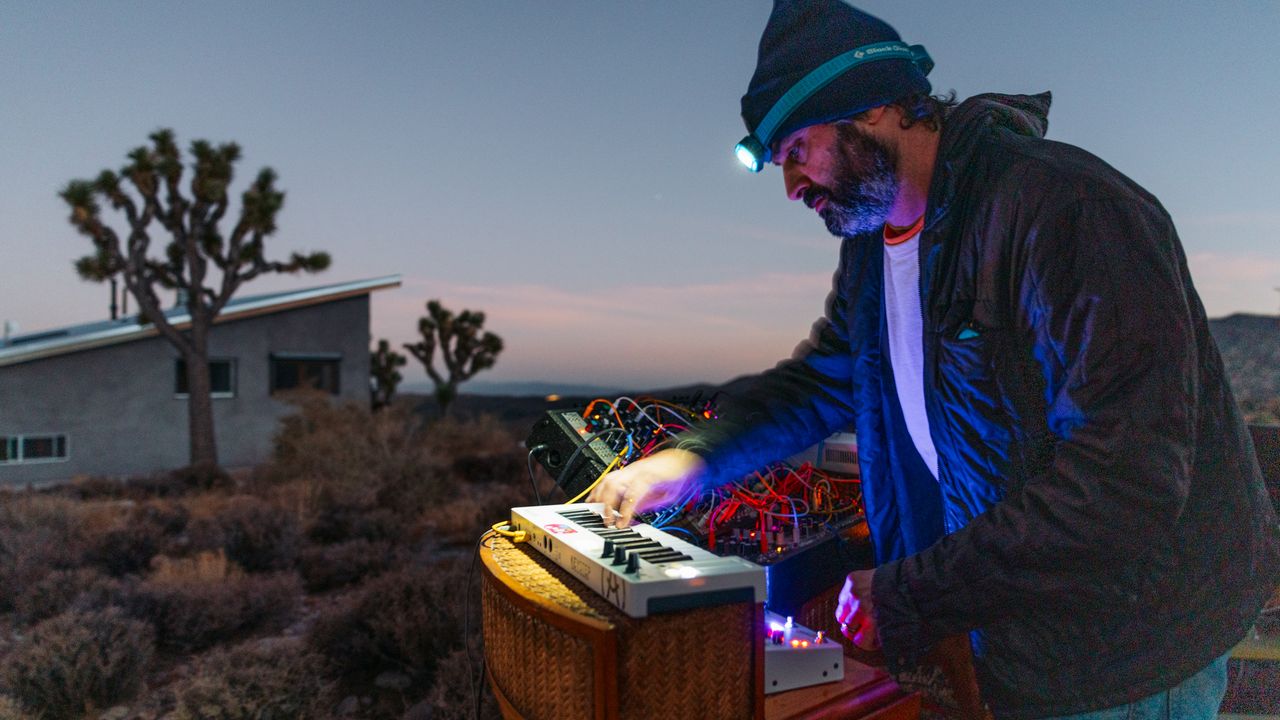
For The Sirens, Geologist and visual artist Kyle Simon did not use the night sky as a theme added after the music was made. At Simon’s Farrington Observatory in Joshua Tree, light from the moon, stars and planets entered a telescope fitted with optical sensors and photodiodes. An analogue amplifier converted that changing light into control voltage for Geologist’s modular system, where it could affect pitch, filtering, rhythm and other parameters in real time.

The distinction matters. This is not a recording of space, and the stars are not secretly composing a melody. Light becomes one influence inside a human-built chain: telescope, sensor, amplifier, patch and performer. Every stage translates the previous one, so the final sound is neither a neutral scientific reading nor an arbitrary musical illustration.

The album, due on 16 October 2026, grows from a single composition recorded in 2024. What stays with me is the modest role assigned to the celestial data. It does not replace musical judgement. It behaves more like an unstable control source, comparable to an envelope or low-frequency oscillator whose movement originates far beyond the instrument. A modular synthesizer is usually praised for precise control. Here its value lies in making room for a signal the musician can guide but cannot fully author.

https://pitchfork.com/story/geologist-reveals-new-album-the-sirens

#Geologist #ModularSynth #Photodiode #ExperimentalMusic

When Moonlight Becomes Voltage When Moonlight Becomes Voltage Pitchfork Geologist Reveals New Album The Sirens The LP, made with visual artist Kyle Simon, consists of a single composition manipulated by the “light of the full moon”
Facebook LinkedIn WhatsApp Threads
More sharing options
X Reddit Pinterest Telegram Email
Akoma

Rhythm as a Problem to Solve

Jlin has described composition as something close to a mathematical proof: the answers seem to be present, but the question still has to be discovered. It is an unusual way to explain music that feels so physical. Her percussion can arrive in hard clusters, sudden gaps and patterns that appear to turn away from a predictable downbeat, yet the detail never sounds casually scattered.

On Akoma, released in 2024, collaborators including Philip Glass, Björk and Kronos Quartet enter that rhythmic language without turning the album into a conventional crossover project. Their identities remain audible, but Jlin’s construction determines the space they occupy. Collaboration becomes another compositional constraint rather than a decorative guest appearance.

Thinking of rhythm as proof shifts attention away from loops alone. A pattern can establish a rule, interrupt it, return with one element displaced and make the earlier version newly legible. The pleasure comes partly from movement and partly from recognising the internal logic after the body has already responded.

Complex electronic rhythm is sometimes discussed as a display of programming skill. Jlin’s description points somewhere more interesting. Precision is not the subject of the music. It is the method that allows surprise to remain coherent.

On “Akoma,” Jlin Fuses Technical Precision with Boundless Imagination

#Jlin #Akoma #RhythmicComposition #ElectronicMusic

Rhythm as a Problem to Solve Rhythm as a Problem to Solve I CARE IF YOU LISTEN On "Akoma," Jlin Fuses Technical Precision with Boundless Imagination Tristan McKay speaks with composer/producer Jlin about her new album, and why she considers composition to be an exciting musical puzzle.
Facebook LinkedIn WhatsApp Threads
More sharing options
X Reddit Pinterest Telegram Email