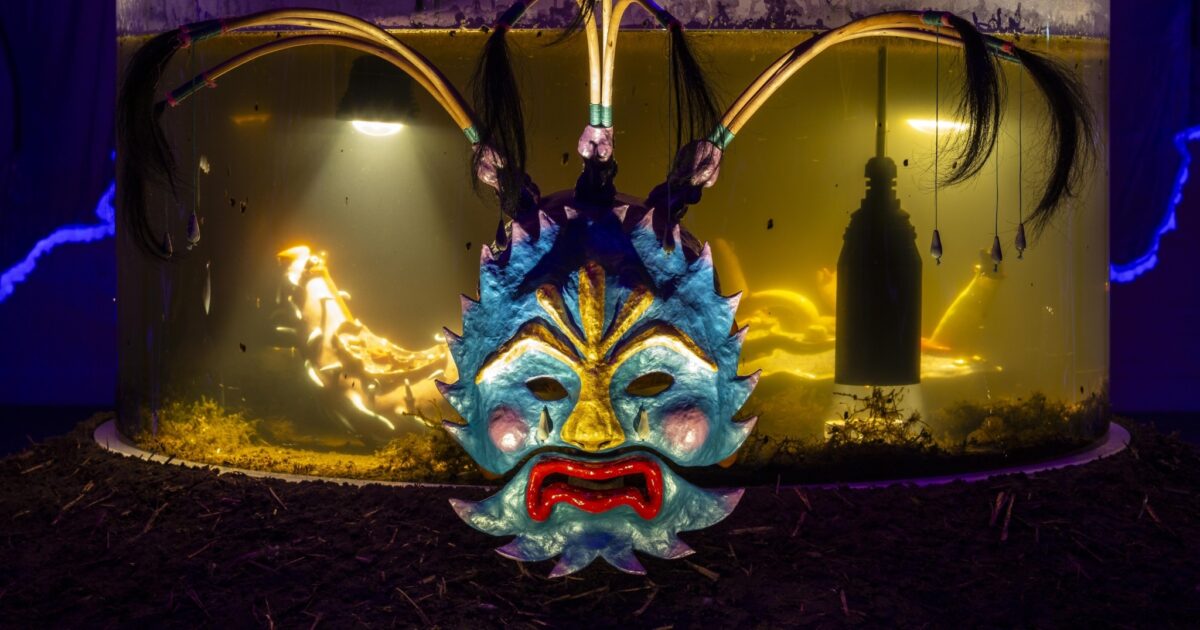
Rae-Yen Song’s new installation at FACT Liverpool contains something unusually literal at its centre: a living pond.
The exhibition •~TUA~• ?? •~MAK~•, opening on 18 September 2026, combines sculpture, sound and moving image within an imagined subaquatic world shaped partly by the artist’s family histories and diasporic mythology.
Cameras observe microscopic life and movement inside the pond. Activity within that ecosystem then affects the lights and sounds of the installation.
I like the reversal.
Interactive digital art usually waits for a human visitor.
Walk here.
Touch this.
Move your hand and the system responds.
Song gives some of that control to organisms that have no interest in being performers.
The gallery becomes responsive, but humans are no longer the only meaningful input.
That changes the idea of interactivity itself.
A living system is not a button.
It does not repeat the same response because somebody requests it.
The artwork has to share control with processes it cannot completely predict.
For a digital installation, that is a surprisingly biological kind of uncertainty.
https://www.fact.co.uk/event/rae-yen-song-%E5%AE%8B%E7%91%9E%E6%B8%8A