Skip to content

One Musician Becoming an Ensemble

MIA

A Pop Song Built From a Political Sample

M.I.A.’s “Paper Planes” takes its central instrumental loop from “Straight to Hell” by The Clash, but the sample does not behave like a nostalgic quotation.

It is pulled into a completely different musical and political environment. Gunshot sounds and a cash-register effect punctuate the chorus, while the track’s lyrics turn attention toward migration, suspicion, money and the stereotypes attached to outsiders. Diplo later described the Clash sample as successful precisely because its new context changed its flavour so completely.

That is what good sampling can do.

The source remains recognisable, but recognition is not the destination.

Context changes meaning.

A melancholy guitar pattern from a British punk record becomes the foundation of a global pop track by a British-Sri Lankan artist whose work repeatedly dealt with borders and displacement.

Sampling is often discussed as ownership of sound.

Artistically, I find the more interesting question to be ownership of interpretation.

A sample can preserve the original recording while completely changing what that recording now seems to say.

#MIA #PaperPlanes #Sampling #PopProduction

A Pop Song Built From a Political Sample A Pop Song Built From a Political Sample YouTube M.I.A. - Paper Planes Subscribe: https://MIA.lnk.to/Subscribe Watch more: https://MIA.lnk.to/WatchMore Connect with M.I.A. Online:Follow M.I.A. on Instagram: https://MIA.lnk.to/I...
Abstraction

A Mountain Reduced to Color

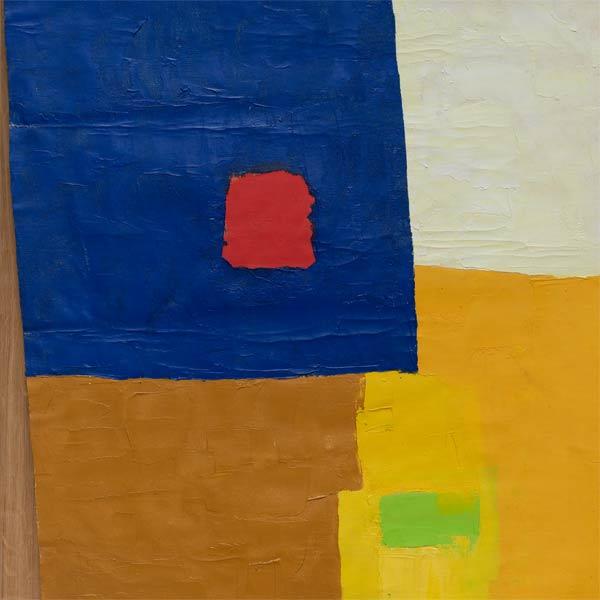
Etel Adnan spent years returning to landscape, especially Mount Tamalpais in California, yet her paintings rarely behave like conventional descriptions of scenery. Colour blocks, simple geometric forms and compressed spaces can reduce a mountain to something almost symbolic.

Adnan once described beginning a painting with one mark, such as a red square, then allowing that first decision to determine what had to happen next. Her work moved between painting, poetry, drawing, tapestry and writing, with colour functioning as something that did not require translation into language.

That last point interests me because Adnan was also a writer.

Someone who spent so much of her life with words found another form precisely where words were unnecessary.

A mountain in a painting does not need to explain itself.

It can become red.

The sky can become green.

Scale can collapse.

Colour can carry the emotional information instead.

Painting then becomes less like describing a place and more like remembering how that place occupied the mind.

https://www.labiennale.org/en/art/2024/abstraction/etel-adnan

#EtelAdnan #LebaneseArt #LandscapePainting #Abstraction

A Mountain Reduced to Color A Mountain Reduced to Color La Biennale di Venezia Biennale Arte 2024 | Etel Adnan Beirut, Lebanon, 1925 – 2021, Paris, France
Abstract Painting

A Grid That Refuses Perfection

Agnes Martin is famous for grids, but the grids are not mechanically perfect.

In Untitled from 1961, repeated lines form a highly controlled structure, yet they remain visibly hand drawn. The Pinault Collection describes the slight irregularity and vibration of those lines as central to the work.

That imperfection changes everything.

A computer could generate a mathematically exact grid in less than a second.

Martin’s grid contains time.

Every line required a hand to travel across the surface.

Tiny deviations record that movement.

The work therefore sits somewhere between system and body.

I keep thinking about this in relation to electronic music.

Quantisation can create perfect rhythmic structure, but sometimes the interesting part is the difference between the structure and the person trying to follow it.

Martin gives geometry the same possibility.

The rule remains visible.

So does the failure to obey it perfectly.

That is why the painting feels quieter than a machine-made grid but also more alive.

https://lesoeuvres.pinaultcollection.com/en/artwork/untitled-72

#AgnesMartin #Minimalism #AbstractPainting #Grid

A Grid That Refuses Perfection A Grid That Refuses Perfection lesoeuvres.pinaultcollection.com Untitled | Pinault Collection Agnes Martin is famous for grids, but the grids are not mechanically perfect. In Untitled from 1961, repeated lines form a highly controlled...
Expanded Cinema

A Film Screening Became a Light Show

In the late 1950s, Jordan Belson worked with composer Henry Jacobs on the Vortex Concerts at San Francisco’s Morrison Planetarium. Rather than projecting a conventional film onto one rectangular screen, they used the planetarium environment for combinations of abstract imagery, electronic music and spatial projection. The Center for Visual Music considers the Vortex events important precursors to expanded cinema.

This feels remarkably close to contemporary audiovisual performance.

The audience was no longer simply looking forward.

Images could occupy the dome and surround the listener while electronic sound transformed the same space acoustically.

That changes what editing means.

In ordinary film, one image replaces another in time.

Inside an immersive projection environment, several images can coexist in different parts of the viewer’s field of vision.

The audience decides where the cut happens by turning its head.

Modern projection mapping, VJ software and immersive installations have made these techniques technically easier.

Belson’s work is useful because it reminds us that immersive media did not begin with powerful projectors.

It began with the desire to escape the rectangle.

https://www.centerforvisualmusic.org/Belson/

#JordanBelson #ExpandedCinema #VisualMusic #LiveVisuals

A Film Screening Became a Light Show A Film Screening Became a Light Show centerforvisualmusic.org Jordan Belson In the late 1950s, Jordan Belson worked with composer Henry Jacobs on the Vortex Concerts at San Francisco’s Morrison Planetarium. Rather than...
Archive Bülent Arel

Electronic Music Hidden in an Archive

Bülent Arel was one of the composers working at the Columbia-Princeton Electronic Music Center during the formative years of American electronic music. Columbia University’s archive still contains tapes, work materials and fragments connected with his electronic compositions, including material associated with Stereo Electronic Music No. 1 and other experiments from the 1960s.

Arel is exactly the kind of figure who makes electronic music history feel incomplete.

The usual story quickly settles around a few famous studios and names. Yet institutions contain shelves of tapes made by composers whose work helped establish the language everybody else later inherited.

Tape music was laborious.

Sound had to be generated, recorded, cut, copied, filtered and physically organised. A twenty-second passage could represent hours of construction.

An archive changes how I hear that history.

The reel is not simply an old recording.

It is evidence of a process in which editing was literally an action performed on material.

Digital production made those gestures invisible.

The tape still shows where the decisions happened.

https://dlc.library.columbia.edu/catalog/10.7916/d8-z89r-xx75

#BulentArel #TapeMusic #ElectronicMusic #MusicArchive

Electronic Music Hidden in an Archive Electronic Music Hidden in an Archive DLC Catalog Channel V materials : [work material] Bülent Arel was one of the composers working at the Columbia-Princeton Electronic Music Center during the formative years of American electronic...
Ensemble Midori Takada

One Musician Becoming an Ensemble

Midori Takada recorded Through the Looking Glass as her first solo album in 1983. The four-piece work centres on percussion and uses instruments including marimba, vibraphone and other acoustic sound sources, building an intricate world from layering and repetition rather than from a conventional band. The album later became a highly sought-after recording before being internationally reissued.

What interests me is how little the music behaves like a demonstration of percussion technique.

Takada uses repeated patterns to create space.

A marimba figure may remain simple while another rhythmic layer slowly alters how we hear it. The ear begins noticing relationships rather than individual hits.

It is almost the acoustic equivalent of sequencing.

Except every repetition has passed through a human body first.

That distinction becomes more audible the longer the music continues.

A loop can repeat perfectly.

A performer can repeat with intention.

Those are not quite the same thing.

https://wereleasewhateverthefuckwewantrecords.bandcamp.com/album/through-the-looking-glass

#MidoriTakada #JapaneseMusic #Minimalism #Percussion

One Musician Becoming an Ensemble One Musician Becoming an Ensemble WRWTFWW Records Through The Looking Glass, by Midori Takada 0 track album
Dub

The Repairman Who Reinvented the Mix

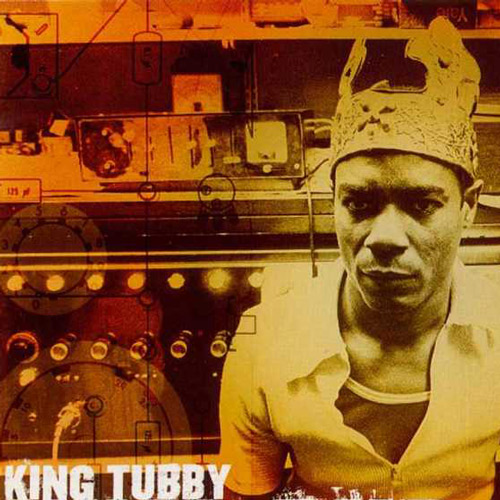
Osbourne Ruddock, better known as King Tubby, began as an electronics and radio repairman in Kingston. His technical knowledge made him valuable to Jamaica’s growing sound-system culture, and by 1964 he was operating Tubby’s Hometown Hi-Fi. His later studio work helped push the mixing console itself toward becoming a musical instrument.

That shift remains one of the most important ideas in modern production.

Normally a mixer is supposed to balance what musicians have already recorded.

Dub asks a different question.

What happens if the mix is the performance?

Vocals disappear. Drums suddenly remain alone. Echo throws a fragment several seconds into the future. A mistake can become a feature if it sounds good enough to repeat. Scientist later described dub precisely in those terms: engineers reorganising existing recordings into new ones.

The producer no longer stands outside the music making it tidy.

The studio becomes playable.

Much of contemporary electronic production still works inside the space Tubby helped open.

https://www.reggaeville.com/artist-details/king-tubby/about/

#KingTubby #Dub #JamaicanMusic #StudioAsInstrument

The Repairman Who Reinvented the Mix The Repairman Who Reinvented the Mix www.reggaeville.com Biography: King Tubby Reggaeville.com - World of Reggae in One Village
Grandmaster Flash

The Break That Would Not End

Before sampling software could loop a drum break automatically, Grandmaster Flash developed what he called Quick Mix Theory.

He used two copies of the same record on two turntables. When the rhythmic break on one copy approached its end, he switched to the other copy at the beginning of the same break, then reset the first record while the second played. Repeating the process could extend a few seconds of percussion almost indefinitely.

That seems almost obvious now because looping has become a basic software command.

But Flash had to invent the loop physically.

Two records became temporary memory.

The mixer became an editing system.

His hands became the transport controls.

What interests me most is that the technique did not merely reproduce an existing song. It isolated the exact part dancers wanted and changed its duration.

That is already sampling logic before the sampler.

Sometimes an entire technological revolution begins because somebody wants eight seconds of music to last a little longer.

https://invention.si.edu/invention-stories/hip-hop-and-african-american-innovation

#GrandmasterFlash #HipHop #Turntablism #SamplingHistory

The Break That Would Not End The Break That Would Not End invention.si.edu Before sampling software could loop a drum break automatically, Grandmaster Flash developed what he called Quick Mix Theory. He used two copies...
Computer Music

Turning a Mouse Into an Instrument

Laurie Spiegel created Music Mouse in the mid-1980s when personal computers were only beginning to enter ordinary homes. Instead of treating the mouse as a device for selecting menus, she turned its movement into musical control. Moving across the screen could generate melodies, harmonies and arpeggios in real time. In 2026 Eventide released a modern version in collaboration with Spiegel.

I like the conceptual shift more than the software itself.

A computer mouse was designed for pointing.

Spiegel asked what else the gesture might mean.

That is often how genuinely new instruments appear. The technology already exists, but someone stops accepting its intended role.

There is also something important about continuous control here. Clicking a note is one thing. Moving a hand through a two-dimensional space creates relationships between several musical parameters at once.

It makes composition feel closer to drawing.

We talk constantly about interfaces becoming more intuitive.

Music Mouse suggests another possibility: make the interface strange enough that the musician starts behaving differently.

https://www.eventideaudio.com/plug-ins/music-mouse/

#LaurieSpiegel #MusicMouse #ComputerMusic #ElectronicMusic

Turning a Mouse Into an Instrument Turning a Mouse Into an Instrument eventideaudio.com Laurie Spiegel created Music Mouse in the mid-1980s when personal computers were only beginning to enter ordinary homes. Instead of treating the...
Donna Summer

The Bassline That Changed the Future

When Giorgio Moroder and Donna Summer made “I Feel Love” in 1977, the idea was to imagine what dance music might sound like in the future. Moroder constructed almost the entire instrumental backing electronically, including bass, kick, snare and hi-hat, creating the mechanical pulse that became the track’s defining feature.

What still surprises me is how little the bassline actually needs to do.

It repeats relentlessly, but the sound is alive because modulation, filtering and the relationship between the electronic pulse and Summer’s voice keep changing our perception of it.

The machine supplies precision. The voice supplies something the machine cannot.

That combination became more influential than either part alone.

Today a sequenced synthesizer bassline is completely ordinary. In 1977, hearing a dance record whose rhythmic foundation sounded deliberately artificial was another matter.

The future Moroder imagined eventually became so familiar that we stopped hearing how strange it once was.

Time – Meet Giorgio Moroder, the Godfather of Modern Dance Music

#GiorgioMoroder #DonnaSummer #IFeelLove #ElectronicMusic

The Bassline That Changed the Future The Bassline That Changed the Future Giorgio Moroder Time - Meet Giorgio Moroder, the Godfather of Modern Dance Music - Giorgio Moroder When Giorgio Moroder and Donna Summer made “I Feel Love” in 1977, the idea was to imagine what dance music might sound like in the future. Moroder construc…
Drum Machine Without Samples

**A Drum Machine Without Samples**

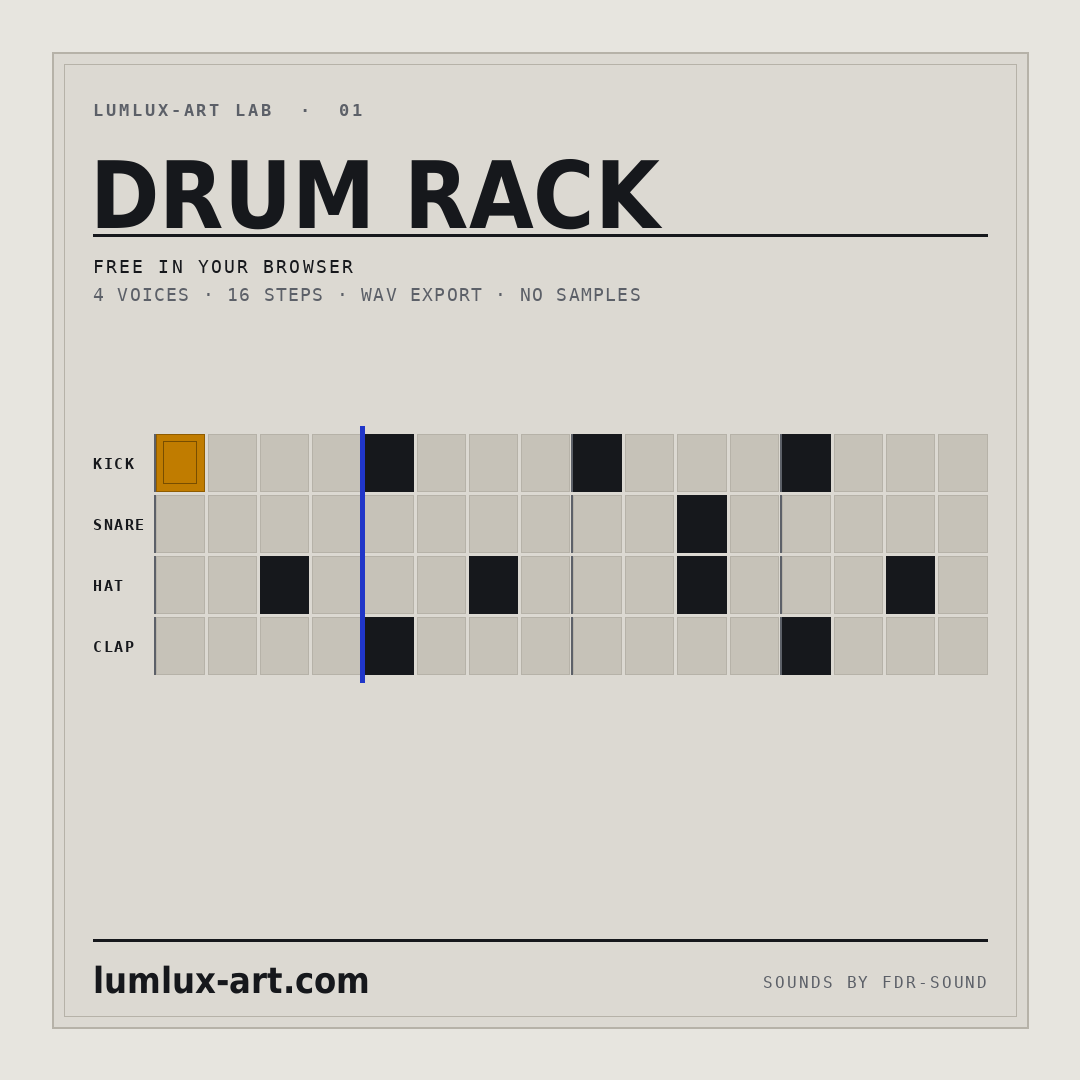
Most drum machines begin with recorded sounds. LumLux Art’s Drum Rack starts somewhere else. Its kick, snare, hi-hat and clap are synthesised directly from oscillators and noise in the browser. There are no drum samples hiding underneath the interface.

That becomes most visible in the kick. Instead of reducing it to a few familiar controls, Drum Rack exposes the pitch envelope itself. Nodes can be moved, added and curved while a waveform display redraws the result. The kick is constructed from three layers: a short noise click for attack, a pitched body and a sine-based sub layer.

What interests me is that this turns a small drum machine into something closer to a lesson in sound design.

Changing a sample usually means selecting another recording. Here, changing the envelope changes the physical behaviour of the sound being generated. A steep pitch fall gives the kick a different sense of attack from a slow one. Harmonics, decay, sub level and drive then reshape the same underlying synthesis rather than disguising it with another preset.

The sequencer follows a similar idea. Individual hits can have their own level, timing nudge and repeated strikes, so a rhythm does not have to remain perfectly attached to the grid. Patterns can also move between 4/4, triplets, 3/4 and odd meters such as 5/4 and 7/4. WAV and MIDI export let the results leave the browser and continue inside a DAW.

Perhaps the most interesting limitation is also the simplest one: only four voices.

In a world of enormous sample libraries and plug-ins with thousands of presets, Drum Rack asks what can happen when there is less to choose from and more to shape.

Sometimes designing the drum is more interesting than finding one.

Drum Rack

#DrumRack #DrumSynthesis #Sequencer #SoundDesign #WebAudio

**A Drum Machine Without Samples** **A Drum Machine Without Samples** Lumlux Art Drum Rack - Lumlux Art Pass it on No install needed — it runs in any browser. Send to a friend Drum Rack is on the App Store The iPhone version is live. The same drum machine you just played, running natively on your phone. Free, no ads, no account, nothing collected. Android version coming soon Drum Rack is in…