Skip to content

Live Visuals

Art Stream
Expanded Cinema

A Film Screening Became a Light Show

In the late 1950s, Jordan Belson worked with composer Henry Jacobs on the Vortex Concerts at San Francisco’s Morrison Planetarium. Rather than projecting a conventional film onto one rectangular screen, they used the planetarium environment for combinations of abstract imagery, electronic music and spatial projection. The Center for Visual Music considers the Vortex events important precursors to expanded cinema.

This feels remarkably close to contemporary audiovisual performance.

The audience was no longer simply looking forward.

Images could occupy the dome and surround the listener while electronic sound transformed the same space acoustically.

That changes what editing means.

In ordinary film, one image replaces another in time.

Inside an immersive projection environment, several images can coexist in different parts of the viewer’s field of vision.

The audience decides where the cut happens by turning its head.

Modern projection mapping, VJ software and immersive installations have made these techniques technically easier.

Belson’s work is useful because it reminds us that immersive media did not begin with powerful projectors.

It began with the desire to escape the rectangle.

https://www.centerforvisualmusic.org/Belson/

#JordanBelson #ExpandedCinema #VisualMusic #LiveVisuals

A Film Screening Became a Light Show A Film Screening Became a Light Show centerforvisualmusic.org Jordan Belson In the late 1950s, Jordan Belson worked with composer Henry Jacobs on the Vortex Concerts at San Francisco’s Morrison Planetarium. Rather than...
Facebook LinkedIn WhatsApp Threads
More sharing options
X Reddit Pinterest Telegram Email
Cinema Escaping the Rectangle

Cinema Escaping the Rectangle

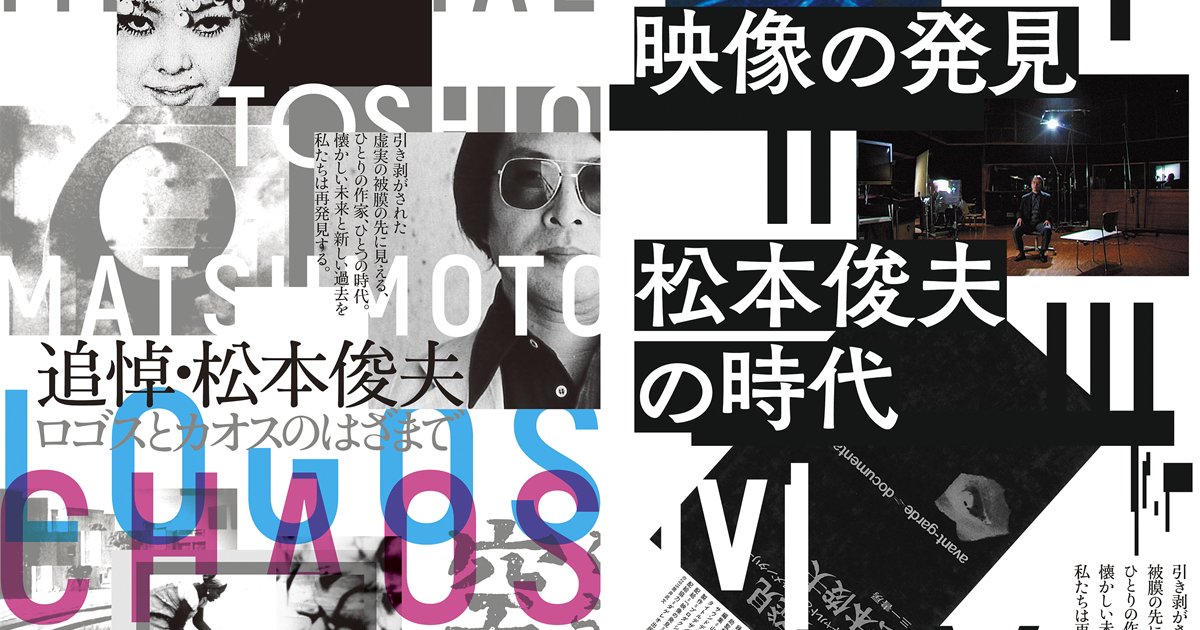
Toshio Matsumoto did not limit experimental film to unusual images inside a conventional cinema screen. During the late 1960s and early 1970s he worked with expanded cinema, questioning what his retrospective material describes as the standard “one projector, one screen” relationship between film and audience. For My Crushed Right Eye from 1968 could be presented with three simultaneous projections, while Space Projection Ako in 1970 pushed the idea further into spatial presentation.

This interests me much more from a VJ perspective than simply synchronising a video to music.

Once several projections occupy a space, editing no longer happens only in time. It happens across walls, screens and the viewer’s field of vision.

The audience effectively performs part of the edit by deciding where to look.

Modern projection mapping and realtime visuals have access to technology Matsumoto could never have imagined, yet the underlying question remains surprisingly current:

Why should a moving image stay inside one rectangle?

The moment that rectangle disappears, cinema begins behaving like architecture.

https://www.imageforum.co.jp/matsumototoshio/

#ToshioMatsumoto #ExpandedCinema #ExperimentalFilm #LiveVisuals

Cinema Escaping the Rectangle Cinema Escaping the Rectangle ??????? ??????????????????-??????? ??????? ??????????????????-??????? ???????? ??????????????????-????????2017?12??????????????????????
Facebook LinkedIn WhatsApp Threads
More sharing options
X Reddit Pinterest Telegram Email
Audiovisual Art

Visuals From Particle Physics

Herman Kolgen’s ISOTOPP grew from a residency at GANIL, the French heavy-ion research facility. Rather than using particle physics simply as futuristic decoration, the Montréal multimedia artist developed an audiovisual work around molecular abstraction and energy transfer. The project eventually became a black-and-white audiovisual performance.

That starting point interests me from a VJ perspective.

Visual performance often begins with images that already look interesting. Film fragments, generated geometry, typography or textures are then synchronised to music. Kolgen’s approach suggests another possibility: begin with a process that is normally invisible and ask how it might acquire both image and sound.

The scientific phenomenon is not automatically the artwork. Transformation is still required.

But it gives the audiovisual system a shared conceptual source. Sound and image do not have to be connected only because a visual event happens on the beat. They can behave like two different outputs generated from the same underlying idea.

That feels much closer to composing audiovisual work than simply decorating music with moving pictures.

https://montreal.mutek.org/en/artists/herman-kolgen

#HermanKolgen #AudiovisualArt #LiveVisuals #VJCulture

Visuals From Particle Physics Visuals From Particle Physics MUTEK Montréal Herman Kolgen | MUTEK Montréal MUTEK is a Montréal-based festival dedicated to the promotion of electronic music and the digital arts.Edition 27, from August 25 to 30, 2026.MUTEK…
Facebook LinkedIn WhatsApp Threads
More sharing options
X Reddit Pinterest Telegram Email
Audiovisual Art

When Image and Sound Share Structure

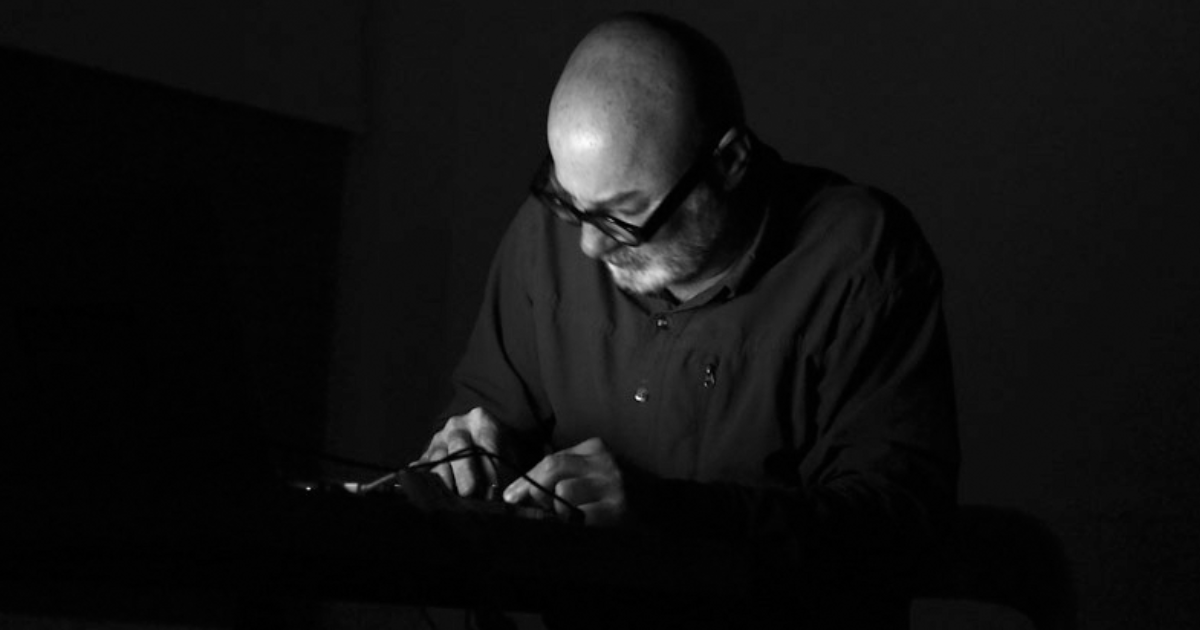
Ryoichi Kurokawa’s syn_ is an audiovisual performance built as a diptych with 2.1-channel sound. First created in 2011, it has been performed internationally in spaces ranging from Tokyo’s Studio Coast to festivals and arts centres in Europe and North America. Kurokawa describes his broader practice in terms of constructing audiovisual phenomena from field recordings and digitally generated structures.

What interests me from a VJ perspective is that the image does not appear to be decoration placed behind finished music.

Sound and image seem to belong to the same organisational system: fragmentation, rhythm, interruption, density and sudden precision appear in both.

That changes the role of synchronization. Matching a visual flash to a kick drum is the most obvious way of connecting image and sound, but it is only one possibility. Both media can instead share behaviour.

A visual texture can become dense when the sound becomes structurally dense without literally following every beat.

The strongest audiovisual work may happen when you cannot easily decide which medium is leading the other.

https://www.ryoichikurokawa.com/project/syn_.html

#RyoichiKurokawa #AudiovisualArt #LiveVisuals #ExperimentalFilm

When Image and Sound Share Structure When Image and Sound Share Structure Ryoichi Kurokawa’s syn_ is an audiovisual performance built as a diptych with 2.1-channel sound. First created in 2011, it has been performed international…
Facebook LinkedIn WhatsApp Threads
More sharing options
X Reddit Pinterest Telegram Email
Audiovisual Art

Thirty-Five Speakers for One Album

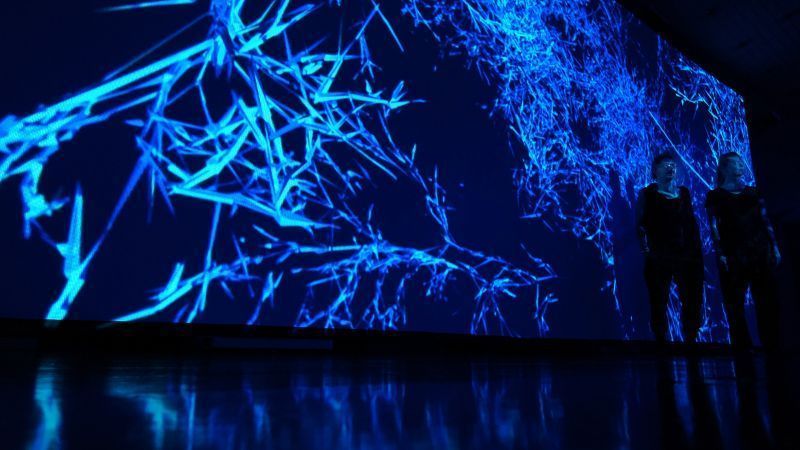
Ryuichi Sakamoto and Shiro Takatani’s async–immersion transforms an album into something closer to an audiovisual environment. The installation was first shown in 2023 inside the basement of the former Kyoto Shimbun newspaper printing plant. Sound engineer ZAK remixed Sakamoto’s async for a 35-speaker system, while Takatani’s imagery occupied a 26.4-metre-wide LED screen.

What interests me from a VJ perspective is the shift from synchronization to space. Sound and image do not merely meet on a timeline. Their physical scale changes the relationship. A sound can arrive from somewhere in the room while the visual field extends far beyond the proportions of a normal cinema screen.

That makes the architecture part of the audiovisual composition.

On a laptop we usually build visuals inside a rectangle and mix audio between left and right. Installations like this expose how arbitrary those boundaries are. Once the room becomes available as material, composition can include direction, distance, movement and the viewer’s own position.

The timeline is no longer the only place where sound and image can meet.

https://www.sitesakamoto.com/artworks/23/

#RyuichiSakamoto #ShiroTakatani #AudiovisualArt #LiveVisuals

Thirty-Five Speakers for One Album Thirty-Five Speakers for One Album Ryuichi Sakamoto and Shiro Takatani’s async–immersion transforms an album into something closer to an audiovisual environment. The installation was first s…
Facebook LinkedIn WhatsApp Threads
More sharing options
X Reddit Pinterest Telegram Email