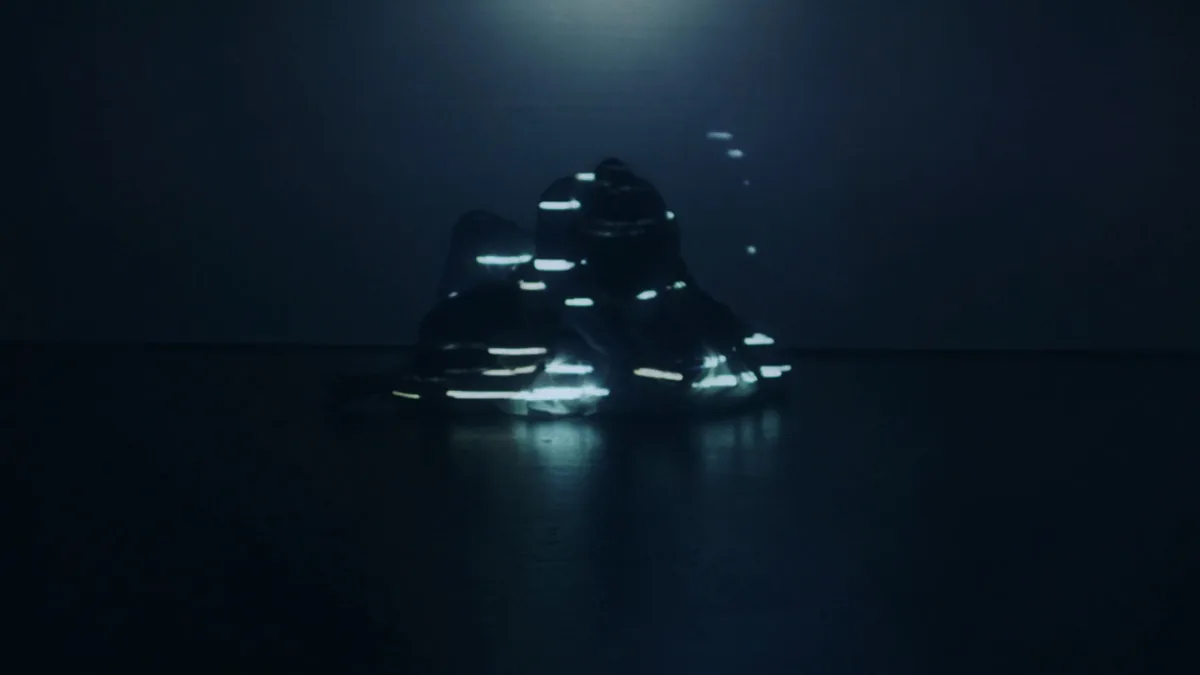
For Nosaj Thing’s “Eclipse/Blue,” Daito Manabe did not treat projected graphics as a backdrop added after choreography. Working with choreographer MIKIKO and two dancers, he built a visual environment in which bodies, shadows and geometric light appear to exchange control. A movement seems to pull an image into place. Moments later, the projection hides or multiplies the body that initiated it.
The effect depends on restraint. Large areas remain dark, so a narrow blue line or a white silhouette can alter the whole stage. The dancers do not compete with a permanently busy screen. Their movement determines when the image needs detail and when an empty field carries more tension.
This is a valuable principle for live visuals. Audio reactivity alone does not create a relationship between performance and image. A stronger system identifies a small number of meaningful events: a hand reaching a position, a body crossing a boundary, a vocal entrance or a sudden pause. Visual response then becomes choreography rather than decoration.
The exact boundary between live projection and post-production is intentionally difficult to read in the finished work. That uncertainty is part of its force. The screen does not illustrate the dancers. It makes their physical space unstable.
https://daito.ws/en/archive/nosaj_thing_eclipse_blue/
#DaitoManabe #NosajThing #EclipseBlue #ProjectionMapping #AudiovisualArt