Skip to content

VJCulture

Art Stream
Culture Before Video Oskar

VJ Culture Before Video

Oskar Fischinger was experimenting with multiple projected images before electronic video existed.

During the 1920s, his Raumlichtmusik performances used several film and slide projectors simultaneously to create abstract moving environments. Elsewhere he explored single-frame animation, scratching directly onto film and even experiments in drawn optical sound.

This is where experimental-film history begins to overlap surprisingly well with modern VJ culture.

A contemporary VJ can run several video layers, blend them, map them onto architecture and synchronise them with music in realtime. Fischinger had none of that digital flexibility. Every additional projector was another physical machine, another film path and another alignment problem.

Yet the artistic question was already there.

Why should cinema consist of one rectangular image directly in front of a seated audience?

Once several projections begin occupying space, the screen stops being only a window. Light itself becomes material.

Fischinger later became famous for tightly synchronised abstract animation, but I find these earlier multiple-projection experiments even more interesting today.

The technology is obsolete.

The idea is not.

A century later, Resolume, projection mapping and immersive audiovisual performances are still exploring what happens when moving images escape from a single screen.

https://centerforvisualmusic.org/Fischinger/

#OskarFischinger #VisualMusic #ExpandedCinema #VJCulture

VJ Culture Before Video VJ Culture Before Video centerforvisualmusic.org Fischinger - CVM pages Oskar Fischinger was experimenting with multiple projected images before electronic video existed. During the 1920s, his Raumlichtmusik...
Facebook LinkedIn WhatsApp Threads
More sharing options
X Reddit Pinterest Telegram Email
Audiovisual Art

Visuals From Particle Physics

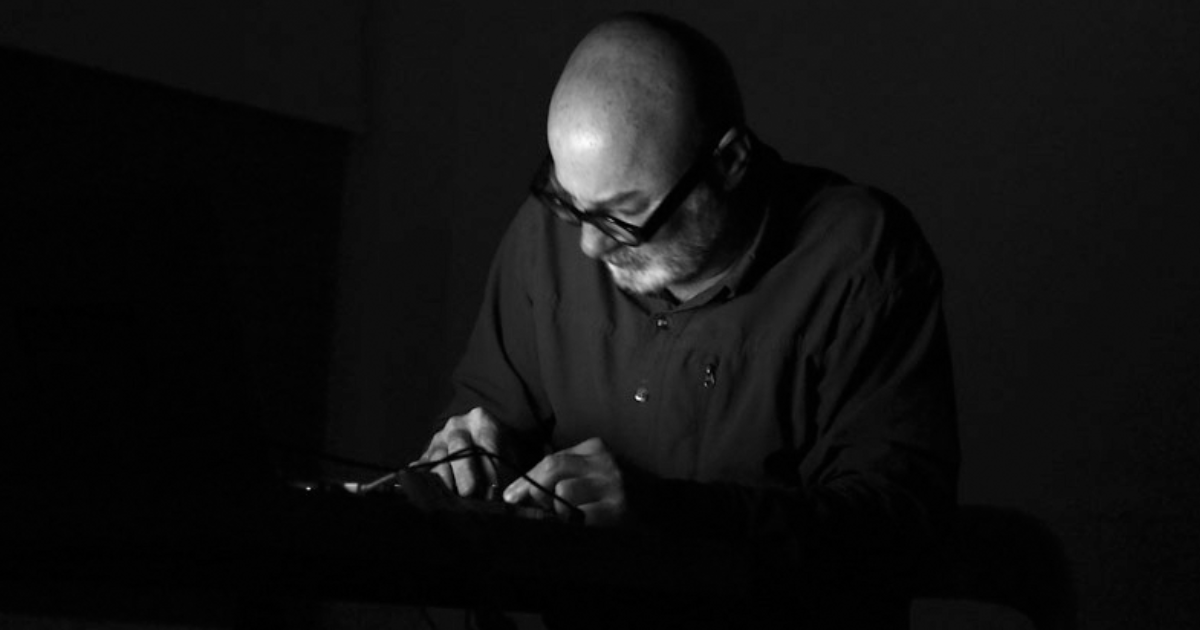
Herman Kolgen’s ISOTOPP grew from a residency at GANIL, the French heavy-ion research facility. Rather than using particle physics simply as futuristic decoration, the Montréal multimedia artist developed an audiovisual work around molecular abstraction and energy transfer. The project eventually became a black-and-white audiovisual performance.

That starting point interests me from a VJ perspective.

Visual performance often begins with images that already look interesting. Film fragments, generated geometry, typography or textures are then synchronised to music. Kolgen’s approach suggests another possibility: begin with a process that is normally invisible and ask how it might acquire both image and sound.

The scientific phenomenon is not automatically the artwork. Transformation is still required.

But it gives the audiovisual system a shared conceptual source. Sound and image do not have to be connected only because a visual event happens on the beat. They can behave like two different outputs generated from the same underlying idea.

That feels much closer to composing audiovisual work than simply decorating music with moving pictures.

https://montreal.mutek.org/en/artists/herman-kolgen

#HermanKolgen #AudiovisualArt #LiveVisuals #VJCulture

Visuals From Particle Physics Visuals From Particle Physics MUTEK Montréal Herman Kolgen | MUTEK Montréal MUTEK is a Montréal-based festival dedicated to the promotion of electronic music and the digital arts.Edition 27, from August 25 to 30, 2026.MUTEK…
Facebook LinkedIn WhatsApp Threads
More sharing options
X Reddit Pinterest Telegram Email