Skip to content

Projection Art

Art Stream
Aether

One Projector, Three Dimensions

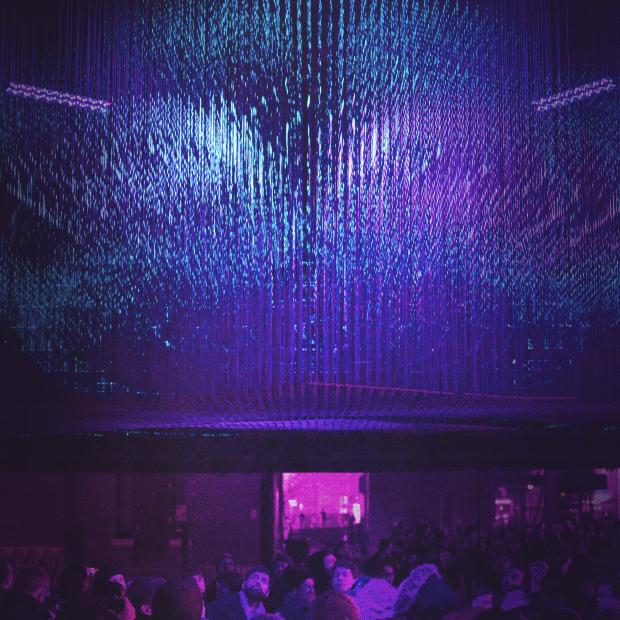
Max Cooper and Architecture Social Club built Aether from an unexpectedly economical illusion. Thousands of lines of string hang in space while a single projector sends light through them. From a distance, the illuminated intersections resemble a three-dimensional matrix of LEDs. Up close, the material construction becomes visible.
The installation turns projection into an object that can be entered and viewed from different positions. Visitors walk below and around a changing lattice while Cooper’s music is mapped to waves, surfaces and symmetrical forms. Image and sound share spatial behaviour rather than matching through a sequence of obvious beat triggers.
Its strongest lesson may be material rather than digital. Projection mapping is often discussed as a software problem, but the receiving surface determines what the software can achieve. String catches only fragments of the projected image. The empty space between the threads does as much work as the illuminated material.
For small installations, this suggests testing cheap physical structures before adding more projectors. Mesh, translucent fabric, fishing line or layers of scrim can divide one beam into several apparent depths. The projector remains flat. The material teaches the light to occupy space.

https://maxcooper.net/aether

#MaxCooper #Aether #LightInstallation #ProjectionArt #ElectronicMusic
One Projector, Three Dimensions One Projector, Three Dimensions Max Cooper Max Cooper – Aether light installation The light installation created in collaboration with Architecture Social Club
Facebook LinkedIn WhatsApp Threads
More sharing options
X Reddit Pinterest Telegram Email
BYOB

BYOB Opens the Walls

BYOB began from a practical observation. Rafaël Rozendaal was living in Berlin and noticed that many artists around him owned projectors. Instead of waiting for a museum to supply equipment, walls and a finished curatorial structure, he and Anne de Vries invited artists to bring their own beamers to a one-night exhibition in 2010. The instruction was deliberately simple: find a space, invite many artists, ask them to bring a projector.
That simplicity changed the social structure of the exhibition. Each projector created a temporary territory, but light could overlap, spill across architecture or collide with another work. Installation happened quickly and remained visible as a process. Cables, tables and improvised surfaces were not backstage problems. They became part of an event assembled by the participants themselves.
Rozendaal kept BYOB as an open format rather than a protected franchise. It travelled to other cities because the idea could be repeated without reproducing the original exhibition exactly. The projector was both display device and admission ticket.
For a contemporary VJ, BYOB still offers a useful correction to the pressure for ever larger screens. A strong projection does not begin with scale. It begins with a clear relationship between image, surface, neighbouring light and the people moving through the room.

Austin Lee interviews Rafaël Rozendaal for SFAQ magazine

#BYOB #RafaelRozendaal #ProjectionArt #DigitalArt #VJCulture

BYOB Opens the Walls BYOB Opens the Walls Rafaël Rozendaal Austin Lee interviews Rafaël Rozendaal for SFAQ magazine - Rafaël Rozendaal Austin Lee interviews Rafaël Rozendaal for SFAQ magazine. New York, February 2014. AL: Your artwork has strong ties to both painting and animation. How do you think about time in both mediums and how does it function in your work? RR: I’m interested in movement, and I’m interested in staring. That means I want to […]
Facebook LinkedIn WhatsApp Threads
More sharing options
X Reddit Pinterest Telegram Email