Skip to content

Visual Music

Art Stream
Expanded Cinema

A Film Screening Became a Light Show

In the late 1950s, Jordan Belson worked with composer Henry Jacobs on the Vortex Concerts at San Francisco’s Morrison Planetarium. Rather than projecting a conventional film onto one rectangular screen, they used the planetarium environment for combinations of abstract imagery, electronic music and spatial projection. The Center for Visual Music considers the Vortex events important precursors to expanded cinema.

This feels remarkably close to contemporary audiovisual performance.

The audience was no longer simply looking forward.

Images could occupy the dome and surround the listener while electronic sound transformed the same space acoustically.

That changes what editing means.

In ordinary film, one image replaces another in time.

Inside an immersive projection environment, several images can coexist in different parts of the viewer’s field of vision.

The audience decides where the cut happens by turning its head.

Modern projection mapping, VJ software and immersive installations have made these techniques technically easier.

Belson’s work is useful because it reminds us that immersive media did not begin with powerful projectors.

It began with the desire to escape the rectangle.
https://www.centerforvisualmusic.org/Belson/

#JordanBelson #ExpandedCinema #VisualMusic #LiveVisuals

A Film Screening Became a Light Show A Film Screening Became a Light Show centerforvisualmusic.org Jordan Belson In the late 1950s, Jordan Belson worked with composer Henry Jacobs on the Vortex Concerts at San Francisco’s Morrison Planetarium. Rather than...
Facebook LinkedIn WhatsApp Threads
More sharing options
X Reddit Pinterest Telegram Email
Drawing the Soundtrack With

Drawing the Soundtrack With a Pen

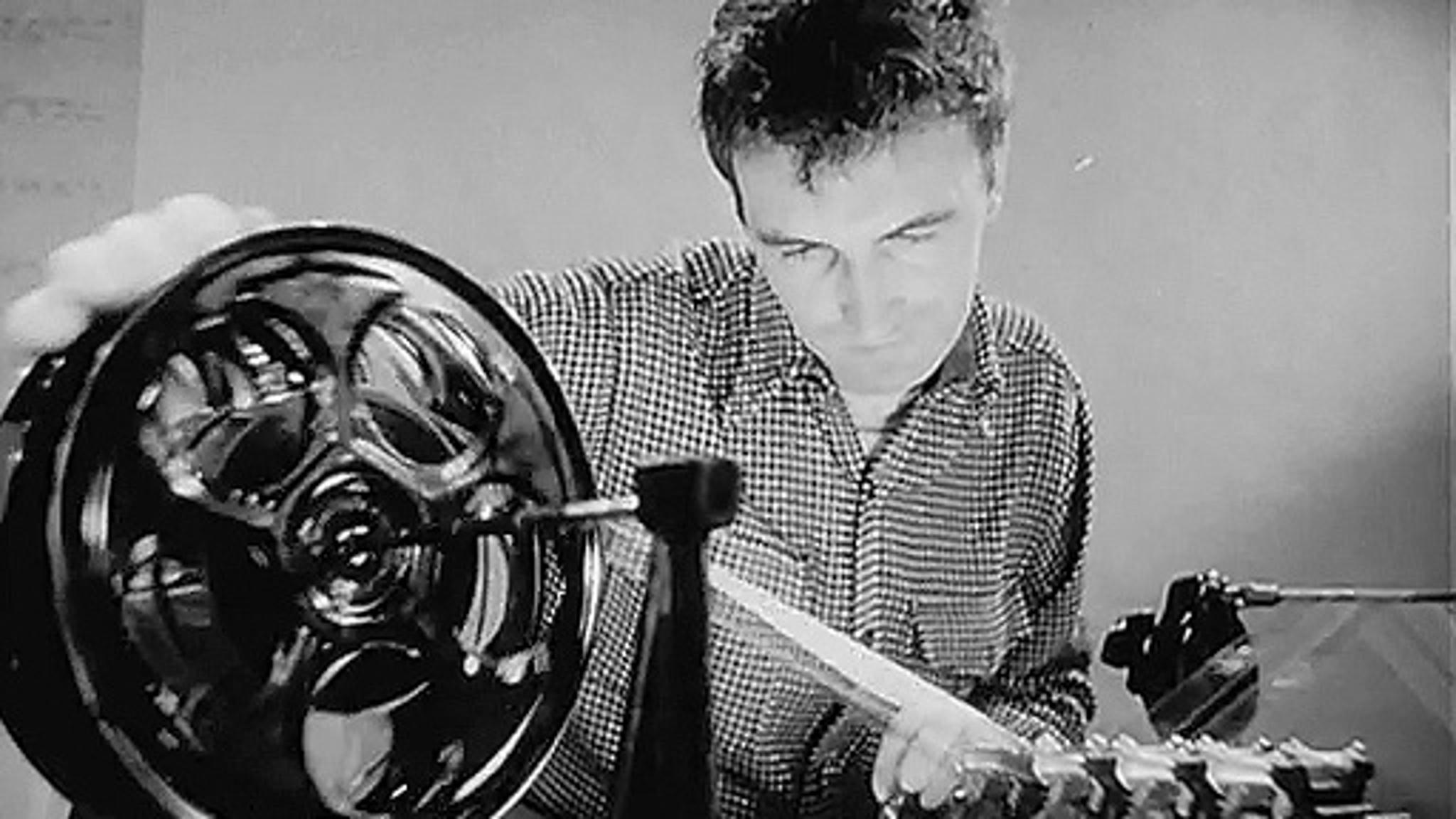
Norman McLaren discovered that sound on film did not necessarily have to be recorded with a microphone.

Optical film sound converts visual information on the soundtrack area of a film strip into audio. McLaren realised that if the system was reading shapes, he could create those shapes himself. He drew and scratched patterns directly into the optical soundtrack area and produced synthetic sounds without first generating them acoustically. The National Film Board’s Pen Point Percussion demonstrates exactly how the process works.

I love the directness of this.

Normally sound becomes an image only after software analyses it as a waveform or spectrum.

McLaren could move in the opposite direction.

Draw the image.

Hear what it sounds like.

That collapses animation and electronic composition into the same physical material.

A mark can simultaneously belong to cinema and music.

For contemporary audiovisual artists this remains a surprisingly useful idea. We often synchronise completed audio and completed visuals afterwards.

McLaren’s process suggests something deeper.

Design one system capable of generating both.

When sound and image share a source, synchronisation stops being an effect.

It becomes part of their anatomy.

https://www.nfb.ca/film/pen_point_percussion/

#NormanMcLaren #VisualMusic #ExperimentalFilm #OpticalSound

Drawing the Soundtrack With a Pen Drawing the Soundtrack With a Pen National Film Board of Canada Pen Point Percussion Norman McLaren explains how he makes synthetic sound on film. With an oscilloscope he first demonstrates what familiar sounds look like on the screen; next, how sound shapes …
Facebook LinkedIn WhatsApp Threads
More sharing options
X Reddit Pinterest Telegram Email
Experimental Film

Visual Music Before Computers

Mary Ellen Bute wanted abstract images to possess something painting could not give her: actual duration. She turned to film and, between the 1930s and 1950s, created abstract animations in which shapes, light and movement were organised in close relationship with music. Her work also included technological experiments involving oscilloscopes and electronic imagery. Several of her films reached audiences at places such as Radio City Music Hall, an unusual level of public exposure for experimental abstraction.

What interests me from a VJ perspective is how familiar the ambition feels.

We now open Resolume, TouchDesigner or After Effects and assume that sound can be translated into movement almost automatically.

Bute was asking similar questions before digital graphics existed.

What does a musical phrase look like?

Should a visual form follow rhythm literally?

Can colour behave like orchestration?

How can movement produce something equivalent to musical tension?

The technology changes dramatically, but those questions hardly change at all.

That is why early experimental film can be more useful to a contemporary VJ than another software tutorial.

Software teaches us how to make an effect.

Bute reminds us to ask why an image should move in the first place.

https://www.eastman.org/mary-ellen-bute-rhythms-light

#MaryEllenBute #VisualMusic #ExperimentalFilm #VJHistory

Visual Music Before Computers Visual Music Before Computers eastman.org Mary Ellen Bute wanted abstract images to possess something painting could not give her: actual duration. She turned to film and, between the...
Facebook LinkedIn WhatsApp Threads
More sharing options
X Reddit Pinterest Telegram Email
Culture Before Video Oskar

VJ Culture Before Video

Oskar Fischinger was experimenting with multiple projected images before electronic video existed.

During the 1920s, his Raumlichtmusik performances used several film and slide projectors simultaneously to create abstract moving environments. Elsewhere he explored single-frame animation, scratching directly onto film and even experiments in drawn optical sound.

This is where experimental-film history begins to overlap surprisingly well with modern VJ culture.

A contemporary VJ can run several video layers, blend them, map them onto architecture and synchronise them with music in realtime. Fischinger had none of that digital flexibility. Every additional projector was another physical machine, another film path and another alignment problem.

Yet the artistic question was already there.

Why should cinema consist of one rectangular image directly in front of a seated audience?

Once several projections begin occupying space, the screen stops being only a window. Light itself becomes material.

Fischinger later became famous for tightly synchronised abstract animation, but I find these earlier multiple-projection experiments even more interesting today.

The technology is obsolete.

The idea is not.

A century later, Resolume, projection mapping and immersive audiovisual performances are still exploring what happens when moving images escape from a single screen.

https://centerforvisualmusic.org/Fischinger/

#OskarFischinger #VisualMusic #ExpandedCinema #VJCulture

VJ Culture Before Video VJ Culture Before Video centerforvisualmusic.org Fischinger - CVM pages Oskar Fischinger was experimenting with multiple projected images before electronic video existed. During the 1920s, his Raumlichtmusik...
Facebook LinkedIn WhatsApp Threads
More sharing options
X Reddit Pinterest Telegram Email