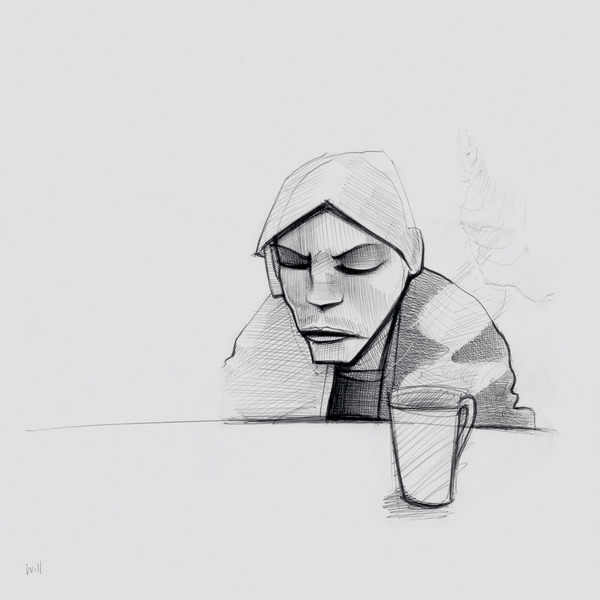
For the twentieth anniversary of Massive Attack’s Mezzanine, researchers at ETH Zurich translated the album’s digital audio into DNA.
The process sounds almost absurdly futuristic. The music was first compressed using the Opus codec. Its binary information was then converted into sequences based on the four DNA building blocks A, C, G and T. Around 920,000 short DNA strands were produced and encapsulated in microscopic silica spheres.
The whole album effectively became biological data.
What interests me is not the novelty of putting music into DNA. It is what this says about the idea of a recording.
We usually associate an album with its carrier.
Vinyl record.
Cassette.
CD.
Hard drive.
Stream.
But none of these is actually the music. Each one is simply a temporary system for storing instructions that can later be turned back into sound.
DNA makes that fact impossible to ignore.
Mezzanine can exist without grooves, magnetic particles, a waveform on a screen or even an object recognisable as music.
At that point an album starts resembling a genetic recipe.
Nothing inside the tiny glass particles sounds like Massive Attack.
The music only returns when another machine knows how to read the code.
A record is therefore not necessarily sound.
Sometimes it is the possibility of sound waiting inside information.
https://fml.ethz.ch/research/research/storing-mezzanine-in-dna.html