Skip to content

Painting for a Temple That Never Existed

Gamelan

One Rhythm Made by Many Hands

Gamelan is often described as an Indonesian percussion orchestra, but the word also refers to the collection of instruments itself. Ensembles typically combine hand-forged metal gongs, gong-chimes and metallophones with drums, cymbals and, depending on the tradition, strings and bamboo flutes. UNESCO notes that its music is organised through precise tuning systems, rhythmic structures and performance techniques. Individual instruments can play interlocking patterns that only become complete when heard together. Gamelan remains connected to ceremonies, theatre, festivals and concerts, and archaeological representations of musical ensembles appear on the eighth-century Borobudur temple.

That interlocking principle interests me. In much Western music we easily focus on the individual performer, melody or solo. Gamelan can make musical meaning feel distributed. No single player necessarily owns the rhythm we hear. The pattern exists because several people leave exactly the right spaces for one another.

https://ich.unesco.org/en/RL/gamelan-01607

#Gamelan #IndonesianMusic #Percussion #MusicTradition

ich.unesco.org Gamelan - UNESCO Intangible Cultural Heritage Gamelan refers to the traditional Indonesian percussion orchestra and to the set of musical instruments used. Consisting primarily of ornate, percussive instruments made of hand-forged metal, the ensemble typically includes xylophones, gongs, gong-chimes, drums, cymbals, string instruments and bamboo flutes. Gamelan music follows precise rules and techniques regarding tuning, layout, rhythmic and ...
Addis Ababa

When a Landscape Is Felt Physically

Ethiopian painter Tesfaye Bekele uses grass, flowers, leaves and seasonal change as more than landscape subjects. In Moments of Change, shown at Addis Fine Art in Addis Ababa in early 2026, repeated dots and layered lines produced surfaces that could resemble landscapes, aerial maps or constellations. The works were made with acrylic on canvas and textiles, with fabric connecting the paintings to ideas of bodily vulnerability, effort and care. Bekele grew up in Addis Ababa, studied at the Alle School of Fine Arts and Design and later taught there.

What stays with me is the decision to connect changes in nature with the way time is experienced by a body. We normally measure a season with dates, yet we recognise it through temperature, colour, smell, growth and disappearance. A landscape painting can therefore record much more than a place. It can describe what change feels like before we have found words for it.

https://addisfineart.com/exhibitions/136-moments-of-change-tesfaye-bekele/

#TesfayeBekele #EthiopianArt #Painting #AddisAbaba

City Music Born Between

A City Music Born Between Worlds

Rebetiko emerged in the urban centres and port cities of Greece during the early twentieth century, initially among working-class and marginalised communities. Its musical language did not grow from a single source. UNESCO describes a tradition shaped through exchanges among Greeks from Asia Minor and the Aegean and the Turkish, Jewish, Armenian, Balkan and Levantine communities of the former Ottoman world. Songs were originally transmitted mainly by listening, playing and learning directly from older musicians. Recordings, cinema, conservatories and universities later created additional ways of passing the repertoire on.

What interests me is how easily a music that begins on society’s margins can later become part of a country’s cultural identity. Rebetiko did not become valuable because somebody preserved it unchanged. It kept absorbing new surroundings, performers and technologies. Its history suggests that tradition may be strongest when it is flexible enough to travel without forgetting where it came from.

https://ich.unesco.org/en/RL/rebetiko-01291

#Rebetiko #GreekMusic #UrbanFolkMusic #MusicHistory

ich.unesco.org Rebetiko - UNESCO Intangible Cultural Heritage Rebetiko is a musical and cultural expression directly linked to song and dance that initially spread among the urban lower and working-class populations in the early twentieth century. Rebetiko songs are now a standardized repertoire in almost every social occasion involving music and dance. The element is performed in public and performers encourage audience participation. The practice is open t...
City Photographed Before

A City Photographed Before It Disappears

Memoria y relato. Fotografía en Puebla looks at photographs made in Puebla from the mid-nineteenth century through the 1940s, drawing from public and private collections and including professional photographers, amateurs, visitors and anonymous makers. Museo Amparo deliberately avoids presenting a complete history of photography. Instead, the exhibition follows smaller visual stories through which ideas of the city and its inhabitants were constructed. That approach becomes even more interesting because the museum has invited people in 2026 to add contemporary photographs of Puebla to a “living archive.” Historical photographs can easily acquire an authority they never possessed when they were made. They seem to tell us what a place was. But every photograph is also a choice about what deserved to enter the frame. Placing old images beside contemporary contributions reminds us that a city is never finished being photographed, and its visual history is never complete.

https://museoamparo.com/exhibitions/pieces/313/memory-and-tale-photography-in-puebla

#Photography #Puebla #MexicanPhotography #VisualHistory

museoamparo.com Memoria y relato. Fotografía en Puebla | Exposiciones | exposiciones actuales | Museo Amparo, Puebla Organizada en el marco del 35 aniversario del Museo Amparo, esta exposición indaga en el vasto universo de fotografías producidas en Puebla desde me ...
Maria Taniguchi

Painting Time One Rectangle at a Time

Maria Taniguchi’s ongoing “brick paintings” are built from thousands of small hand-drawn rectangular cells, individually filled with paint. Some of the canvases become enormous, yet their structure comes from an almost modest repeated action. Afterimage, at Singapore Art Museum until 22 November 2026, is the first monographic exhibition of Taniguchi presented by a Singapore museum and brings these paintings together with sculpture and video. The rectangles are not mechanically printed. Their subtle differences accumulate across days, weeks and sometimes months of work. Taniguchi considers the paintings individual parts of one continuing artwork rather than isolated compositions. I like what that does to repetition. From a distance the surface can appear systematic, almost architectural. Up close, the system becomes a record of labour and duration. Nothing dramatic needs to happen from one cell to the next. Time becomes visible precisely because the gesture changes so little.

https://www.singaporeartmuseum.sg/en/art-events/exhibitions/maria-taniguchi-afterimage

#MariaTaniguchi #PhilippineArt #Painting #SingaporeArt

singaporeartmuseum.sg Maria Taniguchi: Afterimage | Singapore Art Museum Maria Taniguchi: Afterimage is the first monographic exhibition of the acclaimed artist presented by a Singaporean institution.
Abstract Art

Painting for a Temple That Never Existed

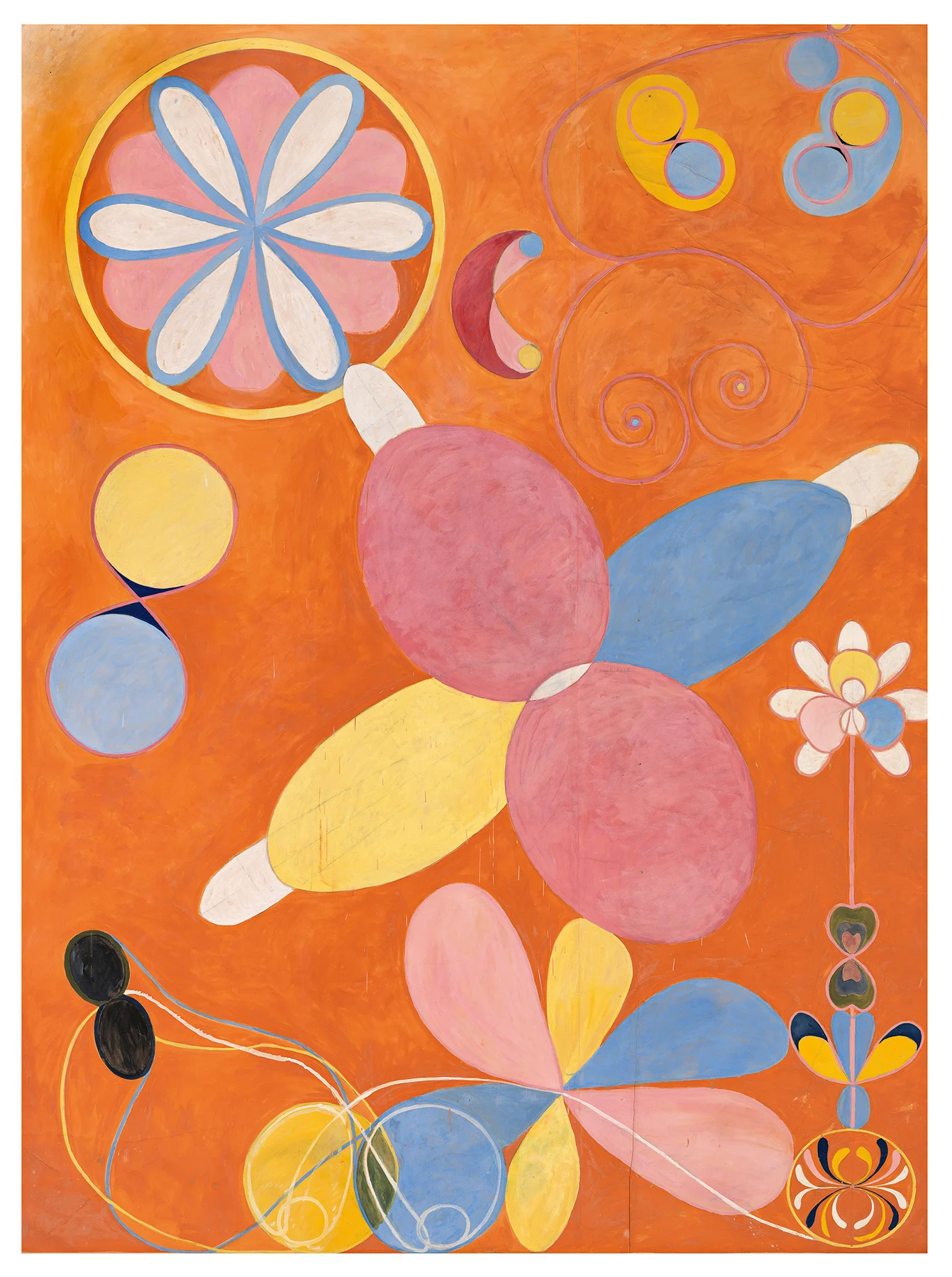
Hilma af Klint began The Paintings for the Temple in 1906, creating a vast cycle of works filled with spirals, circles, botanical forms, letters and vivid colour long before abstraction became established in European modernism. The current Grand Palais exhibition in Paris brings this cycle to France for the first time, including the monumental The Ten Largest. What interests me is that these paintings were not originally conceived for the art world as we know it. Af Klint imagined them for a spiritual temple that was never built, while her public career remained largely figurative. She also stipulated that much of this work should not be shown until years after her death. That changes how I look at the paintings. They were not attempts to anticipate an art movement or win a place in modernist history. Geometry, colour, science and spiritualism became tools for trying to picture something she believed existed beyond ordinary sight.

https://www.grandpalais.fr/en/program/hilma-af-klint-paintings-temple-1906-1915

#HilmaAfKlint #AbstractArt #ModernArt #ParisArt

Grand Palais Hilma af Klint, paintings for the Temple (1906-1915) Her work upended the chronology of modern art. For the first time in France, discover the visionary world of Hilma af Klint (1862?1944), a pioneer of abstraction long kept in the shadows. From her large-scale compositions to her secret avant-garde works, her art blends color, form, and symbolism with captivating audacity.
Conceptual Art

Sweetness That Refuses to Stay Still

Felix Gonzalez-Torres built some of his most affecting works from materials that seem almost too ordinary for a museum: wrapped candies, stacks of paper, strings of lights, curtains and billboards. Sweet Revenge, at Madrid’s Museo Reina Sofía until 12 October 2026, brings together more than fifty works and is his first large-scale presentation in the city. Madrid carries particular weight in his biography. Gonzalez-Torres was sent there from Cuba in 1971 before moving to Puerto Rico, and when he returned almost twenty years later he premiered “Untitled” (Revenge), a spill of blue candies.

What interests me is how instability becomes part of the work rather than something a museum must prevent. Visitors can take sheets of paper or candies. The works diminish and may be replenished. Ownership does not produce one permanent physical object. Gonzalez-Torres created rules, but those rules deliberately leave space for change. That combination of tenderness and structure feels especially powerful in work shaped by love, loss, the AIDS crisis and the conservative politics of the 1980s and 1990s. The work can disappear in your hand and still remain the work.

https://www.museoreinasofia.es/en/exhibition/felix-gonzalez-torres/

#FelixGonzalezTorres #ConceptualArt #ContemporaryArt #MadridArt

museoreinasofia.es Felix Gonzalez-Torres Sweet Revenge is the first large-scale presentation of Felix Gonzalez-Torres (1957–1996) in Madrid. The work of the Cuban-born, American artist’s emotive and political practice continues to resonate today in powerful ways. The city of Madrid was an emotionally fraught site for Gonzalez-Torres, one he contemplated in his early work and referenced throughout his all-too-brief career. In 1971, he was sent to Spain as part of a program to transport children out of Cuba to escape the regime. He stayed in Madrid for a brief period of time before relocating to Puerto Rico and later New York city, where he would spend most of his adult life. He did not return to Madrid until 1991 on the occasion of a group exhibition. For this show, he premiered the sculpture “Untitled” (Revenge), a spill of crystal blue candies. Reflecting on his first return to the city, he wrote, “went back to Madrid after almost twenty years — sweet revenge.” This major exhibition of Gonzalez-Torres’s work uses the paradox of “sweet revenge” as the methodological lens through which to understand his powerful uses of difference, contradiction, and paradox across the different bodies of work that comprise his oeuvre. The refined beauty of his aesthetic vocabulary, for instance, is often tempered or enhanced by the parenthetical parts of titles he ascribed to the individual pieces, invoking references to diverse topics such as romance, war, and illness as well as contested social and political narratives, which remain visually unarticulated. Similarly, the protocols governing his give-away, endlessly replenishable paper stacks and candy spills, or the installation of his curtains, billboards, and light strings (all objects included in this exhibition) are structured yet flexible—leaving room for contingency and reinterpretation. The central framework of Sweet Revenge is to demonstrate how Gonzalez-Torres’s work consistently sustains multiple, often seemingly opposing conditions at once. The tension between these terms is not incidental but central to how the work activates critical reflection. As a queer artist working at the height of the AIDS crisis, and within a political climate in the U.S. shaped by the conservative right, the work of Gonzalez-Torres employs a visual language that is purposefully unstable, participatory, and personal. In his elegiac work, the death of his lover to AIDS in 1991 was fundamental. The artist mourned his loss as much as he celebrated their love; the work articulates and enacts this. Gonzalez-Torres’s knowledge of his own impending death from AIDS afforded him the opportunity to contemplate the future of his work, leaving an influential legacy that transforms aesthetic forms into vehicles for both emotional resonance and political urgency. 
Empty Fiji Museum’s Voyages

The Ocean Was Never Empty

Fiji Museum’s Voyages: Stories of an Ocean People places maritime knowledge at the centre of Fijian history, from early Lapita navigation to iTaukei voyaging and later migrations. What stays with me is how differently the ocean appears when it is understood as a route rather than a barrier. On many maps, islands look isolated by huge areas of blue. For generations of Pacific navigators, that same water connected communities through knowledge of currents, stars, weather and vessels. Geography changes when you change the knowledge used to read it.

Our Exhibitions

#FijiMuseum #PacificCulture #OceanicArt #MaritimeHistory

Arctic Art

Light as a Form of Resistance

The National Gallery of Canada’s Qillaniq brings together more than seventy contemporary artists from the circumpolar Arctic. Its title is an Inuktitut word describing light shimmering on water. I like that image because the exhibition uses brightness rather than darkness as a way to speak about resilience. Indigenous contemporary art is too often framed primarily through loss or historical damage. Joy, humour, imagination and continuity can be equally political. Survival is not only the preservation of what existed before. It is also the freedom to keep inventing what comes next.

https://www.gallery.ca/

#Qillaniq #IndigenousArt #CanadianArt #ArcticArt

Architecture Art

Rebuilding a House at Full Scale

For Obras extraordinarias in Santiago, Carolina Illanes reconstructs a fragment of a politically charged residence at full scale while working with housing archives and documents. The gesture fascinates me because architecture becomes evidence. A room is never only walls and dimensions; it can contain assumptions about power, privacy and who is allowed to occupy space comfortably. Rebuilding part of a structure inside a museum does not simply reproduce architecture. It removes the building from normal use so that its politics become much harder to ignore.

Obras extraordinarias

#CarolinaIllanes #ChileanArt #ArchitectureArt #Santiago

African Art

Dakar Looking Forward Again

The Dakar Biennale returns in November 2026 for its sixteenth edition, continuing a history that has made the city an important platform for contemporary African art and its diasporas. What interests me is not simply the scale of a biennale, but what happens when an international art event grows from a cultural history that predates the current global exhibition circuit. Dakar connects contemporary practice to earlier Pan-African cultural ambitions. A biennale can be temporary, yet the conversations it keeps reopening may last much longer than the exhibition itself.

PRESS RELEASE

#DakArt #SenegalArt #AfricanArt #Dakar

BIENNALE DE L'ART AFRICAIN CONTEMPORAIN PRESS RELEASE - BIENNALE DE L'ART AFRICAIN CONTEMPORAIN The Government of Senegal, through the Ministry of Culture, Crafts, and Tourism, is pleased to announce the organization of the 16th edition of the Biennale of Contemporary African Art, which will take place in Dakar from November 19 to December 19, 2026. Recognized as one of the most prominent artistic events on the international stage, […]