Skip to content

An Album With Almost No Ground

Album Becomes

When an Album Becomes an Instrument

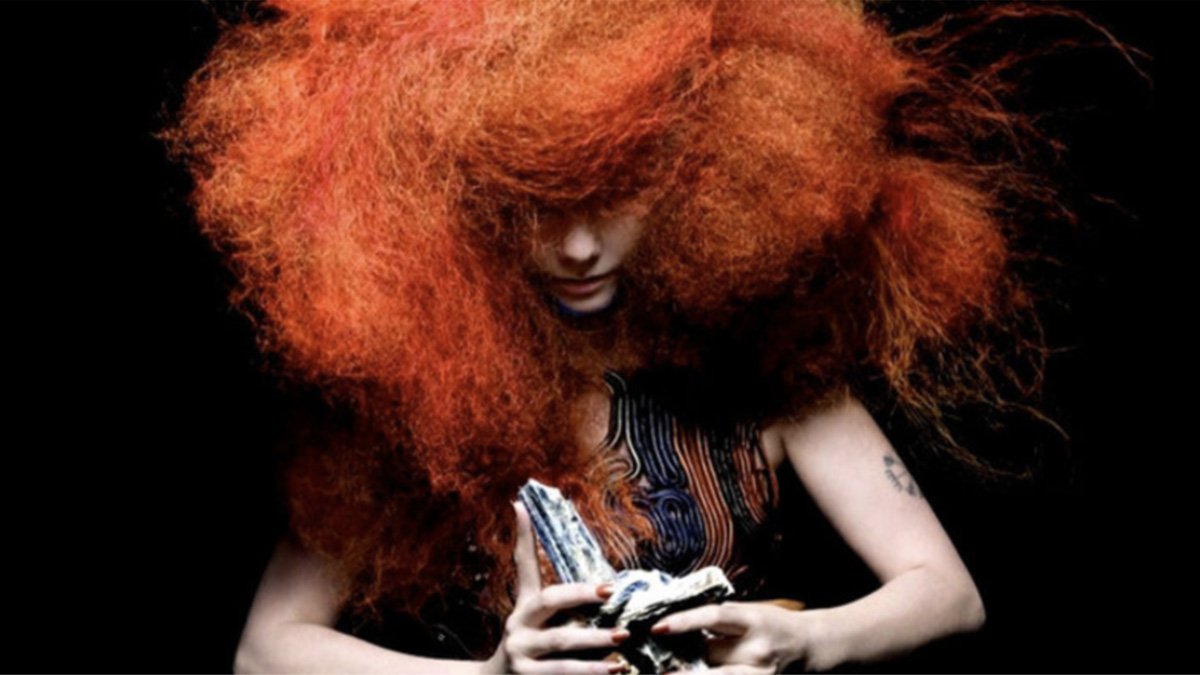
With Biophilia, Björk treated an album as something that could be entered, touched and changed. Released in 2011, the project connected ten songs to interactive apps exploring relationships between musical structures and natural phenomena. The live version pushed that idea into physical space with custom instruments: pendulum harps used gravity to pluck strings, Tesla coils produced pitched electrical arcs, and a modified celeste incorporated bronze gamelan bars. The project also included educational workshops rather than limiting itself to concerts.

What interests me is how Biophilia refuses to decide where the music actually lives. Is it in the recording, the app, the instrument, the physical force producing the sound, or the listener interacting with it? Most albums arrive as finished objects. Here the musical idea becomes a system that can be explored from several directions. Technology is not simply used to decorate the music. It becomes a way of making musical structure visible and playable.

https://www.snibbe.com/apps/biophilia

#Bjork #Biophilia #InteractiveMusic #MusicTechnology

Scott Snibbe BJÖRK: BIOPHILIA — Scott Snibbe - Interactive Art Biophilia by Björk is the world’s first app album: a multimedia exploration of music, nature and technology.
Belize Culture

When History Has to Be Sung

Garifuna music carries the history of a people whose ancestry combines Indigenous Caribbean and African cultures. After being forced from Saint Vincent in the eighteenth century, Garifuna communities established themselves along the Atlantic coasts of Belize, Guatemala, Honduras and Nicaragua. UNESCO describes songs accompanied by drums and dance whose texts preserve knowledge about fishing, cassava cultivation, canoe building, house construction and community history. Satire also plays a role, and spectators may enter the dancing rather than remain outside the performance.

That makes the music more than entertainment or even heritage in the usual museum sense. A song can function as memory storage. Knowledge that might otherwise require books, maps or archives remains attached to melody, language, rhythm and repeated performance. The danger is equally clear: migration, discrimination and declining use of the Garifuna language threaten the system that carries those songs. When a language disappears, music may lose more than lyrics. It can lose part of the world those lyrics know how to describe.

https://ich.unesco.org/en/RL/language-dance-and-music-of-the-garifuna-00001

#GarifunaMusic #BelizeCulture #TraditionalMusic #CaribbeanHeritage

Ignore Pacita Abad’s Flight

A Painting Too Large to Ignore

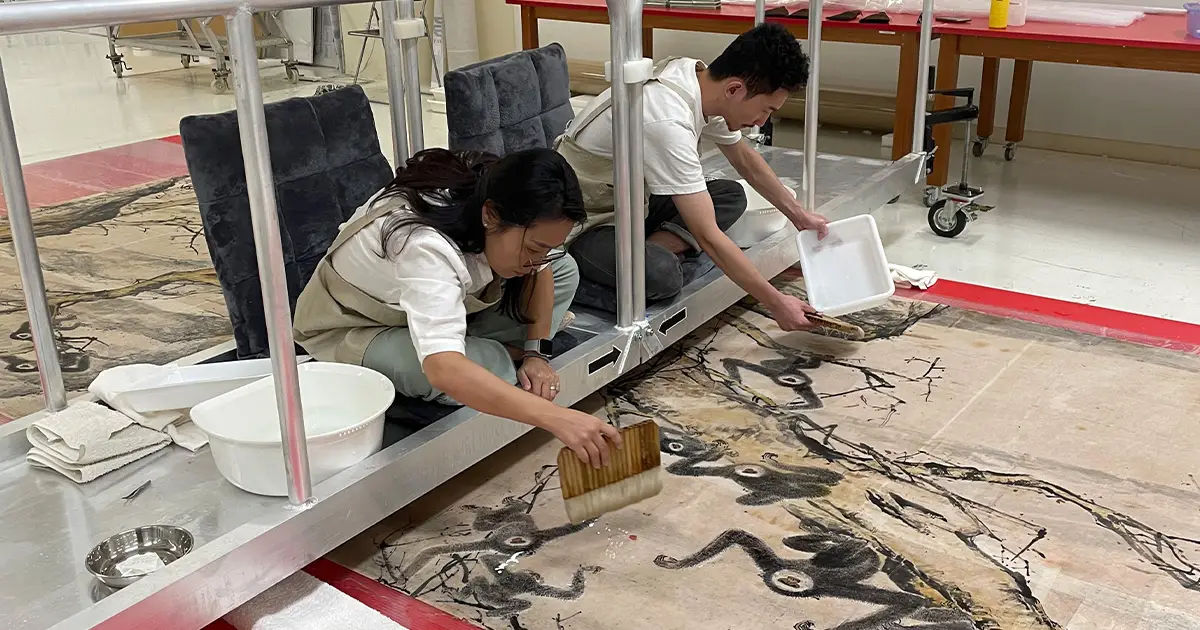
Pacita Abad’s Flight to Freedom grew from her encounters with Cambodian refugees near the Thai border around the period of the Cambodian-Vietnamese conflict. The monumental painting shows a mass of displaced people moving across the landscape, turning migration into something physically difficult to overlook. National Gallery Singapore describes it as one of Abad’s significant social realist works and notes that the Cambodian Refugees series developed from situations she witnessed directly.

Abad later became especially known for colourful stitched and stuffed trapunto paintings, but this earlier work shows another side of her practice. What stays with me is the scale. News photographs of refugees are often consumed quickly, one image among thousands. A painting several metres wide changes that relationship. You cannot absorb the crowd in a glance. Individual figures become part of a collective movement while still resisting disappearance into statistics. Scale becomes an ethical decision about how long an image asks us to look.

https://www.nationalgallery.sg/sg/en/learn-about-art/art-conservation.html

#PacitaAbad #PhilippineArt #SocialRealism #SoutheastAsianArt

National Gallery Singapore Art Conservation | National Gallery Singapore At National Gallery Singapore, art conservation is more than a practice — it’s a commitment to preserving our cultural treasures for future generations.
Barkcloth

Painting With the Bark of a Tree

Samoan siapo begins long before any pattern appears. Makers use the inner bark of the u’a, or paper mulberry tree, scraping and pounding it until thin strips expand into cloth. Separate pieces can then be joined into larger surfaces. Decoration may be drawn freehand or transferred by rubbing the cloth across a relief board called an upeti. Traditional colours can come from soot, tree bark, turmeric, plant seeds and other natural sources. Siapo is still exchanged at ceremonies, weddings and funerals.

I like how difficult it is to separate image from material here. The surface is not a neutral support waiting for an artist to begin. Growing, harvesting, pounding, joining and dye-making are already part of what the finished pattern contains. Even the repeated motifs often refer back to plants and animals. In digital work we can choose a colour with one click and forget where colour comes from. Siapo makes the opposite visible: an image can begin in a tree, an earth pigment and hours of physical preparation before the first deliberate mark appears.

https://collections.tepapa.govt.nz/object/84881

#Siapo #SamoanArt #Barkcloth #PacificArt

collections.tepapa.govt.nz Siapo (tapa cloth) Find out more about Siapo (tapa cloth) at Collections Online - Museum of New Zealand Te Papa Tongarewa
Czech Art

War Drawn as a Dream

Toyen created the nine-part drawing cycle Hide Away, War! in 1944 during the Nazi occupation of Czechoslovakia. The National Gallery Prague describes a world filled with anxiety, threat and destruction, yet Toyen avoided straightforward documentation of wartime suffering. In the drawings, skeletal animal forms inhabit dry, strangely open landscapes and can appear almost alive. The scenes are rendered with enough precision to feel real while remaining impossible.

That choice interests me. Direct representation can tell us what an event looked like. Surrealism can approach something harder to document: what persistent danger does to imagination. When ordinary reality becomes threatening enough, perhaps the nightmare no longer needs exaggerated monsters. A skeleton behaving as if it were alive can be enough. Toyen’s drawings do not remove themselves from history by becoming dreamlike. They show how history can invade the dream.

https://sbirky.ngprague.cz/en/dielo/CZE%3ANG.K_55325

#Toyen #CzechArt #Surrealism #Drawing

Album With Almost

An Album With Almost No Ground

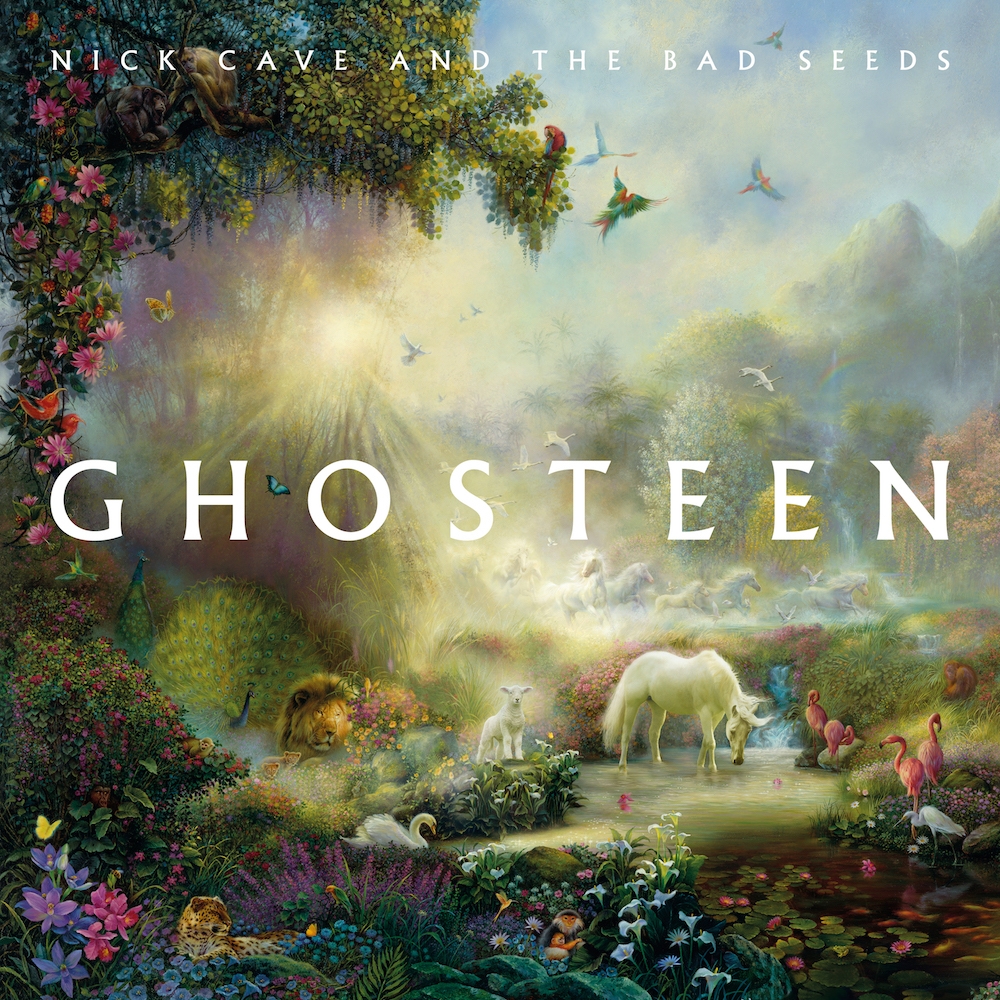
Nick Cave & The Bad Seeds recorded Ghosteen during 2018 and early 2019 across studios in Malibu, Los Angeles, Brighton and Berlin. Its instrumentation includes piano, synthesizers, loops, flute, violin, bass, percussion, vibraphone and guitar, yet much of the album feels unusually weightless. Cave divided it into two parts, describing the first group of songs as “the children” and the second as “their parents.” The record arrived in 2019 after a period in which grief had become inseparable from his writing.

What I keep noticing is how the arrangements often avoid giving the songs a firm floor. Synthesizers and sustained textures can float around the voice rather than locking everything into a conventional rock structure. Even with drums and bass available, space becomes one of the dominant musical materials. That makes Ghosteen interesting from a production perspective as well as an emotional one. Removing weight can sometimes make music feel larger. The arrangement does not need to tell us what grief sounds like. It creates a space where certainty itself seems difficult to hold.

Ghosteen

#NickCave #Ghosteen #MusicProduction #AustralianMusic

Nick Cave Ghosteen - Digital | Nick Cave Buy from the Official Website. A transcendent double album from Nick Cave & The Bad Seeds, exploring loss and hope.
Afro Uruguayan Culture

Three Drums, One Moving City

Candombe is inseparable from the sound of drums moving through Montevideo. The Uruguayan tradition combines music and dance and carries a strong African heritage. Three historic neighbourhoods, Barrio Sur, Palermo and Cordón, developed their own approaches to the drum rhythm, and the annual Desfile de las Llamadas brings comparsas into the streets. Yet candombe does not exist only during the parade. Rehearsals and neighbourhood gatherings continue throughout the year.

What interests me is what happens when rhythm is not confined to a stage. A procession changes acoustics constantly. Buildings reflect the drums differently, spectators move alongside the players, distance alters which parts of the pattern become dominant. The city itself becomes part of the mix. That makes candombe difficult to reduce to an audio recording alone. The recording preserves rhythm, but not the experience of hearing it approach from another street, grow physically larger and then disappear again. Music can occupy architecture without ever needing a concert hall.

CANDOMBE

#Candombe #UruguayanMusic #Montevideo #AfroUruguayanCulture

Drawing With Empty Space

Drawing With Empty Space

Ruth Asawa described her looped-wire sculptures as a way of taking a two-dimensional line into three-dimensional space. Her technique grew from seeing basket makers work with wire during a 1947 trip to Mexico. Back in the United States she developed that looping process into suspended forms built from ordinary industrial materials such as iron, copper and brass wire. In a work from around 1958 now in SFMOMA’s collection, a continuous mesh expands and contracts into nested lobes while remaining transparent enough for the room to pass visually through it.

That transparency may be the most interesting material in the sculpture. Traditional sculpture often defines a solid mass against surrounding emptiness. Asawa gives the emptiness a shape of its own. Light and shadow complicate it further: the wire produces another changing drawing on nearby surfaces. A sculpture can therefore occupy space without filling it. The object and the air inside it become equally necessary.

Untitled (S.114, Hanging Six-Lobed Continuous Form within a Form with an Open Collar and Spheres in the Second, Third, and Fifth Lobes)

#RuthAsawa #WireSculpture #SanFranciscoArt #Sculpture

SFMOMA Untitled (S.114, Hanging Six-Lobed Continuous Form within a Form with an Open Collar and Spheres in the Second, Third, and Fifth Lobes) Explore the artists and artworks of our time at the San Francisco Museum of Modern Art.
Fiddle That Remembers the

A Fiddle That Remembers the Horse

The Mongolian morin khuur has only two strings, but the horse is present throughout the instrument. Its long fretless neck ends in a carved horse head, while traditional strings and bow hair are made from horsehair. The instrument can be played alone or accompany long song, dance, stories, ceremonies and activities connected with horses. UNESCO even records tunes known as tatlaga that were traditionally played in relation to taming animals.

What fascinates me is how thoroughly an environment can enter an instrument. The horse is not simply decoration added to the top of the neck. It appears in the material, symbolism, repertoire and cultural world surrounding the sound. Musical instruments are often discussed mainly through pitch range or playing technique, but they can also function as compact archives of a way of life. Change the materials, social setting and daily relationship with animals, and something larger than the timbre may change. The morin khuur reminds me that an instrument can carry a landscape even when it is played indoors.

https://www.unesco.org/archives/multimedia/document-3754

#MorinKhuur #MongolianMusic #TraditionalInstrument #HorseFiddle

UNESCO Multimedia Archives Morin Khuur - Horse Fiddle: Mongolian traditional musical instrument The design of the Morin Khuur is closely linked to the all-important cult of the horse. The instrument's hollow trapezoid-shaped body is attached to a long fretless neck bearing a carved horse head at its extremity. Just below the head, two tuning pegs jut out like ears from either side of the neck. The soundboard is covered with animal skin, and the strings and bow are made of horsehair. The instrument's characteristic sound is produced by sliding or stroking the bow against the two strings. Common techniques include multiple stroking by the right hand and a variety of left-hand fingering. It is mainly played in solo fashion but sometimes accompanies dances, long songs (urtiin duu), mythical tales, ceremonies and everyday tasks related to horses. To this day, the morin khuur repertory has retained some tunes (tatlaga) specifically intended to tame animals. Owing to the simultaneous presence of a main tone and overtones, morin khuur music has always been difficult to transcribe using standard notation. It has been transmitted orally from master to apprentice for many generations.
Bruce Onobrakpeya

Inventing a Script for Images

Bruce Onobrakpeya’s Ibiebe works contain a writing system that looks ancient but was actually invented by the Nigerian artist himself. He developed and refined the script between 1978 and 1986, creating geometric and curving signs informed by Urhobo symbols and the proverbs connected to them, while also responding to Chinese and Japanese calligraphy. In Ibiebe ABC III from 2000, the glyphs sit inside a checkerboard structure, functioning simultaneously as marks that suggest communication and as visual forms.

I like the uncertainty this creates. We instinctively try to read anything arranged like writing, even when we do not possess the key. Onobrakpeya makes that desire to decode part of the experience. The symbols connect to cultural knowledge, yet they also belong to an individual artistic language he deliberately constructed. Writing normally tries to stabilise meaning. Here it opens another possibility: a sign can communicate through rhythm, shape and association before we know exactly what it says.

https://africa.si.edu/collection/object/nmafa_2005-7-1

#BruceOnobrakpeya #NigerianArt #Printmaking #VisualLanguage

Canto ATenore

Four Voices Inside One Circle

Sardinia’s canto a tenore is built from four male voices: bassu, contra, boche and mesu boche. The singers stand close together, while one voice carries poetry or prose and the others construct the surrounding harmony. The deep, guttural sound of bassu and contra gives the music a physical weight that feels very different from conventional choral singing. The tradition developed within Sardinia’s pastoral culture, particularly around Barbagia, and could be heard not only at weddings, religious festivities and carnival but spontaneously in local bars. Its repertoire includes old poetry as well as texts about contemporary subjects such as unemployment, migration and politics.

What interests me is how much the music depends on proximity. Four separate voices have to become one acoustic object, yet each retains a precise role. UNESCO also notes a tension that many living traditions face: taking the music onto stages for visitors can help it survive while changing the intimate context that shaped it. Preservation is rarely as simple as keeping the notes unchanged. Sometimes the room, the people standing around you and the reason for singing are part of the composition too.

https://unesco.cultura.gov.it/en/projects/canto-a-tenore-sardinian-pastoral-songs/

#CantoATenore #SardinianMusic #PolyphonicSinging #ItalianMusic