Skip to content

Bodies Inside the Projection

Aether

One Projector, Three Dimensions

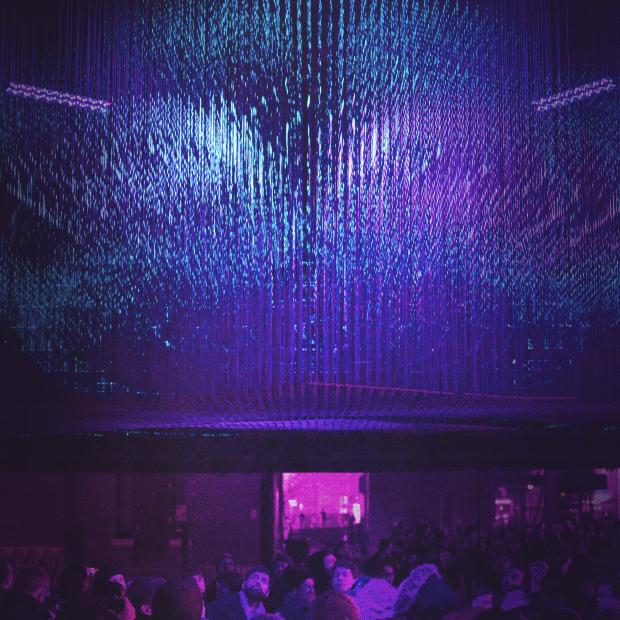
Max Cooper and Architecture Social Club built Aether from an unexpectedly economical illusion. Thousands of lines of string hang in space while a single projector sends light through them. From a distance, the illuminated intersections resemble a three-dimensional matrix of LEDs. Up close, the material construction becomes visible.
The installation turns projection into an object that can be entered and viewed from different positions. Visitors walk below and around a changing lattice while Cooper’s music is mapped to waves, surfaces and symmetrical forms. Image and sound share spatial behaviour rather than matching through a sequence of obvious beat triggers.
Its strongest lesson may be material rather than digital. Projection mapping is often discussed as a software problem, but the receiving surface determines what the software can achieve. String catches only fragments of the projected image. The empty space between the threads does as much work as the illuminated material.
For small installations, this suggests testing cheap physical structures before adding more projectors. Mesh, translucent fabric, fishing line or layers of scrim can divide one beam into several apparent depths. The projector remains flat. The material teaches the light to occupy space.

https://maxcooper.net/aether

#MaxCooper #Aether #LightInstallation #ProjectionArt #ElectronicMusic
One Projector, Three Dimensions One Projector, Three Dimensions Max Cooper Max Cooper – Aether light installation The light installation created in collaboration with Architecture Social Club
Facebook LinkedIn WhatsApp Threads
More sharing options
X Reddit Pinterest Telegram Email
Audiovisual Installation

Light Without a Screen

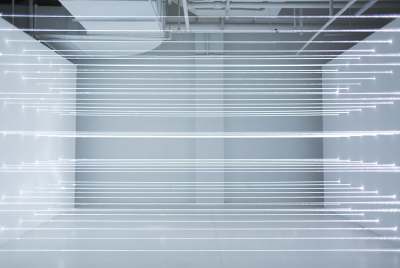
NONOTAK’s ZERO POINT TWO V.2 uses a sparse arrangement of horizontal light lines. There is no image in the conventional sense and no screen carrying a rectangular composition. Light appears to float in the room, moving quickly enough to suggest a volume that is present for a moment and then gone.
For a VJ, the work separates visual density from intensity. A nearly empty field can feel charged when position, brightness, speed and sound are tightly controlled. Test the principle with one thin line on black. Let its width, position and luminance respond differently to sound rather than connecting every parameter to the same amplitude value. The aim is not to imitate NONOTAK, but to discover how little visual information a room actually needs.

https://nonotak.com/_ZERO-POINT-TWO-V-2

#NONOTAK #LightArt #SoundAndLight #MinimalVisuals #AudiovisualInstallation

Light Without a Screen Light Without a Screen nonotak.com _ZERO POINT TWO V.2 - NONOTAK studio ZERO POINT TWO V.2, light & Sound installation, 2017 In ZERO POINT TWO, the abstract matter that is light is precisely sculptured to take shape in the most delicate and slender lines imaginable. Using a minimal sparse arrangement of horizontal...
Facebook LinkedIn WhatsApp Threads
More sharing options
X Reddit Pinterest Telegram Email
Audiovisual Art

Bodies Inside the Projection

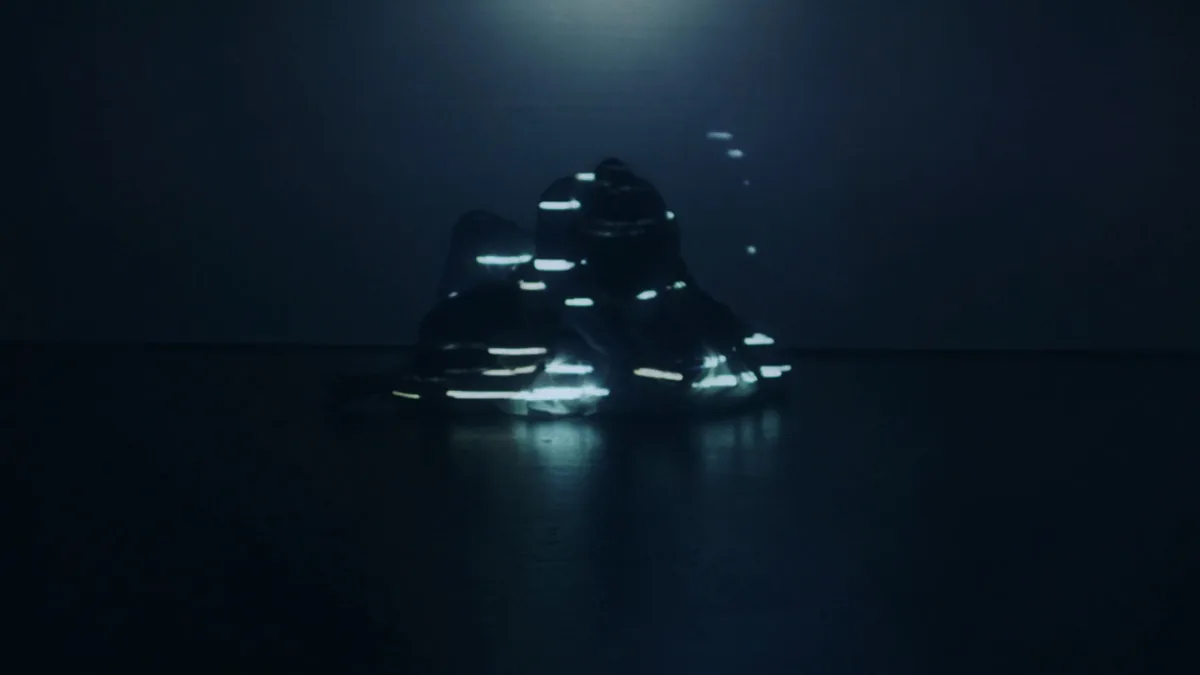
For Nosaj Thing’s “Eclipse/Blue,” Daito Manabe did not treat projected graphics as a backdrop added after choreography. Working with choreographer MIKIKO and two dancers, he built a visual environment in which bodies, shadows and geometric light appear to exchange control. A movement seems to pull an image into place. Moments later, the projection hides or multiplies the body that initiated it.
The effect depends on restraint. Large areas remain dark, so a narrow blue line or a white silhouette can alter the whole stage. The dancers do not compete with a permanently busy screen. Their movement determines when the image needs detail and when an empty field carries more tension.
This is a valuable principle for live visuals. Audio reactivity alone does not create a relationship between performance and image. A stronger system identifies a small number of meaningful events: a hand reaching a position, a body crossing a boundary, a vocal entrance or a sudden pause. Visual response then becomes choreography rather than decoration.
The exact boundary between live projection and post-production is intentionally difficult to read in the finished work. That uncertainty is part of its force. The screen does not illustrate the dancers. It makes their physical space unstable.

https://daito.ws/en/archive/nosaj_thing_eclipse_blue/

#DaitoManabe #NosajThing #EclipseBlue #ProjectionMapping #AudiovisualArt

Bodies Inside the Projection Bodies Inside the Projection daito.ws Nosaj Thing “Eclipse Blue” | Archive | Daito Manabe "Eclipse Blue" Nosaj Thing feat. kazu makino youtube: article: http://www.fastcodesign.com/1671348/a-stunning-music-video-inspired-by-a-solar-eclipse#1 http://www.theverge.com/2012/11/27/3698842/watch-this-nosaj-thing-e…
Facebook LinkedIn WhatsApp Threads
More sharing options
X Reddit Pinterest Telegram Email
BYOB

BYOB Opens the Walls

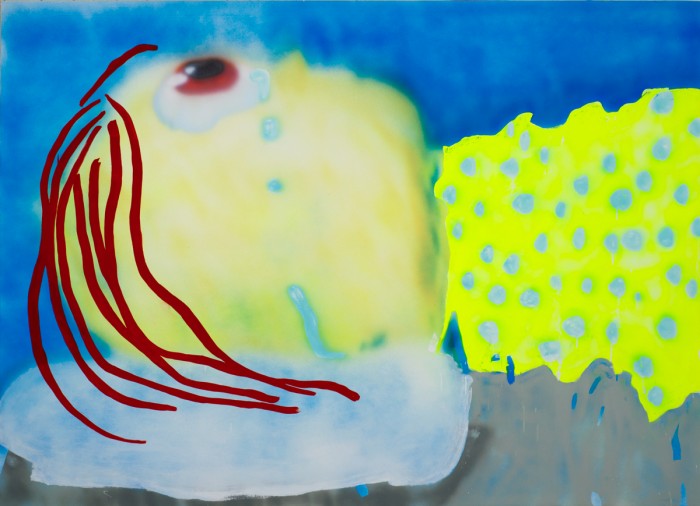
BYOB began from a practical observation. Rafaël Rozendaal was living in Berlin and noticed that many artists around him owned projectors. Instead of waiting for a museum to supply equipment, walls and a finished curatorial structure, he and Anne de Vries invited artists to bring their own beamers to a one-night exhibition in 2010. The instruction was deliberately simple: find a space, invite many artists, ask them to bring a projector.
That simplicity changed the social structure of the exhibition. Each projector created a temporary territory, but light could overlap, spill across architecture or collide with another work. Installation happened quickly and remained visible as a process. Cables, tables and improvised surfaces were not backstage problems. They became part of an event assembled by the participants themselves.
Rozendaal kept BYOB as an open format rather than a protected franchise. It travelled to other cities because the idea could be repeated without reproducing the original exhibition exactly. The projector was both display device and admission ticket.
For a contemporary VJ, BYOB still offers a useful correction to the pressure for ever larger screens. A strong projection does not begin with scale. It begins with a clear relationship between image, surface, neighbouring light and the people moving through the room.

Austin Lee interviews Rafaël Rozendaal for SFAQ magazine

#BYOB #RafaelRozendaal #ProjectionArt #DigitalArt #VJCulture

BYOB Opens the Walls BYOB Opens the Walls Rafaël Rozendaal Austin Lee interviews Rafaël Rozendaal for SFAQ magazine - Rafaël Rozendaal Austin Lee interviews Rafaël Rozendaal for SFAQ magazine. New York, February 2014. AL: Your artwork has strong ties to both painting and animation. How do you think about time in both mediums and how does it function in your work? RR: I’m interested in movement, and I’m interested in staring. That means I want to […]
Facebook LinkedIn WhatsApp Threads
More sharing options
X Reddit Pinterest Telegram Email
95MINDJERES

The Beat Remembers Ninety-Five Women

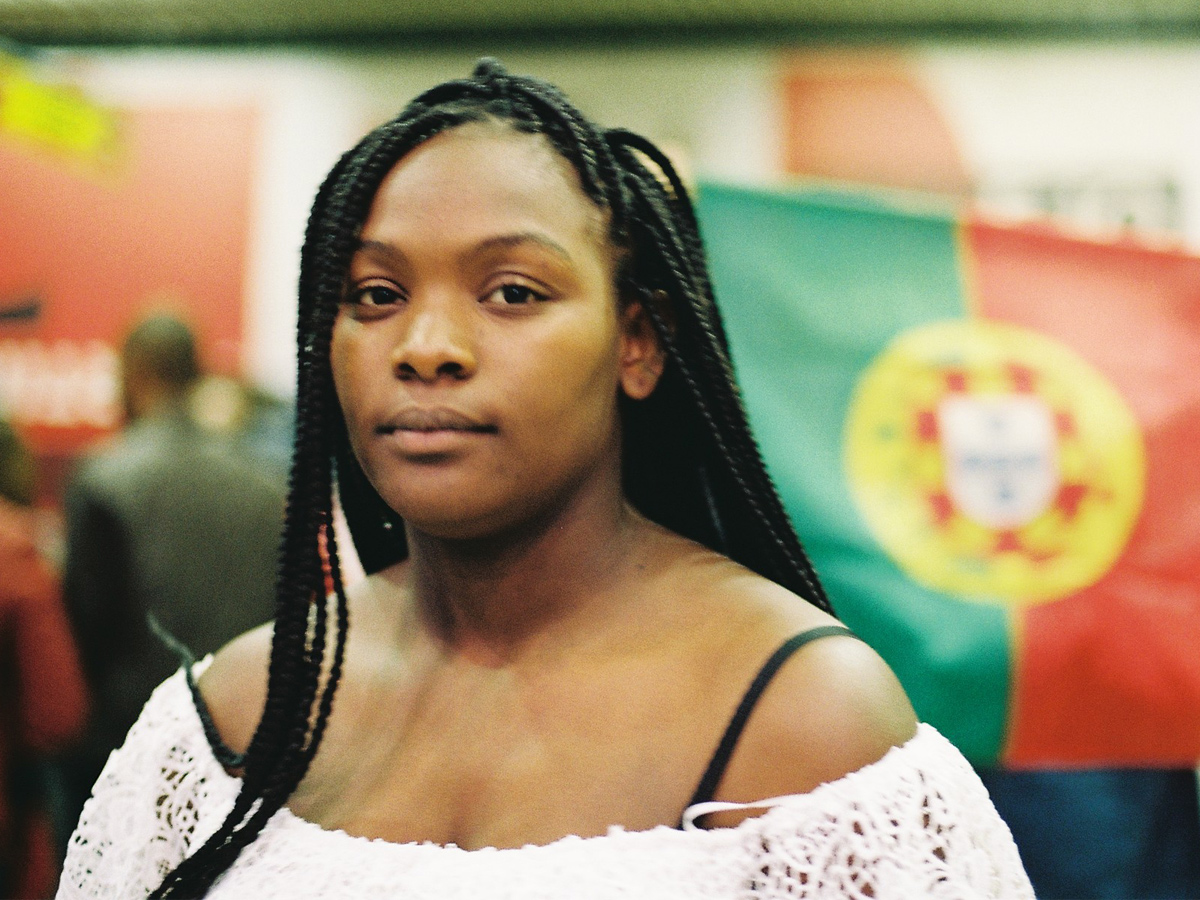
Nídia named her 2023 album 95 MINDJERES after a group of ninety-five young women who participated in the struggle for Guinea-Bissau’s independence during the 1960s. The reference is connected to her own Cape Verdean and Bissau-Guinean heritage, but the album does not turn history into a spoken lesson. It remains dance music, built through her particular approach to batida, kuduro and electronic rhythm.
Nídia learned computer production as a teenager and connected online with other people in the Afro-Portuguese diaspora. Digital production, community memory and the circulation of dance rhythms are already part of the same story. A club track can acknowledge a history without illustrating it bar by bar. The title changes the frame through which the rhythms are heard, while the music retains its speed, humour and independence.

https://gulbenkian.pt/agenda/nidia-2/

#Nidia #95MINDJERES #Batida #GuineaBissau #AfroPortugueseMusic

The Beat Remembers Ninety-Five Women The Beat Remembers Ninety-Five Women Fundação Calouste Gulbenkian Nídia Em colaboração com a Filho Único, a nossa festa de abertura propõe um programa de celebração com alguns dos mais entusiasmantes nomes da música atual.
Facebook LinkedIn WhatsApp Threads
More sharing options
X Reddit Pinterest Telegram Email
Before Tape Music Had

Before Tape Music Had a Name

In Cairo in 1944, Halim El-Dabh borrowed a wire recorder and took it to a Z?r ceremony, where women used chanting and percussion as part of a ritual practice. He did not treat the recording as a neutral document. Back at the Middle East Radio station, he transformed the captured sound and presented the resulting work, The Expression of Zaar, at a Cairo art gallery.
The piece has circulated under several related names, including Ta’abir al-Zaar, The Elements of Zaar and Wire Recorder Piece. That unstable naming is a reminder of how easily early electronic work can sit outside the history written around later studios and institutions. The recording existed, but the language used to place it within electronic music was still being formed.
The date unsettles the familiar European timeline of musique concrète. More interesting, though, is the artistic decision already present in El-Dabh’s experiment: a recording could be material rather than evidence. A voice could be filtered, reshaped and removed from ordinary duration without losing all connection to the body that produced it.
Electronic music histories often begin with a studio, an institution or a newly invented machine. This one begins with listening outside the studio, then returning with a sound whose cultural meaning could not be reduced to technique. The wire recorder did not create the idea. It made another way of handling the idea possible.

https://brahms.ircam.fr/en/composer/halim-el-dabh/biography

#HalimElDabh #ElectronicMusicHistory #Cairo #WireRecorder #MusiqueConcrete

Before Tape Music Had a Name Before Tape Music Had a Name Ressources IRCAM Biographie - Halim El-Dabh La biographie du compositeur Halim El-Dabh
Facebook LinkedIn WhatsApp Threads
More sharing options
X Reddit Pinterest Telegram Email
Drum Machine

A Drum Machine Learns to Improvise

Ikue Mori’s move from a drum kit to drum machines in the mid-1980s was not a search for tighter time. She took machines designed to supply dependable backing rhythms into improvised music, where listening and immediate response matter more than repetition. Eventually she was orchestrating three drum machines with effects and a digital mixer before replacing that setup with a laptop around 2000.
The unusual part is not the equipment but the role she gave it. A conventional drum-machine part often establishes a stable ground for other musicians. Mori made the programmed sounds behave like another improviser: interrupting, changing density, leaving space, introducing textures that did not resemble a normal drum kit. A limited palette became expressive because she learned how quickly she could redirect it in performance.
That suggests a useful way to practise with electronic instruments. Do not begin by building a finished loop. Load a deliberately small set of contrasting sounds, map only a few controls, and respond to another recording in real time. Mute, retrigger, change decay and move between sparse and crowded passages. The aim is not to prove that a machine can imitate a human drummer. It is to discover what kind of listening becomes possible when the machine is treated as an instrument rather than an obedient clock.

https://www.macfound.org/fellows/class-of-2022/ikue-mori

#IkueMori #DrumMachine #Improvisation #ElectronicPercussion #ExperimentalMusic

A Drum Machine Learns to Improvise A Drum Machine Learns to Improvise macfound.org Ikue Mori Transforming the use of percussion in improvisation and expanding the boundaries of machine-based music.
Facebook LinkedIn WhatsApp Threads
More sharing options
X Reddit Pinterest Telegram Email
Basic Channel

Sound With Its Edges Removed

Basic Channel did not simply add Jamaican dub effects to Berlin techno. Moritz von Oswald and Mark Ernestus treated the mix itself as the composition. On records such as Phylyps Trak and Quadrant Dub, kick drums and chords appear less like fixed objects than signals passing through filters, delay and reverb. The repeated pattern stays recognizable, but its surface is always being rubbed away.
That distinction is useful in production. A delay does not have to decorate a finished sound. It can replace part of the arrangement. Try sending one short chord to a delay, then automate the send level, feedback and filter rather than adding new notes. The empty bars become active because the previous sound is still changing inside them. Basic Channel made this feel architectural: rhythm marks the floor, while echoes keep altering the size of the room.

https://www.nts.live/artists/3079-basic-channel

#BasicChannel #DubTechno #BerlinTechno #StudioAsInstrument

Sound With Its Edges Removed Sound With Its Edges Removed NTS Radio Basic Channel | Discover music on NTS Basic Channel has been played on NTS over 150 times, featured on 125 episodes and was first played on 13 January 2013. Basic Channel is a minimal techno production team and record label, composed of Moritz Von Oswald and Mark Ernestus, that originated in Berlin, Germany in 1993. The duo released a number of vinyl-only tracks under various aliases, each of which employed their signature brand of dissonant dub techno. The nine original releases were each primarily identified as Basic Channel productions by their catalogue numbers, as the Basic Channel logo on the label became more distorted and unreadable with each subsequent release. The duo set...
Facebook LinkedIn WhatsApp Threads
More sharing options
X Reddit Pinterest Telegram Email