Skip to content

Light Art

Art Stream
Audiovisual Installation

Light Without a Screen

NONOTAK’s ZERO POINT TWO V.2 uses a sparse arrangement of horizontal light lines. There is no image in the conventional sense and no screen carrying a rectangular composition. Light appears to float in the room, moving quickly enough to suggest a volume that is present for a moment and then gone.
For a VJ, the work separates visual density from intensity. A nearly empty field can feel charged when position, brightness, speed and sound are tightly controlled. Test the principle with one thin line on black. Let its width, position and luminance respond differently to sound rather than connecting every parameter to the same amplitude value. The aim is not to imitate NONOTAK, but to discover how little visual information a room actually needs.

https://nonotak.com/_ZERO-POINT-TWO-V-2

#NONOTAK #LightArt #SoundAndLight #MinimalVisuals #AudiovisualInstallation
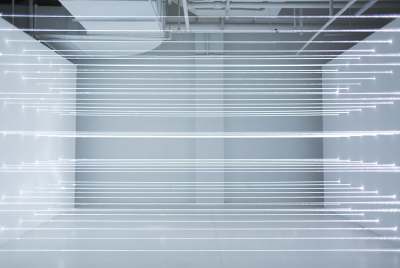
Light Without a Screen Light Without a Screen nonotak.com _ZERO POINT TWO V.2 - NONOTAK studio ZERO POINT TWO V.2, light & Sound installation, 2017 In ZERO POINT TWO, the abstract matter that is light is precisely sculptured to take shape in the most delicate and slender lines imaginable. Using a minimal sparse arrangement of horizontal...
Facebook LinkedIn WhatsApp Threads
More sharing options
X Reddit Pinterest Telegram Email
Artwork James Turrell

Building an Observatory as an Artwork

James Turrell has spent decades transforming Roden Crater, an extinct volcanic cinder cone in northern Arizona, into an artwork built around direct observation of light, sky and celestial movement.

What interests me is that almost nothing about the central material is manufactured.

The sun already exists.

The moon already moves.

Stars were visible long before the architecture arrived.

Turrell changes the conditions under which we see them.

Interior chambers, tunnels and openings frame portions of the sky, turning natural cycles into events with almost architectural precision.

This reverses a familiar relationship between artwork and lighting.

Museums usually design lighting so we can see the artwork.

At Roden Crater, the architecture exists so we can see the light.

That distinction becomes important.

A rectangular opening can make a piece of sky suddenly appear flat, almost like a painted surface. A tunnel can isolate an astronomical event that would otherwise disappear inside the enormous scale of the landscape.

Nothing has been added to the sky.

Attention has been engineered.

Perhaps that is one of the strangest powers architecture possesses.

It cannot change the universe outside the building.

But it can change how large a piece of that universe we are capable of noticing.

About

#JamesTurrell #RodenCrater #LightArt #LandArt

Building an Observatory as an Artwork Building an Observatory as an Artwork Roden Crater About James Turrell has spent decades transforming Roden Crater, an extinct volcanic cinder cone in northern Arizona, into an artwork built around...
Facebook LinkedIn WhatsApp Threads
More sharing options
X Reddit Pinterest Telegram Email