Skip to content

Fifty-Two Strings Becoming Noise

Egyptian Music

Improvisation Inside a Twelve-Piece Machine

Maurice Louca’s Elephantine was recorded in Stockholm with a twelve-piece ensemble containing two percussionists, bass, vibraphone, saxophones, bass flute, tuba, clarinets, voice, oud, violin and Louca himself on guitar and piano. Released in 2019, the record moves between written composition and improvisation while drawing musicians from Egypt, Iraq and several European countries into one ensemble.

That line between composition and improvisation interests me.

With twelve players, complete freedom could easily become chaos. Write everything down, and the individual personalities might disappear. Louca seems interested in the unstable area between those extremes, where enough structure exists for a large ensemble to move together but enough space remains for musicians to change what happens inside it.

Electronic production has a similar problem. A sequencer can organise almost everything with absolute precision, but precision is not automatically life.

Sometimes the most interesting musical system is not the one with the most control. It is the one that controls exactly enough.

https://northernspyrecs.com/product/elephantine/

#MauriceLouca #EgyptianMusic #Improvisation #ExperimentalMusic

Improvisation Inside a Twelve-Piece Machine Improvisation Inside a Twelve-Piece Machine Northern Spy Records Northern Spy Records Northern Spy Records — official site and store. Browse the catalog, artists, news, and tour dates.
Electronic Music

The Subway Became Part of the Synthesizer

When Robert Henke and Gerhard Behles travelled to Hong Kong in 1996 for the International Computer Music Conference, Henke carried a recorder through Hong Kong and Guangzhou. Those field recordings later became part of Monolake’s Hongkong. The closing track, “Mass Transit Railway,” is based on sound captured inside a Hong Kong subway train. The album was produced with instruments including a Prophet VS, Yamaha SY77 and TG77, Ensoniq ASR-10, Waldorf Microwave and an Atari running Notator, alongside a step sequencer Henke wrote in Max.

What interests me is how naturally the city enters the electronic system. The subway recording is not simply atmosphere placed behind a track. It becomes another component in a studio already built from samplers, synthesizers and code.

Sampling a city does something strange to geography. A train journey becomes repeatable. A moment that happened once can be filtered, looped and reorganised twenty years later.

Electronic music can sometimes feel completely synthetic. Hongkong reminds me that a machine-made composition can still contain a very specific street, vehicle and moment in time.

https://www.roberthenke.com/releases/ml-000.html

#Monolake #RobertHenke #FieldRecording #ElectronicMusic

The Subway Became Part of the Synthesizer The Subway Became Part of the Synthesizer roberthenke.com Monolake - Hongkong When Robert Henke and Gerhard Behles travelled to Hong Kong in 1996 for the International Computer Music Conference, Henke carried a recorder through Hong…
But the

A Painting Made for a Ritual

Nepalese paubha paintings can look astonishingly dense to someone encountering them simply as images. Deities, architectural forms, geometric structures and repeated motifs occupy almost every part of the cloth. But the tradition was not developed merely to create something visually impressive.

The Nepal Academy of Fine Arts places paubha among traditional arts closely connected with religion, narrative, ritual and everyday cultural life. The Nepal Art Council continues to present the form as part of a living Himalayan artistic tradition rather than only an archaeological inheritance.

That changes how I think about composition.

In contemporary art we often assume that an artwork exists primarily to be looked at. A ritual painting may also function as an aid to devotion, storytelling or contemplation. Its organisation therefore follows another logic.

The density is not necessarily decorative excess. Information has to be located, recognised and revisited.

A screen interface also organises symbols so that a viewer knows where attention should move next. Paubha painting reminds me that complex visual information systems existed long before we started calling anything an interface.

https://www.nepalartcouncil.org.np/publications/paubha-scroll-paintings/

#Paubha #NepaliArt #HimalayanArt #TraditionalPainting

A Painting Made for a Ritual A Painting Made for a Ritual nepalartcouncil.org.np One moment, please... Nepalese paubha paintings can look astonishingly dense to someone encountering them simply as images. Deities, architectural forms, geometric structures an…
Cabaret Crusades

History Performed by Clay

For Cabaret Crusades: The Path to Cairo, Egyptian artist Wael Shawky reconstructed episodes from the medieval Crusades using approximately 120 handmade clay puppets. The larger trilogy draws on Amin Maalouf’s The Crusades Through Arab Eyes, shifting attention toward historical narratives recorded from an Arab perspective.

The choice of puppets makes the work stranger than a conventional historical reconstruction.

A puppet cannot pretend that we are watching reality. We constantly see the mechanism of representation. The figures are obviously artificial, yet they perform events whose consequences were violently real.

That distance interests me.

Film normally tries to make historical reconstruction convincing through costumes, locations and actors. Shawky removes that illusion almost completely. History becomes theatre, and because the manipulation is visible, we start thinking about who is moving the characters.

Perhaps that is appropriate. Historical narratives are also constructed. Events happened, but every retelling involves selection, framing and perspective.

The puppet strings are simply more visible than the ones inside a history book.

https://www.lissongallery.com/artists/wael-shawky

#WaelShawky #EgyptianArt #CabaretCrusades #ContemporaryArt

History Performed by Clay History Performed by Clay Lisson Gallery Lisson Gallery Wael Shawky tackles notions of national, religious and artistic identity in contemporary art through film, performance, and storytelling.
Audiovisual Art

Visuals From Particle Physics

Herman Kolgen’s ISOTOPP grew from a residency at GANIL, the French heavy-ion research facility. Rather than using particle physics simply as futuristic decoration, the Montréal multimedia artist developed an audiovisual work around molecular abstraction and energy transfer. The project eventually became a black-and-white audiovisual performance.

That starting point interests me from a VJ perspective.

Visual performance often begins with images that already look interesting. Film fragments, generated geometry, typography or textures are then synchronised to music. Kolgen’s approach suggests another possibility: begin with a process that is normally invisible and ask how it might acquire both image and sound.

The scientific phenomenon is not automatically the artwork. Transformation is still required.

But it gives the audiovisual system a shared conceptual source. Sound and image do not have to be connected only because a visual event happens on the beat. They can behave like two different outputs generated from the same underlying idea.

That feels much closer to composing audiovisual work than simply decorating music with moving pictures.

https://montreal.mutek.org/en/artists/herman-kolgen

#HermanKolgen #AudiovisualArt #LiveVisuals #VJCulture

Visuals From Particle Physics Visuals From Particle Physics MUTEK Montréal Herman Kolgen | MUTEK Montréal MUTEK is a Montréal-based festival dedicated to the promotion of electronic music and the digital arts.Edition 27, from August 25 to 30, 2026.MUTEK…
Experimental Music

Fifty-Two Strings Becoming Noise

Krzysztof Penderecki’s Threnody to the Victims of Hiroshima was composed in 1960 for 52 string instruments. Instead of treating those instruments primarily as carriers of melody and harmony, Penderecki pushed them toward clusters, glissandi, extreme registers and unconventional methods of producing sound. Players strike or bow unusual parts of their instruments, while blocks of sound expand and contract almost like physical objects.

The piece was originally titled 8’37” before receiving the name by which it became famous.

What interests me is how radically the identity of the string orchestra changes.

We know what a violin is supposed to sound like. Penderecki uses fifty-two familiar instruments to construct something that can initially seem electronic, industrial or impossible to locate.

No synthesizer is required.

That is useful to remember when thinking about experimental sound design. New timbre does not always require new technology. Sometimes it comes from asking an old instrument to perform an unfamiliar physical action.

The instrument has not changed.

Our definition of what counts as its sound has.

https://penderecki-center.pl/en/krzysztof-penderecki

#KrzysztofPenderecki #Threnody #Sonorism #ExperimentalMusic

Fifty-Two Strings Becoming Noise Fifty-Two Strings Becoming Noise penderecki-center.pl ?ycie i twórczo?? - Europejskie Centrum Muzyki Krzysztofa Pendereckiego (en) Krzysztof Penderecki’s Threnody to the Victims of Hiroshima was composed in 1960 for 52 string instruments. Instead of treating those instruments primarily…
Australian Music

Three Musicians Without a Map

The Necks consist of Chris Abrahams on piano, Lloyd Swanton on bass and Tony Buck on drums. That sounds like one of the most conventional line-ups in jazz. What happens when they play is much harder to categorise.

Their live performances are built through long-form improvisation. The musicians do not begin by performing a predetermined composition. A small figure may appear, repeat and slowly attract other sounds. Rhythm can settle into something almost hypnotic, then change so gradually that it becomes difficult to identify the exact moment when one musical state became another.

What I find remarkable is the trust required.

In a conventional arrangement, structure tells each musician where everyone should be. Here the structure has to be discovered while the music is already happening.

That changes repetition too. A repeated piano figure is never simply looping because bass and percussion continually alter the context around it. The same notes can slowly acquire another meaning without changing themselves.

A sequencer can repeat something indefinitely.

Three musicians listening closely can make repetition behave like evolution.

Press Kit

#TheNecks #Improvisation #AustralianMusic #ExperimentalJazz

Three Musicians Without a Map Three Musicians Without a Map The Necks Press Kit - The Necks Download Press and Media photos of The Necks in HiRes.
Chilean Music

A Folk Guitar Becoming Experimental

Violeta Parra spent years travelling through Chile recording, collecting and learning traditional songs. But that work did not push her toward simply conserving folklore. In 1957 she recorded Composiciones de Violeta Parra, which included two anticuecas, instrumental guitar works that her foundation describes as innovative and experimental. Around the same period she created El Gavilán, a composition originally conceived for a folkloric ballet but developed into something far more singular.

This interests me because research and experimentation are often treated as opposites.

One supposedly looks backward while the other moves forward.

Parra shows how artificial that distinction can be. The deeper she entered traditional forms, instruments and rural musical knowledge, the more material she had available to transform.

She even learned the Chilean guitarrón, with its 25 strings, while carrying out her folklore research.

Tradition here is not a set of rules telling a musician what cannot be changed. It becomes a vocabulary large enough to make experimentation possible.

Sometimes the shortest route toward new music runs straight through very old music.

https://www.fundacionvioletaparra.org/trayectoria

#VioletaParra #ChileanMusic #ExperimentalGuitar #FolkMusic

A Folk Guitar Becoming Experimental A Folk Guitar Becoming Experimental Violeta Parra spent years travelling through Chile recording, collecting and learning traditional songs. But that work did not push her toward simply conse…
Dinastia Duende

Fifty Years Behind the Speakers

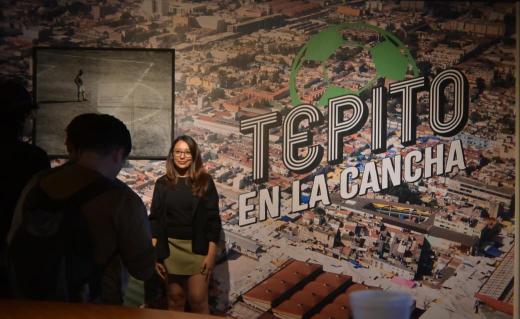
In Mexico City, Dinastía Duende. 50 años documents five decades of one family inside the city’s sonidero culture. Ricardo Mendoza García, known as Papá Duende, founded Sonido Duende with his wife Élfiga Gómez, Sonido Butterfly. Their project grew through family and community events and continued into later generations. Photographs, jackets, shirts, flyers and record sleeves now form part of an exhibition at Galería José María Velasco, open in 2026.

What interests me is that the archive of a sound system is not primarily made from musical scores.

It is made from objects that travelled with the music.

A flyer records where people gathered. A jacket remembers who carried the equipment. A record sleeve points toward what was played. The loudspeakers themselves may disappear, yet social memory accumulates around them.

Sonidero culture makes the person selecting and presenting records part DJ, part announcer and part community connector. The music matters, but so does the act of gathering people around amplified sound.

A dancefloor can produce an archive even when nobody planned to build one.

https://inba.gob.mx/prensa/23893/la-galeria-jose-maria-velasco-presenta-las-exposicionestepito-en-la-canchay-dinastia-duende-50-aos

#Sonidero #MexicoCity #DinastiaDuende #SoundCulture

Fifty Years Behind the Speakers Fifty Years Behind the Speakers INBAL - Instituto Nacional de Bellas Artes y Literatura LA GALERÍA JOSÉ MARÍA VELASCO PRESENTA LAS EXPOSICIONES TEPITO EN LA CANCHA Y DINASTÍA DUENDE. 50 AÑOS - Dos exposiciones exploran la identidad cultural de Tepito a través del futbol y la tradición sonidera - Las muestras inauguran los festejos por el 75 aniversario de la Galería José María Velasco como espacio de encuentro con las comunidades de la
Experimental Music

Trying to Hear Light

For The Gleam, South Korean composer Park Jiha started with something that cannot actually be heard: changing daylight. The album moves from “At Dawn” through pieces concerned with sunrise and daytime before reaching “Nightfall Dancer.” She performs the music herself using instruments including piri, saenghwang, yanggeum and glockenspiel.

One piece, “Temporary Inertia,” grew from a performance in a meditation space designed by Tadao Ando, where a strip of daylight moves gradually across the interior. Park wanted to translate the changing texture, intensity and warmth of that light into sound.

I like the impossibility of the task.

There is no correct sonic equivalent of sunlight. You cannot measure a certain brightness and conclude that it should become one specific note. The translation has to remain subjective.

That is where the idea becomes interesting. Instead of illustrating nature, music becomes a way of paying closer attention to something we normally experience without noticing.

The album also reminds me that silence can function like shadow. Without space around a sound, its brightness is much harder to perceive.

The Gleam by Park Jiha

#ParkJiha #KoreanMusic #ExperimentalMusic #TheGleam

Trying to Hear Light Trying to Hear Light For The Gleam, South Korean composer Park Jiha started with something that cannot actually be heard: changing daylight. The album moves from “At Dawn” thro…
Afro Cuban

Dakar Listening to Havana

Orchestra Baobab formed in Dakar in 1970 as the house band of the newly opened Club Baobab. Its musicians arrived with remarkably different musical histories. Members had roots in Senegal’s Wolof and Casamance cultures, Mali, Morocco and Togo, while Cuban records and musicians arriving through Dakar’s port had already made Afro-Cuban music an important part of the city’s listening culture.

The band called its own approach variété, almost like a musical salad.

That word makes sense when you listen to how guitar, saxophone, percussion and voices coexist. Cuban influence is clearly present, yet it never feels like musicians in Senegal trying to reproduce Havana exactly. Local phrasing, languages and musical backgrounds continually reshape it.

I find that circulation fascinating. Music travelled from Africa across the Atlantic, changed enormously in Cuba, returned through records and ports, then became raw material for something new in Dakar.

Influence is sometimes described as a straight line from one artist to another. Orchestra Baobab sounds more like a route drawn around an ocean.

https://orchestrabaobab.com/

#OrchestraBaobab #SenegaleseMusic #AfroCuban #Dakar

Dakar Listening to Havana Dakar Listening to Havana Orchestra Baobab Orchestra Baobab - West Africa's most iconic dance band Orchestra Baobab are West Africa's most iconic dance band. They have sold over half a million records and are now releasing their 4th album with World Circuit.