Skip to content

Returning Workers to an Empty Factory

Argentine Music

The Instrument Tango Adopted

The bandoneon seems inseparable from Argentine tango, yet the instrument was developed in nineteenth-century Europe and arrived in Buenos Aires later. Early tango groups commonly used combinations of violin, guitar, flute and piano. The bandoneon gradually entered these ensembles and became increasingly central as quartets and, from around 1910, the larger orquesta típica developed. The standard tango orchestra eventually brought bandoneons together with violins, piano and double bass.

I like how completely a migrating instrument can become identified with a music that did not invent it. The bandoneon arrived with its own mechanical construction and tonal possibilities, but musicians in Buenos Aires gave it another cultural life. Its ability to sustain, swell and reshape a note suited tango so well that the imported instrument eventually sounded local.

Musical identity often works like this. Cultures do not necessarily become distinctive by avoiding outside influences. Sometimes they become distinctive through what they do with something that arrived from elsewhere.

https://buenosaires.gob.ar/gcaba_historico/tango/orquesta-tipica

#Bandoneon #Tango #ArgentineMusic #BuenosAires

Belmore’s Fountain

Projecting an Image Onto Water

Rebecca Belmore’s Fountain, created for the Canadian Pavilion at the 2005 Venice Biennale, does something deceptively simple with video: the image is projected onto falling water rather than a conventional screen. The work moves between fire, water and blood, placing elemental imagery against an industrial North American landscape.

The physical projection surface changes everything for me. A normal screen is designed to disappear so that we concentrate on the image. Falling water refuses to disappear. It moves, breaks the projected light and reminds us that the image has a body. The medium becomes visible precisely because it cannot hold the picture perfectly still.

Belmore, an Anishinaabe artist, has repeatedly worked with land, bodies, political histories and the material presence of water. In Fountain, water is simultaneously subject, projection surface and moving sculpture. The video cannot be separated cleanly from the substance carrying it.

Digital images often feel weightless. Here light needs something unstable and physical before we can see it.

Fountain

#RebeccaBelmore #VideoArt #IndigenousArt #InstallationArt

Ca Tru

Three Musicians, an Entire World

Ca trù can be performed by only three musicians: a female singer, a player of the long-necked three-stringed ?àn ?áy and a drummer whose praise drum reacts to the performance. The singer also marks rhythm with phách, small bamboo clappers struck against a wooden or bamboo surface. Vietnamese heritage sources connect the form with poetry, worship, communal ceremonies, private entertainment and intellectual culture, with reliable written evidence reaching back at least to the fifteenth century.

What fascinates me is how much musical information can exist inside such a small ensemble. The singer does not simply place melody over accompaniment. Voice, poetry, clappers, lute and drum continually define one another. Even appreciation becomes audible because the praise drum can respond at particular moments.

That is almost the opposite of the modern studio tendency to add layers until a track feels complete. Ca trù shows how three performers can create complexity through interaction rather than density. Space between sounds becomes part of the arrangement.

https://dsvh.gov.vn/ca-tru-485

#CaTru #VietnameseMusic #TraditionalMusic #VocalMusic

Ben Enwonwu

A Nation Cast in Bronze

Ben Enwonwu completed Anyanwu, also known as The Awakening, in 1956 for the new National Museum in Lagos. The elongated bronze female figure was conceived during a period when Nigeria was moving toward independence. Enwonwu described the work in terms of womanhood, growth and the emergence of a nation. His approach combined indigenous aesthetic traditions connected to his Edo-Onitsha heritage with techniques he had encountered through Western art education.

A copy was presented by the Nigerian government to the United Nations in 1966. That change of location interests me. In Lagos, the sculpture could speak to the formation of Nigerian national identity. At the UN headquarters, the same figure entered a much wider political space and could be read as part of Africa’s post-colonial emergence.

Monuments often look permanent once installed, but their meanings keep moving. Bronze remains physically stable while history repeatedly changes what we see in it. Anyanwu is therefore not only an image of awakening. Its own public life has continued to accumulate new contexts long after the sculpture was cast.

Mission and Symbol

#BenEnwonwu #NigerianArt #ModernAfricanArt #Sculpture

Fado

A Music That Became a City

Fado grew from Lisbon’s historic neighbourhoods and developed over roughly two centuries while continually absorbing cultural and technological change. The Museu do Fado treats it not as a frozen tradition but as a performing art still under construction. Its history can be followed through recordings, scores, photographs, instruments, theatre, radio, cinema and television, but none of those objects is actually the music itself.

That interests me. A museum can preserve the Portuguese guitar, a singer’s costume or an old shellac recording, yet the essential event disappears as soon as the final note ends. Fado survives because people keep singing and listening, not because the objects remain untouched. Technology has changed how the music travels, from intimate rooms to records, radio and global streaming, without completely removing its association with Lisbon.

Perhaps the most difficult art to preserve is also the most alive. You can archive evidence of a performance, but the performance itself always has to happen again.

https://museudofado.pt/en/history-en

#Fado #PortugueseMusic #LisbonMusic #MusicHistory

Museu do Fado History - Museu do Fado
Chen Chieh Jen

Returning Workers to an Empty Factory

Chen Chieh-Jen made Factory in 2003 after meeting former workers from Taiwan’s Lien Fu garment factory, which had closed in 1996 without paying workers compensation and pension claims. The women had spent years protesting. Chen invited them back into the abandoned workplace and filmed them quietly performing the labour they once carried out there.

The resulting work is deliberately slow and silent. Images of the women inside the empty factory are combined with archival propaganda footage presenting Taiwan’s earlier manufacturing prosperity. That collision interests me because nothing needs to be explained through dramatic narration. The same industrial history looks completely different depending on whether it is told through economic success or through the bodies left behind when production moves elsewhere.

Re-enacting work inside a factory that no longer employs anyone turns labour into something almost ghostlike. The machines, gestures and building still remember a system that has already abandoned them. Silence does not make the political argument weaker. It gives the workers’ presence more weight.

???

#ChenChiehJen #TaiwaneseArt #VideoArt #LabourHistory

Caribbean Music

An Orchestra Hammered From Oil Drums

The steelpan emerged in Trinidad and Tobago during the 1930s and 1940s, but its development is tied to a much longer history of Carnival, percussion and restriction. After authorities limited the use of instruments in late nineteenth-century Carnival celebrations, performers developed tamboo-bamboo ensembles using bamboo of different lengths. Metal containers gradually entered these groups, and experimentation eventually transformed discarded steel drums into pitched instruments.

A steelpan looks almost impossibly simple until you realise that different areas of one metal surface are carefully shaped and tuned to specific notes. Modern steelbands extend that principle across instruments covering different registers, making arrangements possible that range far beyond simple percussion patterns.

What I like most is the transformation of function. An industrial container designed to transport material becomes an instrument capable of carrying melody and harmony. Innovation here did not begin with access to specialised technology. It grew from restriction, available materials, Carnival culture and repeated experimentation with sound.

Steelband

#Steelpan #TrinidadAndTobago #CaribbeanMusic #InstrumentDesign

Ciurlionis

When Painting Starts Thinking Like Music

Mikalojus Konstantinas ?iurlionis is difficult to place neatly inside one discipline because he worked simultaneously as a painter and composer. During a creative period of only about seven years, he produced more than 300 paintings, hundreds of graphic works and sketches, and around 400 musical compositions. His museum in Kaunas preserves most of that legacy.

The connection between the two practices was not merely biographical. ?iurlionis explored how principles associated with music could operate visually, and some of his best-known painting cycles even use musical terms such as Sonata, Fugue and Prelude. His landscapes and imagined spaces often avoid ordinary perspective, moving instead toward layered, rhythmic and almost cosmic structures.

What interests me is that translating music into painting does not require illustrating sound waves or musical instruments. Rhythm can become repetition of shapes. A motif can return like a theme. Visual space can develop tension and release. ?iurlionis shows that the connection between sound and image may exist deepest at the level of structure.

https://ciurlionis.lt/activity/branches/m-k-ciurlionis-national-museum-of-art/expositions/m-k-ciurlionio-kuryba-en/

#Ciurlionis #LithuanianArt #PaintingAndMusic #Symbolism

ciurlionis.lt M. K. ?iurlionis’ Creation The exhibition showcases not only ?iurlionis’ paintings but also his multifaceted creative legacy – music, graphic art, and photography. The artworks are revealed in a new, modern light – the same lighting technology used to preserve masterpieces by Italy’s greatest artists. Visitors can pause and immerse themselves in the ?iurlionis atmosphere while resting in chairs upholstered with Japanese vegan leather. M. K. ?iurlionis – a composer and painter who also explored literature and photography – created over 300 paintings, more than 700 graphic works and sketches, and around 400 musical compositions during his remarkably short yet prolific 7-year creative period. Nearly all of these works are preserved in this museum. His paintings are notable for a uniquely poetic perception of space, often evoking a bird’s-eye view. They carry a cosmic perspective and a sense of deep inner contemplation. ?iurlionis was drawn to questions about the origins and structure of the universe, the spiritual forces that govern the world, nature and its cycles, the meaning of human life, psychological states, the evolution of being, and the possibility of applying musical principles to visual art. Music filled ?iurlionis’ life in countless forms. He composed distinctive original works, harmonized folk songs, led choirs, gave concerts, and published articles on music and culture. His graphic art and sketches offer valuable insight into his creative thought process and the recurring motifs that sparked his imagination. His ink compositions are particularly striking for their virtuoso, jewel-like technique, diverse strokes, and intricate ornamentation. ?iurlionis was a curious and wide-ranging thinker, deeply interested in philosophy, theosophy, cosmology, religions and myths, as well as the latest scientific and technological innovations of his time. It’s no surprise that he also picked up a camera – the photos he took during the summer of 1905 in the Caucasus capture intimate moments of that journey.
Brazilian Music

European Dances Learned to Speak Brazilian

Choro emerged in Rio de Janeiro during the second half of the nineteenth century, but calling it simply a Brazilian genre hides the musical exchange inside it. Brazil’s National Historical and Artistic Heritage Institute describes roots in European dances such as polkas, waltzes and schottisches, alongside music shaped by African diasporas, including lundu, modinha and other forms circulating across the Atlantic.

Musicians did not simply reproduce imported sheet music. Melodies were ornamented, expanded, reduced, answered with counterpoint and opened to improvisation. The social setting mattered too: the roda de choro made music something musicians built together rather than a fixed score delivered intact.

What interests me is that cultural identity can emerge precisely from material that did not originally belong to one place. Choro became distinctly Brazilian not by removing foreign influences but by changing how they were phrased, accompanied, improvised and heard. A musical language can become local through use rather than through purity.

https://www.gov.br/iphan/pt-br/assuntos/noticias/choro-e-reconhecido-como-patrimonio-cultural-do-brasil

#Choro #BrazilianMusic #RioDeJaneiro #MusicHistory

Edge of the Arctic

A Print Studio at the Edge of the Arctic

Kinngait Studios in Nunavut has released an annual collection of limited-edition prints every year since 1959. What began as an experiment in transferring Inuit drawing and carving traditions to paper became the longest continuously operating print studio in Canada. Early experiments included sealskin stencils, but local carving stone proved particularly suitable for relief printing. Engraving, lithography and etching later expanded the range of techniques.

I find the collaborative structure behind these images especially interesting. A drawing does not simply become a reproduction by pressing a button. Artists and specialist printmakers work through translation: deciding how a drawing should become a stonecut, lithograph or etching while retaining the character of the original image. That makes every edition the result of both individual vision and technical exchange.

Printmaking is usually associated with multiplying an image. At Kinngait, multiplication also created something larger: a continuing artistic infrastructure in a remote Arctic community that has supported several generations of Inuit artists and printmakers.

https://www.dorsetfinearts.com/kinngait-studios

#KinngaitStudios #InuitArt #Printmaking #Nunavut

Among the Zafimaniry

A House Built Without Nails

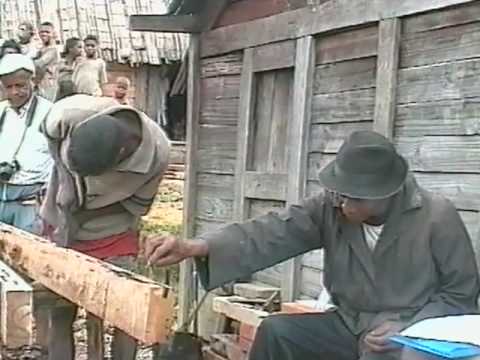
Among the Zafimaniry communities of Madagascar, woodcraft is not confined to objects placed inside a house. The house itself is part of the craft. UNESCO describes buildings assembled with traditional mortise-and-tenon joints without nails, hinges or other metal hardware. Walls, beams, posts, window frames, stools, chests and tools can carry geometric ornament, while different endemic tree species are selected for particular structural or decorative functions.

What stays with me is the absence of a clear boundary between architecture, furniture, ornament and knowledge of the forest. The carved patterns are not simply added after construction to make a useful object beautiful. They carry symbolic associations connected with community beliefs and values, while the choice of wood requires another kind of knowledge altogether. Even within a limited vocabulary of motifs, no two objects need to be identical.

It makes me think about how modern design often separates disciplines that were once inseparable. Here building, ecology, symbolism and decoration remain parts of the same visual language.

https://ich.unesco.org/en/RL/woodcrafting-knowledge-of-the-zafimaniry-00080

#Zafimaniry #MadagascarArt #Woodcraft #TraditionalArchitecture

ich.unesco.org Woodcrafting knowledge of the Zafimaniry - UNESCO Intangible Cultural Heritage The Zafimaniry community is the sole remaining repository of a unique woodcraft culture previously widespread on the island. In the eighteenth century, the Zafimaniry settled in the remote wooded region of south-east Madagascar, seeking refuge from the deforestation that was ravaging much of Madagascar at that time. Today, approximately 25,000 Zafimaniry live in some one hundred villages and hamle...