Skip to content

Electronic Music

A genre characterized by the use of electronic instruments, synthesizers, and digital production techniques to create innovative sounds and rhythms, spanning styles like techno, house, dubstep, and ambient.

The Bassline That Changed the Future

When Giorgio Moroder and Donna Summer made “I Feel Love” in 1977, the idea was to imagine what dance music might sound like in the future. Moroder constructed almost the entire instrumental backing electronically, including bass, kick, snare and hi-hat, creating the mechanical pulse that became the track’s defining feature. What still surprises me is…

Read more

The Nigerian Synth Records Nobody Could Explain

William Onyeabor self-released a series of records in Nigeria between 1977 and 1985, then largely abandoned music and refused for years to explain much about how those recordings had been made. That silence contributed to the mythology, but the music itself is more interesting than the mystery. Onyeabor’s records combine long-form funk grooves, electronic keyboards,…

Read more

The Circuit Died After Performing

Louis and Bebe Barron did not use conventional synthesizers for Forbidden Planet in 1956. They constructed electronic circuits specifically for the film and recorded the unpredictable sounds those circuits produced. Influenced by ideas from cybernetics, the Barrons treated circuits almost as primitive organisms. Individual systems behaved differently, changed as components heated up and could eventually…

Read more

The Machine That Was Supposed to Compose With You

Raymond Scott is remembered by many people without them knowing his name. His earlier compositions were adapted extensively for Warner Bros. cartoons, but another side of his work took place inside a private electronic laboratory. During the 1950s and 1960s Scott built machines with names such as the Circle Machine, Rhythm Modulator, Bass-Line Generator, Clavivox…

Read more

Oxygène Came From a Kitchen

Jean-Michel Jarre recorded Oxygène in 1976 in the kitchen of his Paris apartment. He has described the setup as a modest home studio built around only a handful of instruments, including an ARP 2600, Farfisa organ and Korg Minipops 7 drum machine. That matters because Oxygène now sounds like one of those records that must…

Read more

Bach Had to Be Built Note by Note

When Switched-On Bach appeared in 1968, the Moog synthesizer was still far from the convenient polyphonic instrument we now associate with keyboards. Wendy Carlos worked closely with Robert Moog and used multitrack recording to construct Bach’s polyphonic music from an electronic instrument that could produce only limited musical information at once. Carlos even built her…

Read more

Drawing Automation Before the DAW

Daphne Oram imagined something remarkably close to visual music sequencing decades before a modern DAW existed. Her Oramics system allowed a composer to draw information onto strips of 35mm film. Optical sensors translated those markings into control signals governing properties such as pitch, dynamics and timbre. Waveforms could also be drawn and scanned. Instead of…

Read more

Fred Again Turns Messages Into Memory

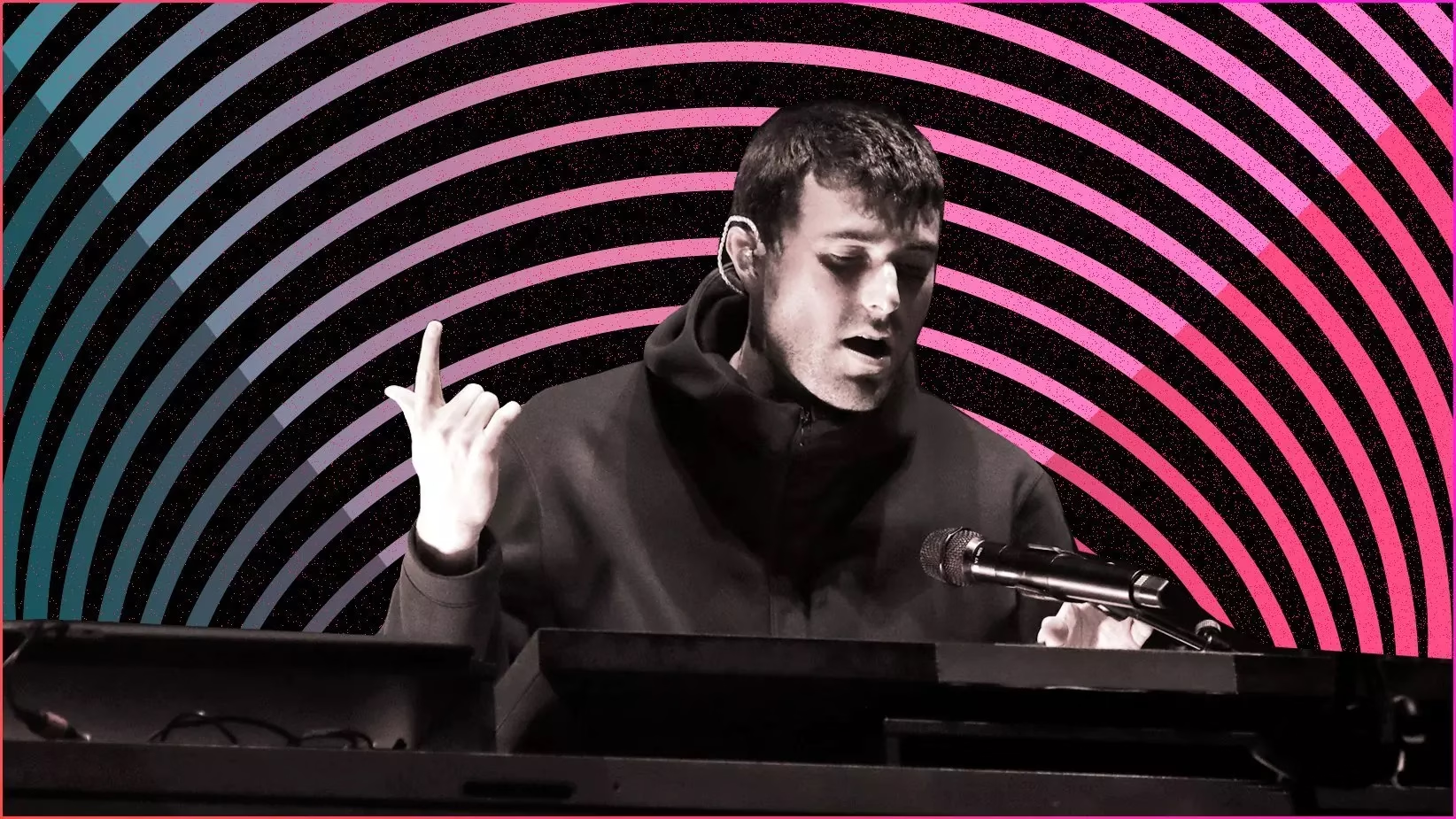
Fred again..’s Actual Life records are built partly from material that normally disappears into the endless flow of phones and social media: voice notes, FaceTime conversations, videos and fragments of everyday speech. On “Marea (We’ve Lost Dancing),” for example, words from The Blessed Madonna originated in a FaceTime conversation about the disappearance of communal dancing…

Read more

Kraftwerk Rebuilding Autobahn From Tape

Fifty years after Autobahn, Kraftwerk returned not to a software session but to the original 16-track analogue tapes. For the album’s 50th anniversary, Ralf Hütter reconstructed a Dolby Atmos version at Kling Klang Studio from those tapes. It is a curious meeting between two completely different eras of recording technology: a work made when multitrack…

Read more

Ambient Music From a Bedroom

Selected Ambient Works Volume II has become one of Aphex Twin’s most recognisable records, yet parts of its history are surprisingly ordinary. The album appeared in 1994, long before ambient music became a permanent streaming category. In notes accompanying the later expanded edition, Richard D. James recalls recording “Blue Calx” in his bedroom studio at…

Read more