Skip to content

Carmen Herrera Waited Decades

Carmen Herrera

Carmen Herrera Waited Decades

Carmen Herrera developed her hard-edged geometric language in the middle of the twentieth century, working between Havana, Paris and New York. She reduced compositions toward straight lines, angles and extremely limited palettes while artists such as Ellsworth Kelly and Frank Stella were becoming major figures in related areas of abstraction.

Herrera did not receive comparable recognition.

At the Whitney she later recalled a gallery owner telling her that she could paint circles around the men represented there but would not be given a show because she was a woman.

That story is uncomfortable precisely because the paintings themselves need no biographical excuse.

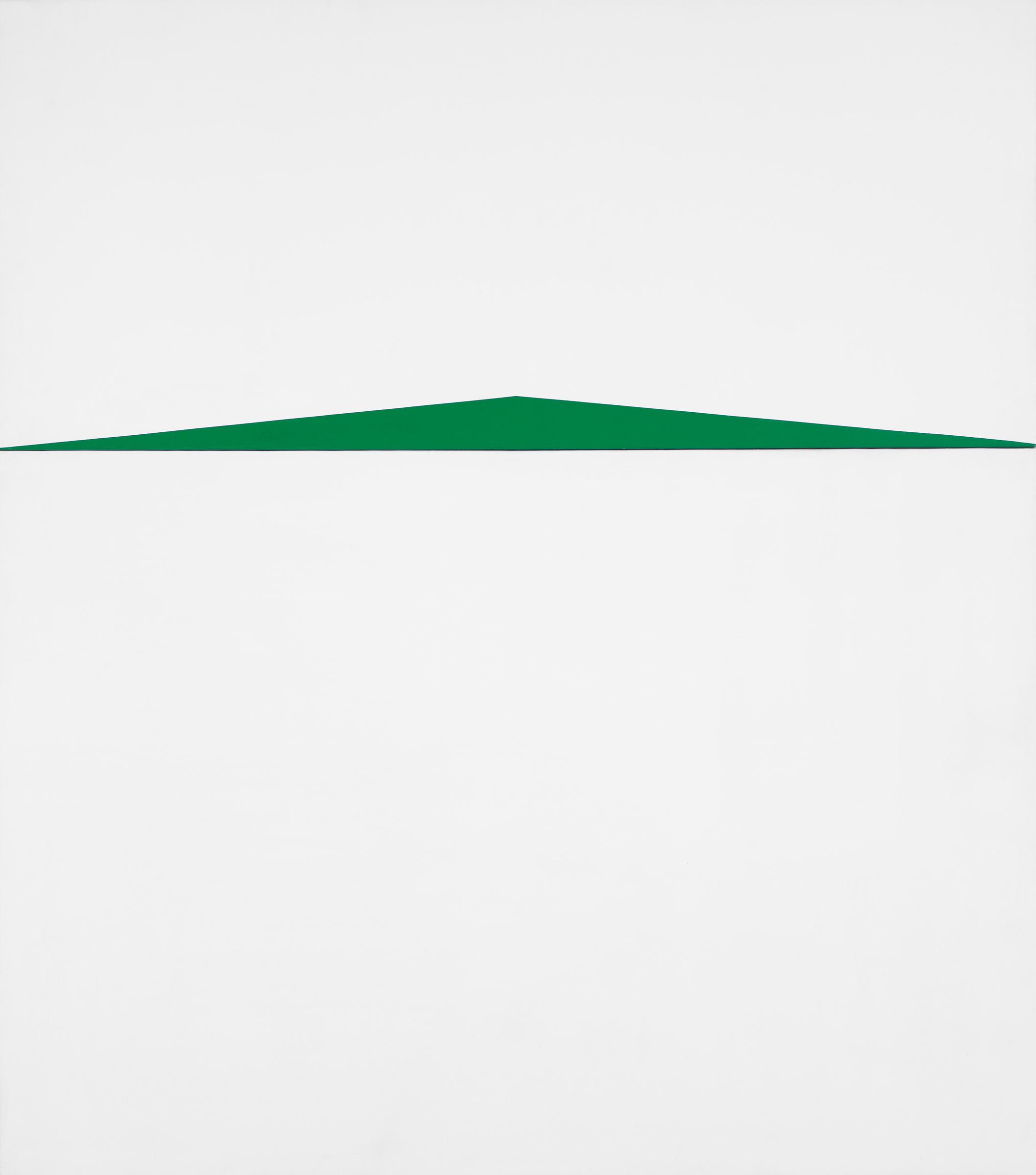
Look at Blanco y Verde. Herrera reduced some compositions almost absurdly far, using white and green forms while treating the edge of the canvas as an active part of the geometry.

Nothing is hiding.

When a work contains so little, every proportion matters.

Herrera is now discussed as an important figure in geometric abstraction, but that late recognition raises a larger problem. Art history often makes success look inevitable after it finally happens.

It was not inevitable.

A major artist can spend decades making strong work while the institutions responsible for recognising it simply look elsewhere.

Rediscovery does not make the work better.

It reveals how incomplete the original map was.

https://whitney.org/exhibitions/carmen-herrera

#CarmenHerrera #GeometricAbstraction #CubanArt #WomenArtists
Carmen Herrera Waited Decades Carmen Herrera Waited Decades Whitney Museum of American Art Carmen Herrera: Lines of Sight Carmen Herrera: Lines of Sight is the first museum exhibition of this groundbreaking artist in New York City in nearly two decades. Focusing on the years 1948 to 1978, the period during which Herrera developed her signature style, the show features more than fifty works, including paintings, three-dimensional works, and works on paper. It begins with the formative period following World War II, when Herrera lived in Paris and experimented with different modes of abstraction before establishing the visual language that she would explore with great nuance for the succeeding five decades. Many of these works have never been displayed before in a museum.
Abstract Painting

A Painting Built From Studio Dirt

Judit Reigl found one of her painting methods almost accidentally.

To protect the floor of her studio, she placed rejected canvases underfoot. Over time they accumulated layers of paint, dust and other material while she repeatedly walked across them. Instead of treating those canvases as ruined, Reigl eventually began excavating the surfaces, scraping through their accumulated layers with homemade tools.

The resulting Guano works turn studio waste into geological structure.

I love this because it reverses the normal hierarchy of the studio.

The artwork is usually the precious object. The floor covering is disposable.

Reigl allowed the disposable material to collect time until it became more interesting than its original purpose.

There is also something close to sampling here. Existing layers are not erased so the artist can begin again. They become raw material for another work.

Judit Reigl had moved from Hungary to France and was connected with Surrealist and later abstract painting, but her work remained much less familiar internationally than many male painters working at comparable scale.

The technique alone deserves attention.

Sometimes a studio produces art even while the artist thinks she is merely protecting the floor.

https://www.metmuseum.org/about-the-met/collection-areas/modern-and-contemporary-art/judit-reigl-in-memoriam

#JuditReigl #AbstractPainting #GuanoSeries #ForgottenArtists

A Painting Built From Studio Dirt A Painting Built From Studio Dirt metmuseum.org Judit Reigl found one of her painting methods almost accidentally. To protect the floor of her studio, she placed rejected canvases underfoot...
Culture Before Video Oskar

VJ Culture Before Video

Oskar Fischinger was experimenting with multiple projected images before electronic video existed.

During the 1920s, his Raumlichtmusik performances used several film and slide projectors simultaneously to create abstract moving environments. Elsewhere he explored single-frame animation, scratching directly onto film and even experiments in drawn optical sound.

This is where experimental-film history begins to overlap surprisingly well with modern VJ culture.

A contemporary VJ can run several video layers, blend them, map them onto architecture and synchronise them with music in realtime. Fischinger had none of that digital flexibility. Every additional projector was another physical machine, another film path and another alignment problem.

Yet the artistic question was already there.

Why should cinema consist of one rectangular image directly in front of a seated audience?

Once several projections begin occupying space, the screen stops being only a window. Light itself becomes material.

Fischinger later became famous for tightly synchronised abstract animation, but I find these earlier multiple-projection experiments even more interesting today.

The technology is obsolete.

The idea is not.

A century later, Resolume, projection mapping and immersive audiovisual performances are still exploring what happens when moving images escape from a single screen.

https://centerforvisualmusic.org/Fischinger/

#OskarFischinger #VisualMusic #ExpandedCinema #VJCulture

VJ Culture Before Video VJ Culture Before Video centerforvisualmusic.org Fischinger - CVM pages Oskar Fischinger was experimenting with multiple projected images before electronic video existed. During the 1920s, his Raumlichtmusik...
Alice Coltrane

The Alice Coltrane Records Almost Nobody Heard

Alice Coltrane is hardly an unknown musician, yet one of the most extraordinary parts of her catalogue spent years largely outside the normal music industry.

After establishing an ashram in California, she recorded devotional music during the 1980s and 1990s and distributed it primarily within that spiritual community on privately released cassettes. The recordings combined influences from the gospel music she had known in Detroit with Indian devotional practice. They also contain synthesizers, organ, harp, strings, percussion and choirs, and include some of the first recordings in her catalogue on which she sings.

These tapes complicate the familiar version of Alice Coltrane as simply an important spiritual-jazz musician connected to John Coltrane.

She was creating another musical system.

What interests me is the audience for which these recordings originally existed. They were not primarily trying to enter charts, jazz criticism or record-store culture. Music was functioning inside a community and spiritual practice.

When the recordings were later recovered from master tapes and brought to a wider audience, their context changed completely.

The music had not suddenly become important.

The rest of us had finally gained access to something that had been important somewhere else for decades.

https://www.luakabop.com/products/copy-of-xx-world-spirituality-classics-1-the-ecstatic-music-of-alice-coltrane-turiyasangitananda

#AliceColtrane #SpiritualJazz #Synthesizer #MusicArchive

The Alice Coltrane Records Almost Nobody Heard The Alice Coltrane Records Almost Nobody Heard luakabop.com World Spirituality Classics 1: The Ecstatic Music of Alice Coltrane Turiyasangitananda by Alice Coltrane Turiyasangitananda - Luaka Bop Alice Coltrane Turiyasangitananda’s devotion to spirituality was the central purpose of the final four decades of her life, an often-overlooked awakening that largely took shape during her four-year marriage to John Coltrane and after his 1967 death. By 1983, Alice had established the 48-acre Sai Anantam Ashram outside of Los Angeles. She quietly began recording music from the ashram, releasing it within her spiritual community in the form of private press cassette tapes. On May 5, Luaka Bop will release the first-ever compilation of recordings from this period, making these songs available to the wider public for the first time. Entitled ‘World Spirituality Classics, Volume 1: The Ecstatic Music of Alice Coltrane Turiyasangitananda,’ the release is the first installment in a planned series of spiritual music from around the globe; curated, compiled and distributed by Luaka Bop. This powerful, largely unheard body of work finds Alice singing for the first time in her recorded catalog, which dates back to 1963 and includes appearances on six John Coltrane albums, alongside Charlie Haden and McCoy Tyner, and 14 albums as bandleader starting with her Impulse! debut in 1967 with ‘A Monastic Trio.’ The songs featured on the Luaka Bop release have been culled from the four cassettes that Alice recorded and released between 1982 and 1995: ‘Turiya Sings,’ ‘Divine Songs,’ ‘Infinite Chants,’ and ‘Glorious Chants.’ The digital, cassette and CD release will feature eight songs. The double-vinyl edition features two additional songs, “Krishna Japaye” from 1990’s ‘Infinite Chants, and the previously unreleased “Rama Katha” from a separate ‘Turiya Sings’ recording session. Luaka Bop teamed with Alice’s children to find the original master tapes in the Coltrane archive. The recordings were prepared for re-mastering by the legendary engineer Baker Bigsby (Ornette Coleman, Sun Ra, John Coltrane), who had overseen the original sessions in the 80s and 90s. The compilation showcases a diverse array of recordings in addition to Alice’s first vocal work: solo performances on her harp, small ensembles, and a 24-piece vocal choir. The release is dotted with eastern percussion, synthesizers, organs and strings, making for a mesmerizing, even otherworldly, listen. Alice was inspired by Vedic devotional songs from India and Nepal, adding her own music sensibility to the mix with original melodies and sophisticated song structures. She never lost her ability to draw from the bebop, blues and old-time spirituals of her Detroit youth, fusing a Western upbringing with Eastern classicism. In all, these recordings amount to a largely untold chapter in the life story of Alice Coltrane Turiyasangitananda. In addition to the recordings, GRAMMY-winning music historian Ashley Kahn has written extensive liner notes on the collection. The package also includes a series of interviews with those who knew Alice best, conducted by Dublab’s Mark “Frosty” McNeill, and an as-told-to interview between musician Surya Botofasina (who was raised on Alice’s ashram) and journalist Andy Beta. 2017 marks what would have been Alice’s 80th year of life, as well as the 10th anniversary of her passing. Alice will be celebrated at events throughout the United States, Europe and South America in the coming year. With this in mind, the time is right to bring this meaningful piece of Turiyasangitananda’s legacy into focus.
Arthur Russell

The Cellist Who Walked Into Disco

Arthur Russell arrived in New York as an experimental cellist and composer. Then, in 1977, an unexpected visit to a disco changed the direction of his work.

Instead of treating club music as intellectually inferior to experimental composition, Russell became fascinated by repetition and by what happened socially when people shared it on a dancefloor. He went on to make influential disco recordings while continuing to work with cello, voice, improvisation and the downtown avant-garde.

By World of Echo, the borders had almost disappeared. Cello and voice pass through echo and feedback until the processing feels inseparable from the composition itself.

What I like about Russell is that he makes our genre categories look unnecessarily rigid.

Disco and experimental music are often placed on opposite sides of an imaginary wall. One supposedly belongs to bodies and clubs, the other to listening rooms and ideas.

Russell seems to have heard repetition in both.

A cello phrase repeating through delay can become as hypnotic as a dance groove. A disco record can be as formally strange as an avant-garde composition.

His career is a useful reminder that experimental music does not need to sound difficult.

Sometimes the experiment is simply refusing to respect the border everybody else has agreed to keep.

https://www.laphil.com/people/arthur-russell

#ArthurRussell #WorldOfEcho #ExperimentalMusic #Disco

The Cellist Who Walked Into Disco The Cellist Who Walked Into Disco laphil.com Arthur Russell Arthur Russell arrived in New York as an experimental cellist and composer. Then, in 1977, an unexpected visit to a disco changed the direction of his work…
Daphne Oram

Drawing Automation Before the DAW

Daphne Oram imagined something remarkably close to visual music sequencing decades before a modern DAW existed.

Her Oramics system allowed a composer to draw information onto strips of 35mm film. Optical sensors translated those markings into control signals governing properties such as pitch, dynamics and timbre. Waveforms could also be drawn and scanned. Instead of turning knobs while tape rolled, Oram wanted musical behaviour to become something the composer could see and shape directly.

Look at a modern automation lane.

A line rises and the filter opens. Another curve changes volume. A timeline moves from left to right while parameters evolve.

The resemblance is difficult to ignore.

But Oram was developing these ideas in an era when electronic composition often meant physically cutting magnetic tape. She left the BBC in 1959 and pursued the system largely outside a major institutional studio, eventually producing a working prototype that remained an evolving experimental machine rather than a commercial product.

That may be why Daphne Oram still feels strangely absent from the popular history of synthesizers.

We remember products that reached shops.

We are less good at remembering machines that demonstrated what the future might look like before the market was ready to manufacture it.

https://www.daphneoram.org/oramicsmachine/

#DaphneOram #Oramics #ElectronicMusic #SynthHistory

Drawing Automation Before the DAW Drawing Automation Before the DAW Daphne Oram The Oramics Machine Daphne Oram imagined something remarkably close to visual music sequencing decades before a modern DAW existed. Her Oramics system allowed a...