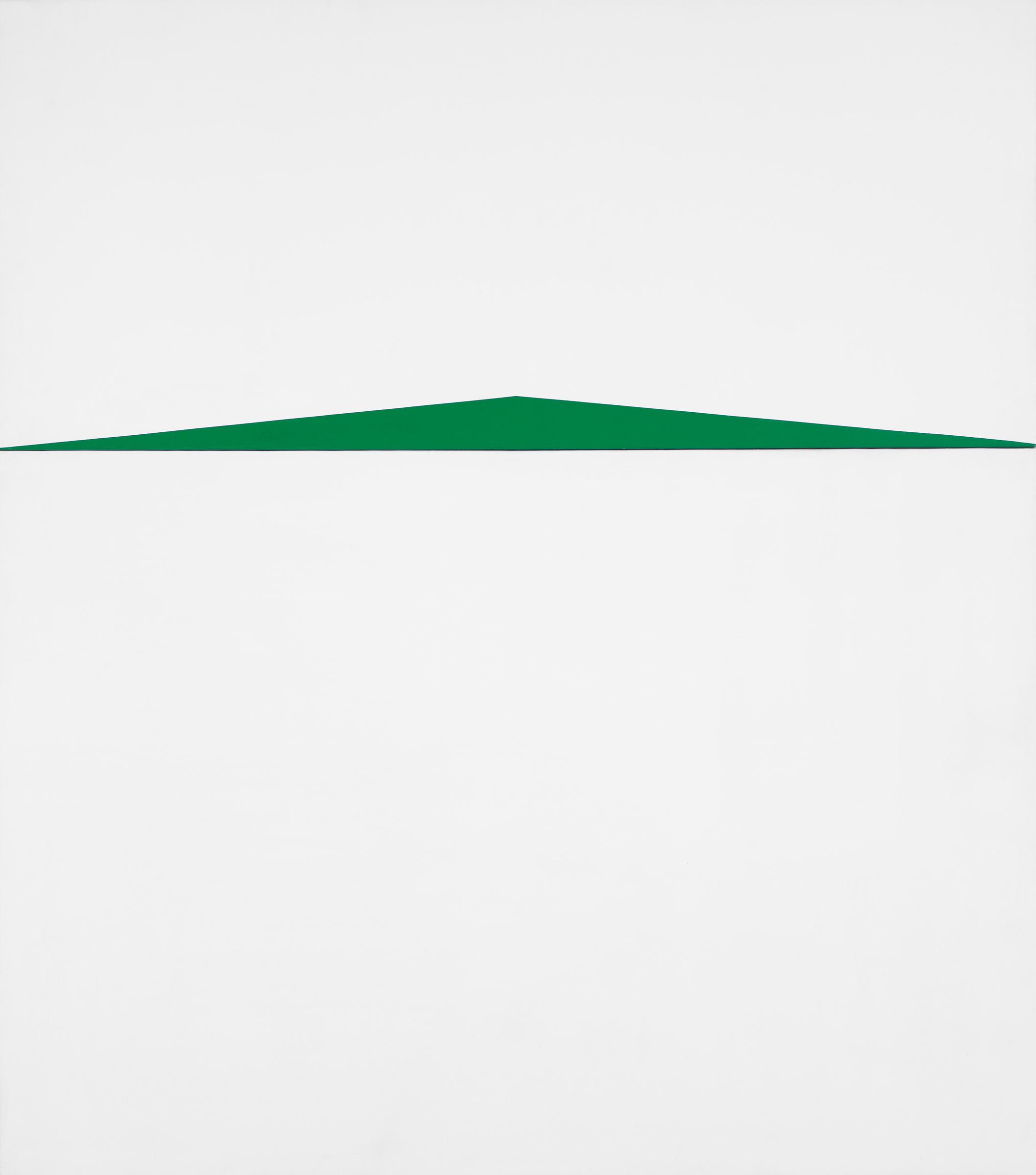
Carmen Herrera developed her hard-edged geometric language in the middle of the twentieth century, working between Havana, Paris and New York. She reduced compositions toward straight lines, angles and extremely limited palettes while artists such as Ellsworth Kelly and Frank Stella were becoming major figures in related areas of abstraction.
Herrera did not receive comparable recognition.
At the Whitney she later recalled a gallery owner telling her that she could paint circles around the men represented there but would not be given a show because she was a woman.
That story is uncomfortable precisely because the paintings themselves need no biographical excuse.
Look at Blanco y Verde. Herrera reduced some compositions almost absurdly far, using white and green forms while treating the edge of the canvas as an active part of the geometry.
Nothing is hiding.
When a work contains so little, every proportion matters.
Herrera is now discussed as an important figure in geometric abstraction, but that late recognition raises a larger problem. Art history often makes success look inevitable after it finally happens.
It was not inevitable.
A major artist can spend decades making strong work while the institutions responsible for recognising it simply look elsewhere.
Rediscovery does not make the work better.
It reveals how incomplete the original map was.
https://whitney.org/exhibitions/carmen-herrera
#CarmenHerrera #GeometricAbstraction #CubanArt #WomenArtists