Skip to content

A Machine That Suggested Music

Electronic Music

A Machine That Suggested Music

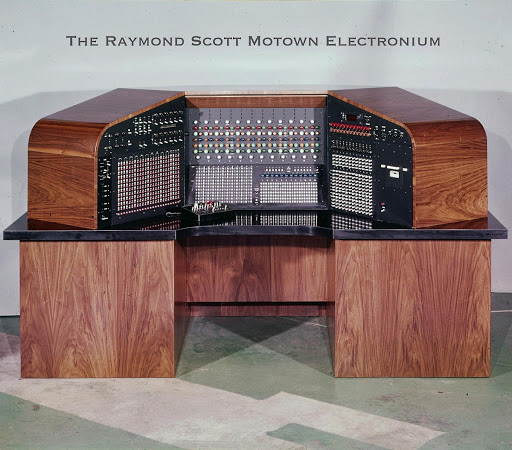
Raymond Scott’s Electronium was not simply an early synthesizer. It was conceived as a system that could generate and perform musical material automatically, using electronic circuits and algorithmic processes. Scott described the relationship as a collaboration between a person and a machine. The operator did not have to enter a finished score and press play. The machine could propose musical events while the composer adjusted, selected and redirected them.

That makes the Electronium difficult to place in the usual history of electronic instruments. A keyboard waits for instructions. A tape machine reproduces decisions already made. A sequencer repeats information placed into it. Scott was trying to build something less obedient: an instrument with enough internal behaviour to surprise its maker without removing the maker from the process.

The surviving machine was never turned into a stable commercial product, and descriptions of its capabilities changed as Scott continued developing it. That incompleteness is part of the story rather than a flaw to hide. Musical tools are often presented as finished solutions, while actual creative practice is full of unstable patches, provisional controls and systems that are never quite complete. The Electronium makes that unfinished state visible. Its most durable contribution may be the model of the studio as a place where composition can emerge through negotiation with a system, not only through commands given to it.

https://artsandculture.google.com/story/the-electronium%E2%80%94a-cockpit-of-dreams-raymondscottarchives/vgVRMrpuDa3FnQ?hl=en

#RaymondScott #Electronium #ElectronicMusic #MusicTechnology
A Machine That Suggested Music A Machine That Suggested Music Google Arts & Culture The Electronium—A Cockpit of Dreams - Google Arts & Culture The Electronium, conceived as a collaboration between man and machine, could instantaneously compose and perform music automatically using algorithms that were precursors of artificial intelligence. It is undoubtedly the magnum opus of Scott's electronic music career.
Facebook LinkedIn WhatsApp Threads
More sharing options
X Reddit Pinterest Telegram Email
Ambient Music

Water Without a Landscape

The 51 tracks on Synthetic Water Music do not try to agree on what water sounds like. Across two hours, the compilation moves between reflective surfaces, submerged tones, imagined currents and pieces whose connection to water is suggested more by texture than by direct imitation. Its scale makes it less like a concept album and more like a collection of listening tests.

Released by the Slovak label mappa on 10 September 2026, the set includes Pauline Anna Strom, Francesca Heart, Visible Cloaks and dozens of other contributors. The title is useful because the word “synthetic” removes any obligation to document a real river, sea or rainfall. Water can be reconstructed through synthesis, memory, naming or rhythm. A track does not need a field recording of waves to create a sense of liquid movement.

There is a practical production idea here. Sound design often begins by asking which device can reproduce a known sound. This compilation suggests another route: identify how a material behaves, then translate that behaviour. Water accumulates, reflects, leaks, repeats, erodes and changes shape around resistance. Those verbs offer more musical possibilities than the search for a convincing splash.

https://mappa.bandcamp.com/album/synthetic-water-music

#SyntheticWaterMusic #Mappa #AmbientMusic #SoundDesign

Water Without a Landscape Water Without a Landscape mappa Synthetic Water Music, by Various Artists 51 track album
Facebook LinkedIn WhatsApp Threads
More sharing options
X Reddit Pinterest Telegram Email
Experimental Music

When Moonlight Becomes Voltage

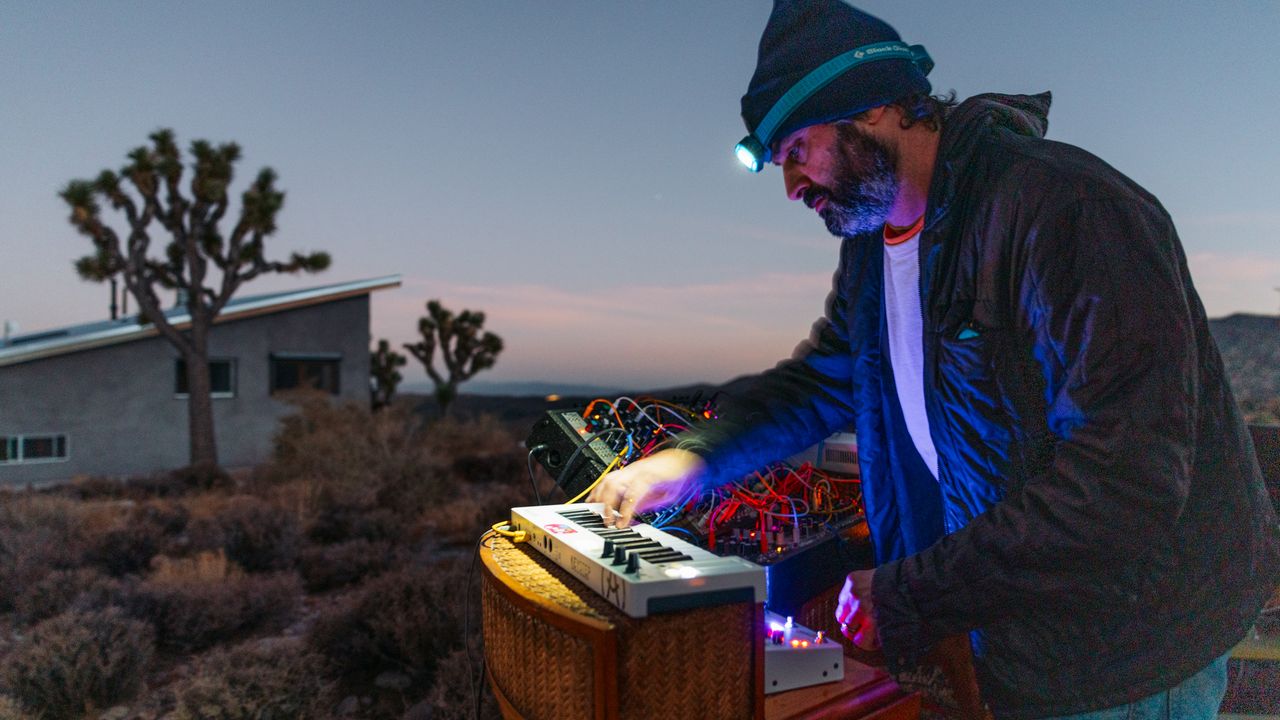
For The Sirens, Geologist and visual artist Kyle Simon did not use the night sky as a theme added after the music was made. At Simon’s Farrington Observatory in Joshua Tree, light from the moon, stars and planets entered a telescope fitted with optical sensors and photodiodes. An analogue amplifier converted that changing light into control voltage for Geologist’s modular system, where it could affect pitch, filtering, rhythm and other parameters in real time.

The distinction matters. This is not a recording of space, and the stars are not secretly composing a melody. Light becomes one influence inside a human-built chain: telescope, sensor, amplifier, patch and performer. Every stage translates the previous one, so the final sound is neither a neutral scientific reading nor an arbitrary musical illustration.

The album, due on 16 October 2026, grows from a single composition recorded in 2024. What stays with me is the modest role assigned to the celestial data. It does not replace musical judgement. It behaves more like an unstable control source, comparable to an envelope or low-frequency oscillator whose movement originates far beyond the instrument. A modular synthesizer is usually praised for precise control. Here its value lies in making room for a signal the musician can guide but cannot fully author.

https://pitchfork.com/story/geologist-reveals-new-album-the-sirens

#Geologist #ModularSynth #Photodiode #ExperimentalMusic

When Moonlight Becomes Voltage When Moonlight Becomes Voltage Pitchfork Geologist Reveals New Album The Sirens The LP, made with visual artist Kyle Simon, consists of a single composition manipulated by the “light of the full moon”
Facebook LinkedIn WhatsApp Threads
More sharing options
X Reddit Pinterest Telegram Email
Akoma

Rhythm as a Problem to Solve

Jlin has described composition as something close to a mathematical proof: the answers seem to be present, but the question still has to be discovered. It is an unusual way to explain music that feels so physical. Her percussion can arrive in hard clusters, sudden gaps and patterns that appear to turn away from a predictable downbeat, yet the detail never sounds casually scattered.

On Akoma, released in 2024, collaborators including Philip Glass, Björk and Kronos Quartet enter that rhythmic language without turning the album into a conventional crossover project. Their identities remain audible, but Jlin’s construction determines the space they occupy. Collaboration becomes another compositional constraint rather than a decorative guest appearance.

Thinking of rhythm as proof shifts attention away from loops alone. A pattern can establish a rule, interrupt it, return with one element displaced and make the earlier version newly legible. The pleasure comes partly from movement and partly from recognising the internal logic after the body has already responded.

Complex electronic rhythm is sometimes discussed as a display of programming skill. Jlin’s description points somewhere more interesting. Precision is not the subject of the music. It is the method that allows surprise to remain coherent.

On “Akoma,” Jlin Fuses Technical Precision with Boundless Imagination

#Jlin #Akoma #RhythmicComposition #ElectronicMusic

Rhythm as a Problem to Solve Rhythm as a Problem to Solve I CARE IF YOU LISTEN On "Akoma," Jlin Fuses Technical Precision with Boundless Imagination Tristan McKay speaks with composer/producer Jlin about her new album, and why she considers composition to be an exciting musical puzzle.
Facebook LinkedIn WhatsApp Threads
More sharing options
X Reddit Pinterest Telegram Email
ARP2500

A Synthesizer Moving Almost Imperceptibly

Éliane Radigue worked with one ARP 2500 for roughly three decades. She called it Jules. The instrument’s matrix switching system let her see signal paths without the dense patch-cord curtain found on many modular synthesizers, while its filters and feedback paths allowed extremely small changes to unfold over long durations.

The slowness of this music can initially suggest that very little is happening. Listening closely produces the opposite impression. Harmonics move in and out of focus, beating patterns form between neighbouring frequencies, and a tone that appeared stable several minutes earlier is no longer quite the same. The composition is not carried by a sequence of obvious events. It exists in the thresholds between them.

This is a useful counterpoint to the way synthesizers are commonly presented. Demonstrations tend to favour immediate contrast: open the filter, increase the resonance, change the waveform. Radigue made the smallest available movement carry structural weight. The machine was not used to generate an abundance of sounds, but to examine how much life could be found inside one slowly changing field.

That kind of attention cannot be automated by simply making an envelope longer. It depends on hearing when a minute adjustment is enough.

https://www.berlinerfestspiele.de/en/maerzmusik/stories/2022/story-eliane-radigue

#ElianeRadigue #ARP2500 #DroneMusic #ElectronicComposition

A Synthesizer Moving Almost Imperceptibly A Synthesizer Moving Almost Imperceptibly berlinerfestspiele.de The Universe of Éliane Radigue MaerzMusik sees itself as a place for artistic experiences, encounters and collective reflection. Developed from the perspective of listening and supported by contemporary music, the festival opens up a space in which life, art and theory can converge with concerts, performances, installations, music theatre, film presentations and discourse formats.
Facebook LinkedIn WhatsApp Threads
More sharing options
X Reddit Pinterest Telegram Email
Buchla

Space Was Part of the Patch

Suzanne Ciani did not treat quadraphonic sound as a larger stereo image. In her account of working with Don Buchla’s instruments, the four speakers were equal, and the position of a sound could be controlled with voltage. The Buchla 227 output module even included a function called Swirl, which could send sound continuously around the listening space at a controllable speed.

That distinction matters. Spatial audio is often added after a piece has been composed, as though location were another finishing effect beside reverb or compression. In Ciani’s setup, movement through the room could be linked to the same voltages shaping pitch, rhythm and timbre. A sound did not have to exist first and acquire a position later. Its trajectory could belong to its musical behaviour from the beginning.

This also changes what performance means. Turning a knob is not merely balancing loudspeakers. It is deciding how quickly a tone travels, whether it circles or remains fixed, and how one electronic gesture approaches the listener while another recedes. The room becomes part of the patch.

Today, immersive audio is often described by counting channels. Ciani’s work suggests a more useful measure: whether spatial movement has been composed with the same care as the sound itself.

https://www.womeninsound.com/issue-6/suzanne-ciani

#SuzanneCiani #Buchla #QuadraphonicSound #SpatialAudio

Space Was Part of the Patch Space Was Part of the Patch Women in Sound Zine Suzanne Ciani - Issue 6 — Women in Sound Zine Electronic music pioneer and composer Suzanne Ciani reflects on her 45 year relationship with Don Buchla and his instruments: “These machines are responsive. They communicate. They’re warm. They talk back.”
Facebook LinkedIn WhatsApp Threads
More sharing options
X Reddit Pinterest Telegram Email