Skip to content

Kraftwerk Rebuilding Autobahn From Tape

Alice Coltrane

The Alice Coltrane Records Almost Nobody Heard

Alice Coltrane is hardly an unknown musician, yet one of the most extraordinary parts of her catalogue spent years largely outside the normal music industry.

After establishing an ashram in California, she recorded devotional music during the 1980s and 1990s and distributed it primarily within that spiritual community on privately released cassettes. The recordings combined influences from the gospel music she had known in Detroit with Indian devotional practice. They also contain synthesizers, organ, harp, strings, percussion and choirs, and include some of the first recordings in her catalogue on which she sings.

These tapes complicate the familiar version of Alice Coltrane as simply an important spiritual-jazz musician connected to John Coltrane.

She was creating another musical system.

What interests me is the audience for which these recordings originally existed. They were not primarily trying to enter charts, jazz criticism or record-store culture. Music was functioning inside a community and spiritual practice.

When the recordings were later recovered from master tapes and brought to a wider audience, their context changed completely.

The music had not suddenly become important.

The rest of us had finally gained access to something that had been important somewhere else for decades.

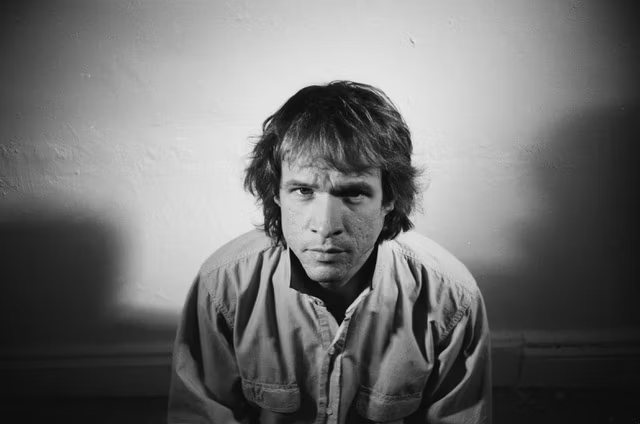
https://www.luakabop.com/products/copy-of-xx-world-spirituality-classics-1-the-ecstatic-music-of-alice-coltrane-turiyasangitananda

#AliceColtrane #SpiritualJazz #Synthesizer #MusicArchive

The Alice Coltrane Records Almost Nobody Heard The Alice Coltrane Records Almost Nobody Heard luakabop.com World Spirituality Classics 1: The Ecstatic Music of Alice Coltrane Turiyasangitananda by Alice Coltrane Turiyasangitananda - Luaka Bop Alice Coltrane Turiyasangitananda’s devotion to spirituality was the central purpose of the final four decades of her life, an often-overlooked awakening that largely took shape during her four-year marriage to John Coltrane and after his 1967 death. By 1983, Alice had established the 48-acre Sai Anantam Ashram outside of Los Angeles. She quietly began recording music from the ashram, releasing it within her spiritual community in the form of private press cassette tapes. On May 5, Luaka Bop will release the first-ever compilation of recordings from this period, making these songs available to the wider public for the first time. Entitled ‘World Spirituality Classics, Volume 1: The Ecstatic Music of Alice Coltrane Turiyasangitananda,’ the release is the first installment in a planned series of spiritual music from around the globe; curated, compiled and distributed by Luaka Bop. This powerful, largely unheard body of work finds Alice singing for the first time in her recorded catalog, which dates back to 1963 and includes appearances on six John Coltrane albums, alongside Charlie Haden and McCoy Tyner, and 14 albums as bandleader starting with her Impulse! debut in 1967 with ‘A Monastic Trio.’ The songs featured on the Luaka Bop release have been culled from the four cassettes that Alice recorded and released between 1982 and 1995: ‘Turiya Sings,’ ‘Divine Songs,’ ‘Infinite Chants,’ and ‘Glorious Chants.’ The digital, cassette and CD release will feature eight songs. The double-vinyl edition features two additional songs, “Krishna Japaye” from 1990’s ‘Infinite Chants, and the previously unreleased “Rama Katha” from a separate ‘Turiya Sings’ recording session. Luaka Bop teamed with Alice’s children to find the original master tapes in the Coltrane archive. The recordings were prepared for re-mastering by the legendary engineer Baker Bigsby (Ornette Coleman, Sun Ra, John Coltrane), who had overseen the original sessions in the 80s and 90s. The compilation showcases a diverse array of recordings in addition to Alice’s first vocal work: solo performances on her harp, small ensembles, and a 24-piece vocal choir. The release is dotted with eastern percussion, synthesizers, organs and strings, making for a mesmerizing, even otherworldly, listen. Alice was inspired by Vedic devotional songs from India and Nepal, adding her own music sensibility to the mix with original melodies and sophisticated song structures. She never lost her ability to draw from the bebop, blues and old-time spirituals of her Detroit youth, fusing a Western upbringing with Eastern classicism. In all, these recordings amount to a largely untold chapter in the life story of Alice Coltrane Turiyasangitananda. In addition to the recordings, GRAMMY-winning music historian Ashley Kahn has written extensive liner notes on the collection. The package also includes a series of interviews with those who knew Alice best, conducted by Dublab’s Mark “Frosty” McNeill, and an as-told-to interview between musician Surya Botofasina (who was raised on Alice’s ashram) and journalist Andy Beta. 2017 marks what would have been Alice’s 80th year of life, as well as the 10th anniversary of her passing. Alice will be celebrated at events throughout the United States, Europe and South America in the coming year. With this in mind, the time is right to bring this meaningful piece of Turiyasangitananda’s legacy into focus.
Arthur Russell

The Cellist Who Walked Into Disco

Arthur Russell arrived in New York as an experimental cellist and composer. Then, in 1977, an unexpected visit to a disco changed the direction of his work.

Instead of treating club music as intellectually inferior to experimental composition, Russell became fascinated by repetition and by what happened socially when people shared it on a dancefloor. He went on to make influential disco recordings while continuing to work with cello, voice, improvisation and the downtown avant-garde.

By World of Echo, the borders had almost disappeared. Cello and voice pass through echo and feedback until the processing feels inseparable from the composition itself.

What I like about Russell is that he makes our genre categories look unnecessarily rigid.

Disco and experimental music are often placed on opposite sides of an imaginary wall. One supposedly belongs to bodies and clubs, the other to listening rooms and ideas.

Russell seems to have heard repetition in both.

A cello phrase repeating through delay can become as hypnotic as a dance groove. A disco record can be as formally strange as an avant-garde composition.

His career is a useful reminder that experimental music does not need to sound difficult.

Sometimes the experiment is simply refusing to respect the border everybody else has agreed to keep.

https://www.laphil.com/people/arthur-russell

#ArthurRussell #WorldOfEcho #ExperimentalMusic #Disco

The Cellist Who Walked Into Disco The Cellist Who Walked Into Disco laphil.com Arthur Russell Arthur Russell arrived in New York as an experimental cellist and composer. Then, in 1977, an unexpected visit to a disco changed the direction of his work…
Daphne Oram

Drawing Automation Before the DAW

Daphne Oram imagined something remarkably close to visual music sequencing decades before a modern DAW existed.

Her Oramics system allowed a composer to draw information onto strips of 35mm film. Optical sensors translated those markings into control signals governing properties such as pitch, dynamics and timbre. Waveforms could also be drawn and scanned. Instead of turning knobs while tape rolled, Oram wanted musical behaviour to become something the composer could see and shape directly.

Look at a modern automation lane.

A line rises and the filter opens. Another curve changes volume. A timeline moves from left to right while parameters evolve.

The resemblance is difficult to ignore.

But Oram was developing these ideas in an era when electronic composition often meant physically cutting magnetic tape. She left the BBC in 1959 and pursued the system largely outside a major institutional studio, eventually producing a working prototype that remained an evolving experimental machine rather than a commercial product.

That may be why Daphne Oram still feels strangely absent from the popular history of synthesizers.

We remember products that reached shops.

We are less good at remembering machines that demonstrated what the future might look like before the market was ready to manufacture it.

https://www.daphneoram.org/oramicsmachine/

#DaphneOram #Oramics #ElectronicMusic #SynthHistory

Drawing Automation Before the DAW Drawing Automation Before the DAW Daphne Oram The Oramics Machine Daphne Oram imagined something remarkably close to visual music sequencing decades before a modern DAW existed. Her Oramics system allowed a...
Actual Life

Fred Again Turns Messages Into Memory

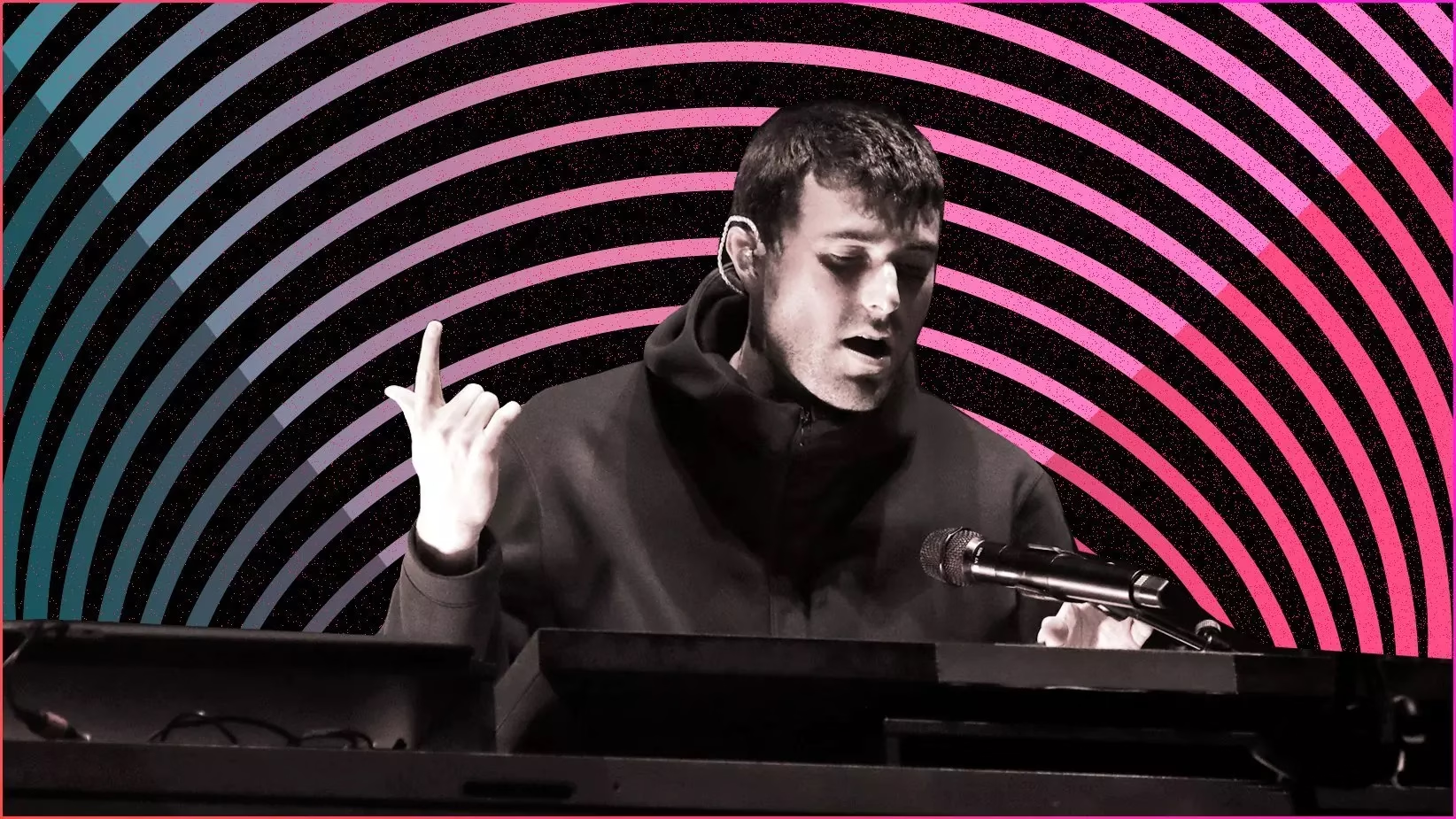
Fred again..’s Actual Life records are built partly from material that normally disappears into the endless flow of phones and social media: voice notes, FaceTime conversations, videos and fragments of everyday speech. On “Marea (We’ve Lost Dancing),” for example, words from The Blessed Madonna originated in a FaceTime conversation about the disappearance of communal dancing during the pandemic.

The interesting part is not simply that Fred samples people speaking. Hip-hop, musique concrète and electronic music have been transforming recorded voices for decades.

What changes is the status of the source.

A traditional sample often begins as something already public: a record, broadcast or film. A voice note was never necessarily intended to become culture at all. It may have existed only as communication between two people.

Fred moves that private fragment into a musical structure where thousands of strangers can attach their own memories to it.

The sampler becomes less like an instrument for borrowing music and more like a machine for preserving fleeting human moments.

There is also a production lesson in this. A technically imperfect recording can carry something a pristine studio vocal cannot reproduce: the circumstances in which it happened.

Sometimes the noise around a voice is part of why we believe it.

https://www.grammy.com/news/fred-again-2024-grammys-nominations-best-new-artist-dance/

#FredAgain #ActualLife #Sampling #ElectronicMusic

Fred Again Turns Messages Into Memory Fred Again Turns Messages Into Memory Grammy 6 Reasons Why Fred Again.. Was Dance Music’s Rookie Of The Year | Grammy Arguably dance music’s buzziest star in 2023, Fred again.. topped off a breakout year with four nominations at the 2024 GRAMMYs, including Best New Artist. Take a look at some of the producer/
Delia Derbyshire

Doctor Who Before the Synthesizer

The original Doctor Who theme sounds so electronic that it is easy to imagine a synthesizer behind it. There wasn’t one.

Ron Grainer supplied the composition in 1963, but Delia Derbyshire and Dick Mills at the BBC Radiophonic Workshop had to construct its electronic reality from tape, test oscillators, white noise and recorded sounds. Individual notes could be created, copied, cut, rearranged and played back at different speeds. Even the famous pulsing bass part grew from manipulated recordings rather than a modern sequencer.

That means the track was assembled through an extraordinary amount of physical work.

Today I can draw a note into Ableton, duplicate it thirty-two times and change its pitch in seconds. Derbyshire had to treat sound almost like film editing.

What interests me is how limitations shaped the final aesthetic. The theme does not sound futuristic despite primitive tools. It sounds futuristic partly because those tools forced its makers to invent procedures that normal instrumental recording did not require.

Delia Derbyshire is often mentioned as an electronic-music pioneer, yet that description can become another historical label we stop thinking about.

Listen again while imagining every splice.

The familiar suddenly becomes experimental again.

https://www.dwtheme.com/derbyshire/1963

#DeliaDerbyshire #DoctorWho #TapeMusic #RadiophonicWorkshop

Doctor Who Before the Synthesizer Doctor Who Before the Synthesizer Doctor Who: The Theme Doctor Who: The Theme — Derbyshire (1963) The original Doctor Who theme sounds so electronic that it is easy to imagine a synthesizer behind it. There wasn’t one. Ron Grainer supplied the compositi…
Autobahn

Kraftwerk Rebuilding Autobahn From Tape

Fifty years after Autobahn, Kraftwerk returned not to a software session but to the original 16-track analogue tapes. For the album’s 50th anniversary, Ralf Hütter reconstructed a Dolby Atmos version at Kling Klang Studio from those tapes. It is a curious meeting between two completely different eras of recording technology: a work made when multitrack tape was still a physical limitation, reopened inside a format where sound can occupy an entire three-dimensional field.

That makes me think differently about remastering.

Usually we imagine restoration as an attempt to get closer to an original. An Atmos reconstruction does something else. The source remains historical, but the listening architecture changes. Sounds that were originally committed to a stereo image can now be positioned around and above the listener.

Kraftwerk are particularly suited to that transformation because Autobahn was already about movement through an environment. The record does not simply describe a motorway. Its pulses, passing noises and electronic motifs create the sensation of travelling through one.

What fascinates me is that an old multitrack tape can contain spatial possibilities nobody could actually hear when it was recorded.

The future was already sitting on the reel. It just needed another room.

https://media.rhino.com/release-info/autobahn

#Kraftwerk #Autobahn #KlingKlang #ElectronicMusic

Kraftwerk Rebuilding Autobahn From Tape Kraftwerk Rebuilding Autobahn From Tape The Latest | Rhino Media The Latest | Rhino Media The Latest | Rhino Media
Frida Kahlo

Two Fridas, One Circulatory System

Frida Kahlo painted The Two Fridas in 1939, the year she divorced Diego Rivera. Two versions of Kahlo sit side by side holding hands. Their exposed hearts are connected by a blood vessel. One wears European-style clothing while the other wears a Tehuana dress associated with Mexican identity.

The painting is famous enough that its symbolism can become almost invisible through familiarity.

What keeps catching my attention is the circulation.

Kahlo does not simply place two identities beside one another. She physically connects them.

Blood moves between the figures.

That turns identity into something less stable than a split portrait suggests. The two selves are separate, but neither is completely independent.

I like this because the composition behaves almost like a diagram while remaining intensely emotional. Clothing gives us cultural information. Anatomy gives us another system of connections underneath it.

A double portrait could simply show contradiction.

Kahlo instead draws the plumbing between contradictions.

The line connecting the hearts may be the most important line in the painting.

https://www.museofridakahlo.org.mx/frida/?lang=en

#FridaKahlo #TheTwoFridas #MexicanArt #Painting

Two Fridas, One Circulatory System Two Fridas, One Circulatory System Museo Frida Kahlo Frida Frida Kahlo painted The Two Fridas in 1939, the year she divorced Diego Rivera. Two versions of Kahlo sit side by side holding hands. Their...
Editing Became the Dance

Editing Became the Dance Partner

Maya Deren’s A Study in Choreography for Camera lasts only a few minutes, but it does something that remains surprisingly modern. Dancer Talley Beatty begins a movement in one location and completes it somewhere completely different. Through precisely matched editing, a gesture can carry him from a forest into a domestic interior or museum space without appearing to stop.

The cut becomes part of the choreography.

That is what interests me from an audiovisual perspective.

Normally a camera records a dancer moving through physical space. Deren realised that cinema could create another kind of space entirely.

The body obeys continuity.

The location does not.

Today we can create far more complicated transitions using digital compositing, realtime graphics and projection systems, but technical complexity does not automatically improve the idea.

Deren needed only movement, framing and a cut.

The result demonstrates something useful for VJ work too: an edit becomes much stronger when it continues an action rather than merely replacing one image with another.

Movement can hide the cut.

The cut can extend the movement.

https://www.moma.org/collection/works/302825

#MayaDeren #ExperimentalFilm #FilmEditing #VisualRhythm

Editing Became the Dance Partner Editing Became the Dance Partner moma.org Maya Deren’s A Study in Choreography for Camera lasts only a few minutes, but it does something that remains surprisingly modern. Dancer Talley...
Nusrat Fateh Ali Khan

When Qawwali Met the Remix

Nusrat Fateh Ali Khan came from a family tradition of qawwali stretching back centuries, yet he was unusually open to placing that tradition inside unfamiliar musical environments. His 1990 collaboration with Canadian guitarist and producer Michael Brook, Mustt Mustt, moved qawwali into contemporary studio production without simply abandoning the voice and improvisational intensity at its centre.

The album even included a Massive Attack remix of the title track.

That interests me because remix culture and devotional music appear, at first, to come from completely different ideas about what music is for.

But both understand repetition.

Qawwali can build emotional intensity through repeated phrases and improvisational expansion. Electronic dance music can build intensity by looping material while gradually changing its context.

The meeting therefore makes more sense structurally than stylistically.

A remix does not necessarily need to reduce a tradition to a fashionable beat.

Sometimes two musical systems discover that they already share a way of building time.

https://realworldrecords.com/releases/mustt-mustt/

#NusratFatehAliKhan #Qawwali #RemixCulture #PakistaniMusic

When Qawwali Met the Remix When Qawwali Met the Remix Real World Records Mustt Mustt - Real World Records The late Nusrat Fateh Ali Khan is today acknowledged as the great master of Qawwali who popularised this beautiful and inspirational music beyond Muslim peoples to a worldwide audience. Mustt Mustt is the first of two albums on which the singer collaborates with Canadian producer Michael Brook to place the music in a contemporary setting.
Afro Peruvian

A Traditional Dance Enters the Club

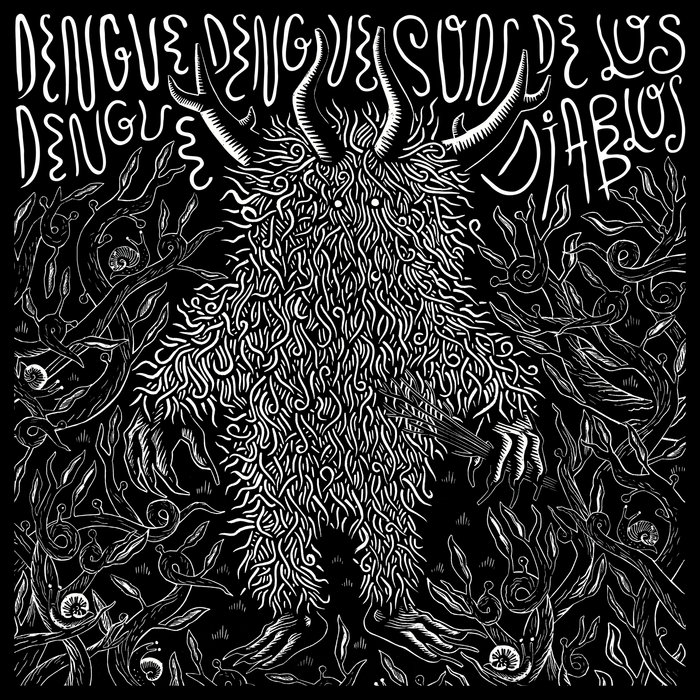
Peruvian duo Dengue Dengue Dengue named their 2018 EP Son de los Diablos after a traditional Afro-Peruvian dance whose name translates as “Sound of the Devils.” Their broader work has repeatedly connected Peruvian and Latin American rhythmic traditions with bass music, dub, techno and other forms of electronic production.

What interests me is what happens when a traditional form reaches the club without being treated as a museum object.

Electronic producers can easily sample an old recording, place a kick drum beneath it and call the result fusion. The more difficult approach is understanding which rhythmic or cultural characteristics can survive transformation.

Dengue Dengue Dengue work in that less obvious space.

The electronic system does not need to imitate the original instruments exactly. It can carry rhythmic memory through another set of machines.

Tradition then becomes neither untouched nor erased.

It behaves more like a source code that can run in another environment.

https://denguedenguedengue.bandcamp.com/album/son-de-los-diablos

#DengueDengueDengue #PeruvianMusic #BassMusic #AfroPeruvian

A Traditional Dance Enters the Club A Traditional Dance Enters the Club Dengue Dengue Dengue Son de los Diablos, by Dengue Dengue Dengue 4 track album
Deep Listening

Listening Below the Music

Pauline Oliveros developed Deep Listening from a deceptively simple distinction: hearing happens continuously, while listening involves attention. Her practice expanded from experimental composition and electroacoustic music into exercises that asked musicians and non-musicians to listen not only to performed sound but also to environments, thoughts and sounds normally filtered from awareness.

The idea feels increasingly relevant in a culture where almost everything competes for attention.

Music production can encourage the opposite behaviour. We solo tracks, isolate frequencies and decide which sound matters. Deep Listening widens the frame again.

What happens outside the track?

The ventilation system. Traffic through a wall. Someone shifting in a chair. Your own breathing.

None of these sounds needs to become a sample. Sometimes simply noticing them changes how you understand silence.

Oliveros described listening as going beneath the surface while remaining aware of the whole field of sound.

That makes listening itself feel like a compositional tool.

Before deciding what a piece needs, perhaps there is another question:

What is already sounding?

Deep Listening

#PaulineOliveros #DeepListening #ExperimentalMusic #SoundPractice

Listening Below the Music Listening Below the Music deeplistening.rpi.edu Deep Listening – The Center For Deep Listening Pauline Oliveros developed Deep Listening from a deceptively simple distinction: hearing happens continuously, while listening involves...