Skip to content

Textile Art

Art Stream
Cloth Can Carry Two

Cloth Can Carry Two Histories

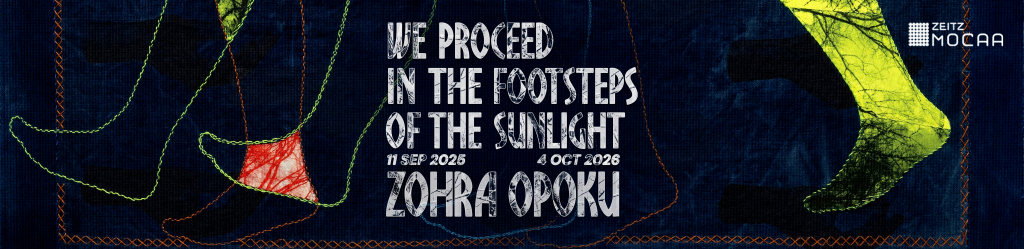
Zohra Opoku works between her upbringing in East Germany and her ancestral connections to Ghana, often using cloth, photography and personal imagery to explore identity and memory. What stays with me is that fabric already has a history before the artist touches it. It folds, travels, wears out and touches bodies. Memory does something similar. Perhaps that is why textile can feel more intimate than a perfectly clean surface.

We Proceed in the Footsteps of the Sunlight

#ZohraOpoku #GhanaianArt #TextileArt #Photography

Zeitz MOCAA We Proceed in the Footsteps of the Sunlight - Zeitz MOCAA Zeitz Museum of Contemporary Art Africa (Zeitz MOCAA) presents We Proceed in the Footsteps of the Sunlight, the first museum survey exhibition of Ghanaian-German artist Zohra Opoku. Tracing a decade of quiet revolutions in cloth, memory, and self, the exhibition brings together textured expressions of personal history and cultural inheritance, revealing an artistic journey in constant motion. […]
Aurelia Munoz

When Textile Starts to Fly

Aurèlia Muñoz pushed fibre beyond the wall. Her macramé structures, bird-kites and handmade-paper works treat weaving less as decoration than as a way of building space. What interests me is how something associated with softness can suddenly behave architecturally, suspended between sculpture and drawing. The knot becomes more than technique. It becomes a way of thinking in three dimensions.

https://www.museoreinasofia.es/en/exhibition/aurelia-munoz/

#AureliaMunoz #TextileArt #Sculpture #SpanishArt

museoreinasofia.es Aurèlia Muñoz The exhibition Aurèlia Muñoz. Beings plots an all-encompassing route through the work of an artist who is pivotal to an understanding of contemporary textile art. Involved in movements such as Nouvelle Tapisserie and the Escuela Catalana del Tapiz (the Catalan Tapestry School), Aurèlia Muñoz (Barcelona, 1926–2011) transcended the spheres of fabric, fibre and craft, her work drawing on a combination of ancestral techniques and contemporary resources to focus on the impact of post-industrial crises in land, water and aerial ecosystems, which emerged as large motifs in her oeuvre.  In this instance, her early collages and assemblages, with Surrealist and gothic influences, and large-scale pictorial embroidery pieces lead into an unseen ensemble of macramé structures from the collections of institutions in Spain, Europe and the USA. Her emblematic kite-sculptures and her final installations, produced with handmade paper, are also central to the show, as is a vast selection of maquettes and drawings displayed for the first time.   The exhibition, with a title referring to one of Muñoz’s core concepts — entes (beings) — spans the fifty or more years of her multifaceted practice, crafting an unprecedented view that seeks to open fresh perspectives on her unique legacy.   The exhibition will also be on view at Museu d’Art Contemporani de Barcelona (MACBA) from 5 November 2026 to 29 March 2027.
Anni Albers

Thread as Modernism

Anni Albers treated weaving as more than decoration. At the Bauhaus and later Black Mountain College, textile became a way to think through structure, repetition, colour and material itself. What interests me is how modern the work still feels without needing a screen or machine. A grid made from thread can carry the same precision we now associate with pixels.

https://shop.tate.org.uk/anni-albers-exhibition-book-paperback/20189.html

#AnniAlbers #TextileArt #Bauhaus #Modernism