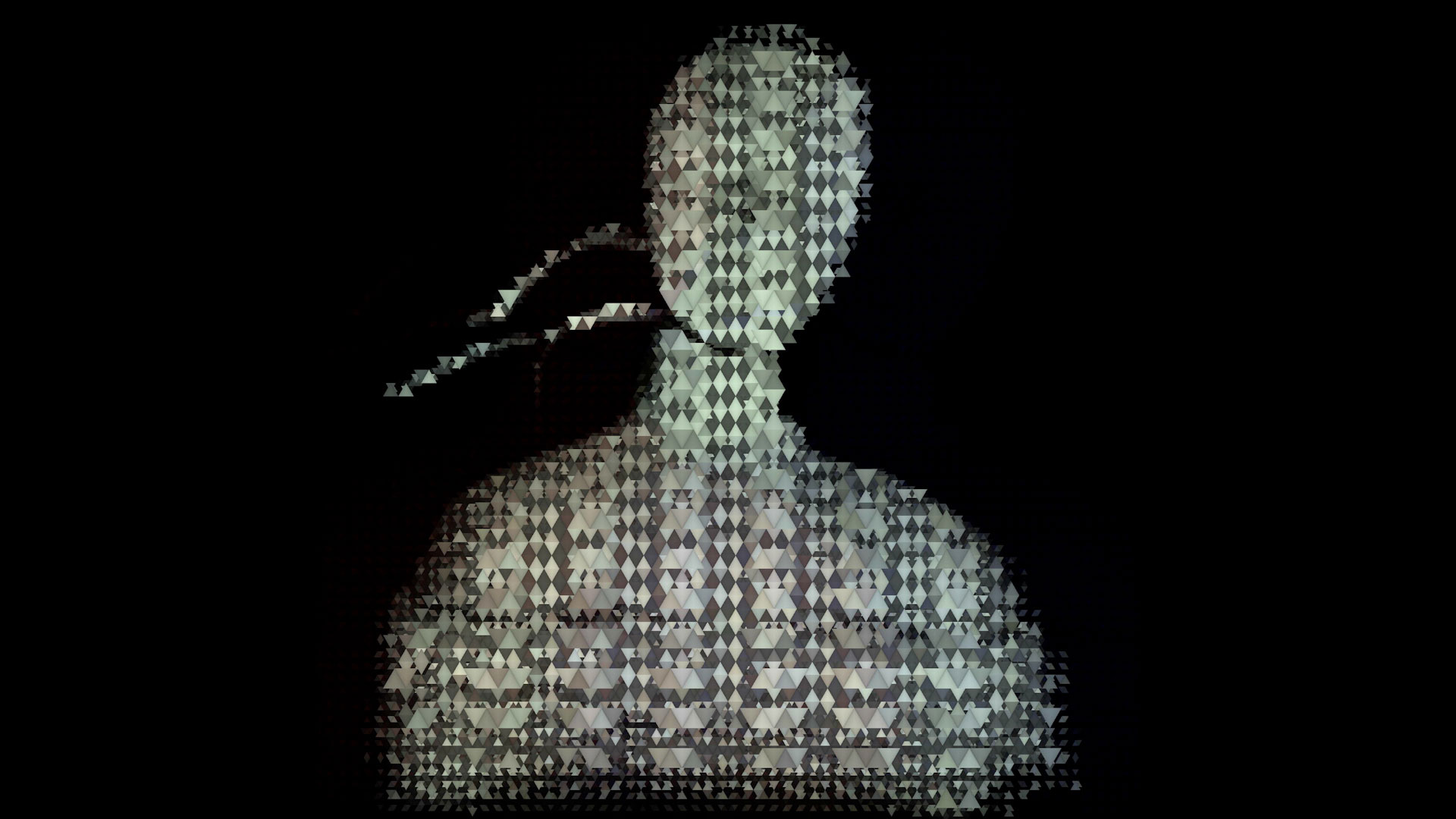
This post is about my VJ projection setup in Resolume for Orphic, performed at Bring Your Own Beamer Antwerp on Friday 30 January 2026. It covers the tools, the process, and what I learned from showing the work in a live public space.
Orphic is a composition of nine images arranged in a strict square grid, exploring themes like transit, war, climate, and the stillness of public space during Covid. The room was full of moving images from different artists, but what stayed with me was how calm the experience could be — light on a wall, people passing, small pauses between scenes.
The visuals — Resolume and Adobe Premiere
The projection was built in Resolume Arena. I used it to compose and mix the visual layers live during the performance. First, all source material — the nine-image grid, the transitions, the timing — was prepared and edited in Adobe Premiere Pro. Then I exported the clips optimized for Resolume and built the composition with separate layers per image zone.
My workflow was as follows. First I edited and graded all footage in Premiere. Second I exported clips optimized for Resolume. Third I built the composition in Resolume with separate layers per image zone. Finally I mapped the output to the projection surface using Resolume’s output transform.
The strict square format of Orphic worked well with Resolume’s slice and dice mapping. As a result, each of the nine images could breathe independently while staying locked in the grid. This VJ projection setup in Resolume gave me the flexibility to respond to the room in real time.and dice mapping. Each of the nine images could breathe independently while staying locked in the grid.
The music — Ableton Live
The Instruments
The soundtrack for Orphic was composed in Ableton Live and released under my music alias FDR-Sound. It was the first time I performed the track live alongside the projection.
The sound palette was built around four synthesizers. First, Surge XT provided the main atmospheric layers — its modulation system gave the piece its slow, evolving texture. In addition, Vital handled the more harmonic, pad-like elements with its spectral warping. Dexed, an FM synthesis engine modelled on the classic DX7, added metallic and bell-like tones underneath the main layers. Finally, Serum 2 was used for the more defined melodic moments where precision mattered.
Processing and effects:
The Mix
The mix was shaped with a focused chain of plugins. TDR SlickEQ handled the tonal balance across all channels — transparent and musical. TDR Nova served as a dynamic equalizer on the bus, catching frequencies that only appear under certain conditions. Ozone Imager widened the stereo field without losing mono compatibility, which is important for a live projection space with a single stereo source.
For space and atmosphere, Valhalla Supermassive was essential — its vast reverb and delay algorithms gave the piece its sense of depth and scale, matching the physical size of the projection on the wall.
On the arrangement side, Ableton’s own Arpeggiator introduced rhythmic movement into otherwise static chords. The Auto Filter shaped the tonal evolution over time, opening and closing the frequency spectrum to create tension and release. Echo added a further layer of spatial depth to specific elements.
The live test:
Hearing Orphic in that room — with the projection surrounding it — was the first real test. The space changed everything. Some parts needed more room, some held better than expected. That feedback from a live setting is something you cannot get from studio monitors alone.
The full track is available soon on Spotify — search FDR-Sound.
What I learned
Three things stood out from this performance.
First, the room matters. A projection that looks controlled on a screen becomes something physical when it fills a wall and people walk past it. Second, Resolume’s live mixing gave me flexibility I didn’t expect to need — but did. Small adjustments in pacing, brightness and layer opacity made a real difference. Third, performing your own music alongside your own visuals in a room full of people is the fastest feedback loop there is.
This VJ projection setup in Resolume is now the foundation for future performances.
What’s next
I’m refining Orphic further — both the visuals and the music. If you want to follow the process, explore my Creative Coding work or follow the blog for new posts about VJ workflow, generative art and music production.