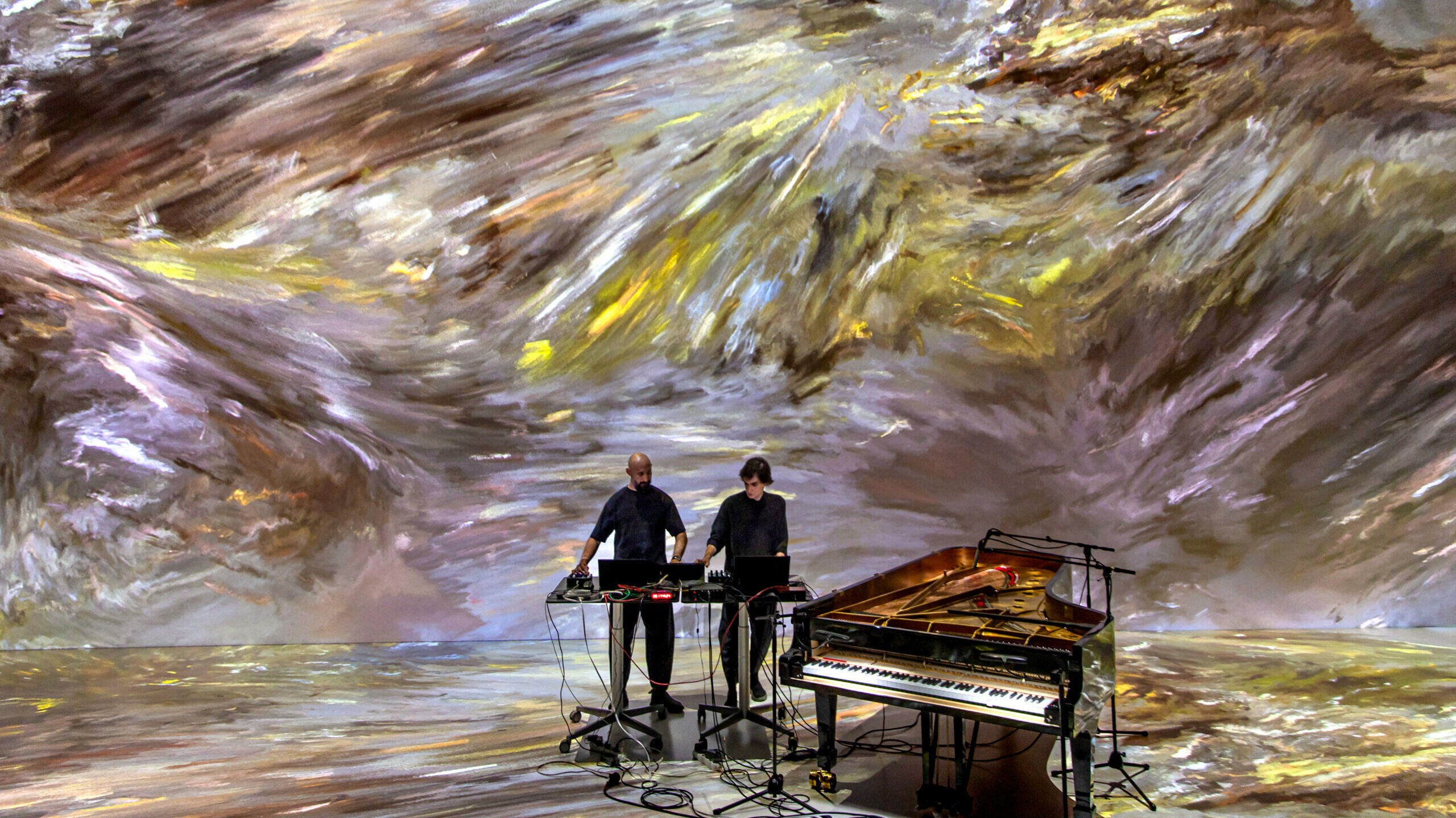
Quayola and Seta’s Transient is an audiovisual concert for two motorized pianos and video projection. The performers improvise with complex algorithms that generate musical and visual structures in real time. The piano is recognizably acoustic, but it no longer represents a protected human tradition standing opposite the machine.
Because the instruments are motorized, the boundary between performance and automation remains visible. Keys move, hammers strike and acoustic bodies resonate, even when algorithmic processes participate in the decisions. The mechanism becomes part of the image. Unlike a software piano hidden inside a computer, these instruments displace air in the same room as the audience.
The word transient is especially precise here. In audio, a transient is the brief attack that gives a sound its definition. In the concert, every generated event is also temporary, one outcome selected from many possibilities. The projection makes those decisions perceptible as changing structures rather than translating each note into a decorative flash.
For audiovisual work, this offers a stronger model than synchronization alone. Sound and image can share a rule without displaying the same event. A rhythmic density might influence the fragmentation of the image while pitch shapes spatial position. The relationship remains legible, but neither medium becomes a subtitle for the other.
The credits reveal how collective such an apparently self-generating work actually is. Software developers, sound-tool designers, an orchestrator and production collaborators all contributed to the system. The algorithms perform, but they do so inside an instrument assembled through many human decisions.
#Quayola #Transient #AlgorithmicMusic #GenerativeVisuals #MechanicalPiano