Skip to content

Field Recording

Field recording captures sound outside the conventional studio, from natural environments and city spaces to machines, voices and incidental noise. The recordings can function as documents, compositional material or the foundation of immersive sound works.

An Estuary Edited Into One Journey

Chris Watson’s Trent Falls follows the Humber Estuary from Goole Docks toward the North Sea, but it is not a continuous recording of one trip. Watson gathered material over nearly two years, then compressed different locations, seasons and events into a single spatial passage. Reeds, birds and grey seals share the route with a freight…


Read more

An Album Composed Between Train Stations

Brussels producer Le Motel made much of Pozo de Agua outdoors or while travelling, especially on trains. The album, due on 15 September 2026 through Constellation Tatsu, treats environmental recordings such as water, movement and air with the same compositional weight as more conventional instruments. Those materials drift through ambient electronics and overlapping rhythmic structures…

Read more

Depeche Mode Went Looking for Metal

During the making of Construction Time Again, Depeche Mode discovered sampling and immediately started looking beyond conventional instruments. For “Pipeline,” Martin Gore, Gareth Jones and the group went into Shoreditch recording metal objects, pipes, steel plates and other found sounds. Engineer Gareth Jones recalls drumsticks and hammers striking objects around a disused railway environment. Gore’s…

Read more

Amon Tobin Turned Recordings Into Instruments

Amon Tobin’s relationship with sampling changed dramatically over time. His earlier work often began with fragments taken from existing records. By Foley Room, he had moved toward recording his own material, gathering sounds from environments that included animals, machines and factories. With ISAM in 2011, he pushed that process further. Field recordings became raw material…

Read more

Listening Through the Hands

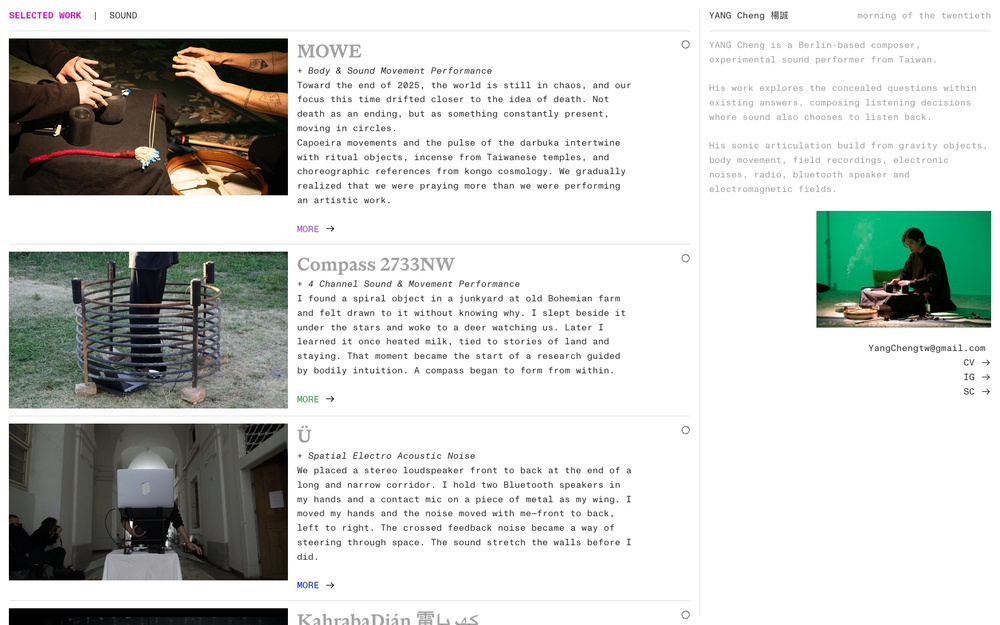
Taiwanese experimental composer Yang Cheng describes abandoning a conventional field-recording setup while travelling around Taiwan. Instead, he attached microphones to his palms and listened through his hands. That small technical decision completely changes the idea of recording a place for me. A normal field recorder encourages distance. Point the microphones toward an environment, remain quiet…

Read more

Recording a City That Is Already Playing

Ruby Solly’s P?neke treats Wellington not simply as the place where an album was recorded but as an active participant in the composition. Solly, a K?i Tahu, Waitaha and K?ti M?moe musician and taonga p?oro practitioner, connects cello, voice and traditional M?ori instruments with environmental recordings and histories embedded in specific locations. On “Koukou,” for…

Read more

The Subway Became Part of the Synthesizer

When Robert Henke and Gerhard Behles travelled to Hong Kong in 1996 for the International Computer Music Conference, Henke carried a recorder through Hong Kong and Guangzhou. Those field recordings later became part of Monolake’s Hongkong. The closing track, “Mass Transit Railway,” is based on sound captured inside a Hong Kong subway train. The album…

Read more

Listening Before Making Sound

KMRU’s work repeatedly begins with recording environments. Joseph Kamaru has built compositions from field recordings gathered in Nairobi and many other places, treating apparently minor environmental sounds as material worthy of sustained attention. His practice has expanded into installations, performances and long-form ambient works in which place is not simply captured but reshaped through processing…

Read more

What’s In A Name

Creating a soundscape that transports the listener to the heart of a rainforest can be a challenging task. However, with the help of electronic tools, it is possible to recreate the natural sounds of the jungle. We need to identify the different elements that make up a rainforest soundscape. The most obvious ones are the…