Chapter 5: Modern Art
1. Impressionism to Post-Impressionism: Experimentation with color and form
Impressionism (c. 1860-1890)
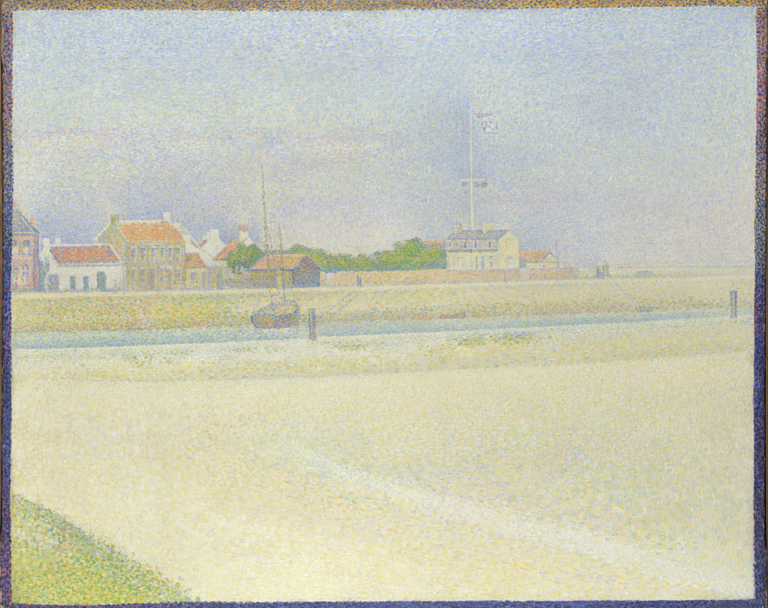
Impressionism emerged in France in the late 19th century as a radical departure from traditional painting techniques. The style is characterized by its emphasis on accurate depiction of light, color, and atmosphere, often at the expense of formal detail.
Impressionist artists aimed to capture fleeting moments and transient effects of light and color, making them pioneers in outdoor painting. They often painted everyday scenes and people, moving away from the historical, religious, and mythological themes that dominated academic art.
The works of Claude Monet, Pierre-Auguste Renoir, and Edgar Degas are typical of the Impressionist style. Monet’s series of ‘Water Lilies’ and ‘Haystacks’, with their emphasis on changing light and color, embody the ethos of Impressionism.
Post-Impressionism (c. 1886-1905)
Post-Impressionism emerged as a reaction against the limitations of Impressionism. While Post-Impressionists continued the use of bright, often unnatural colors, they sought to inject more form and structure into their work, and they often used color and form symbolically or expressively.
Post-Impressionist artists explored various individual paths, often focusing on emotional, symbolic, or spiritual elements. They weren’t a unified movement but rather a group of artists who shared a dissatisfaction with the lack of structure in Impressionist paintings.
Vincent van Gogh, Paul Gauguin, and Paul Cézanne are among the most notable Post-Impressionist artists. Van Gogh’s ‘Starry Night’ exemplifies the use of bold, dramatic brushwork and intense colors to convey emotion. Cézanne, with his analytical approach to form as seen in ‘Mont Sainte-Victoire’, was a significant influence on the development of 20th-century art, particularly Cubism.
In conclusion, Impressionism and Post-Impressionism marked a significant departure from traditional art forms, placing new emphasis on the individual perception and experience of the artist. Through their experiments with color and form, these movements set the stage for the various modern art movements of the 20th century.
2. Expressionism, Cubism, and Surrealism: Breaking the mold of traditional art
Expressionism (c. 1905-1925)
Expressionism emerged in the early 20th century as an art movement centered primarily in Germany. Rather than trying to represent the world objectively, Expressionists sought to depict subjective emotions and responses that objects and events arouse within a person. Expressionist artists distort reality for an emotional effect and to evoke moods or ideas.
Two notable groups within Expressionism were Die Brücke (The Bridge) and Der Blaue Reiter (The Blue Rider). Artists such as Edvard Munch, Wassily Kandinsky, and Egon Schiele employed vivid colors, thick, gestural brushstrokes, and often shocking or disturbing subject matter to convey a range of psychological and emotional states.
Cubism (c. 1907-1914)
Cubism, initiated by Pablo Picasso and Georges Braque, represented a radical breaking away from traditional representation of subjects. Cubist artists fragmented their subjects into geometric forms, presenting multiple viewpoints simultaneously, abandoning one-point perspective that had been used since the Renaissance.
Analytical Cubism and Synthetic Cubism are two phases of the Cubist movement. Analytical Cubism focused on breaking down objects into geometric forms and muted colors, as seen in Picasso’s ‘Les Demoiselles d’Avignon’. Synthetic Cubism, on the other hand, incorporated different textures, surfaces, collage elements, and a variety of shapes and forms, as illustrated by Braque’s ‘Fruit Dish and Glass’.
Surrealism (c. 1924-1940s)
Surrealism, rooted in the groundbreaking work of Sigmund Freud on dreams and the subconscious, sought to reconcile the contradictory conditions of dream and reality. Surrealists created bizarre, illogical, and hallucinatory images that often made use of unexpected, irrational juxtapositions.
Salvador Dalí and René Magritte were two of the most famous Surrealists. Dalí’s ‘The Persistence of Memory’, with its melting clocks, and Magritte’s ‘The Treachery of Images’, which challenges the viewers’ perception of reality, embody the Surrealist ethos.
In conclusion, Expressionism, Cubism, and Surrealism fundamentally challenged and redefined traditional conceptions of artistic representation. They reflected a sense of disillusionment following World War I, and responded to the rapid societal changes and scientific advancements of the time, including the rise of psychoanalysis and the theory of relativity. By breaking the mold of traditional art, these movements paved the way for later modern and contemporary art movements.
3. Discussion: How modern art reflected and influenced a rapidly changing world
The rapid changes that occurred during the late 19th and early 20th centuries profoundly influenced the evolution of modern art. The industrial revolution, urbanization, significant scientific discoveries, and two devastating world wars, among other factors, created a sense of anxiety, disillusionment, and a desire to break with tradition.
Modern Art as a Reflection of a Changing World
Modern art movements such as Expressionism, Cubism, and Surrealism reflected the tension, uncertainty, and rapid change of this period. Expressionism, with its emphasis on depicting emotional reactions to the world, can be seen as a response to the anxiety and alienation experienced by many during these turbulent times.
Cubism, with its fragmented forms and multiple perspectives, reflects the period’s scientific and technological changes. The abandonment of single-point perspective can be seen as a parallel to the shifting viewpoints brought about by advances in physics and the upheaval of societal norms.
Surrealism, influenced by the emergence of psychoanalysis, delved into the realm of dreams, the subconscious, and the irrational, mirroring new ways of understanding the human mind and the complexities of the modern world.
Modern Art as an Influence on a Changing World
At the same time, these modern art movements did not merely reflect the world but also helped shape it. By challenging traditional artistic conventions, these movements questioned societal norms and opened up new ways of seeing and understanding the world.
Expressionism, by valuing emotional experience over objective reality, championed individual perception and feeling, a significant shift in the prevailing moral and aesthetic values.
Cubism, through its radical reconfiguring of form and perspective, challenged the traditional ways of representing the world, paving the way for further abstraction in art and influencing fields as diverse as architecture and literature.
Surrealism, with its exploration of the subconscious and emphasis on dreamlike imagery, had a profound influence on film, literature, and popular culture. It encouraged a broader exploration and acceptance of the irrational and the subjective in human experience.
In conclusion, the modern art movements of the late 19th and early 20th centuries both reflected and influenced the rapidly changing world in which they arose. They captured the spirit of the time, marked by upheaval and anxiety, but also by innovation and the potential for radical change. They broadened the possibilities of what art could be and how it could influence society, laying the groundwork for the diverse range of artistic expressions that exist today.