|

VCV Kick

Een donkere kick in VCV Rack (gratis modules, 120 BPM)

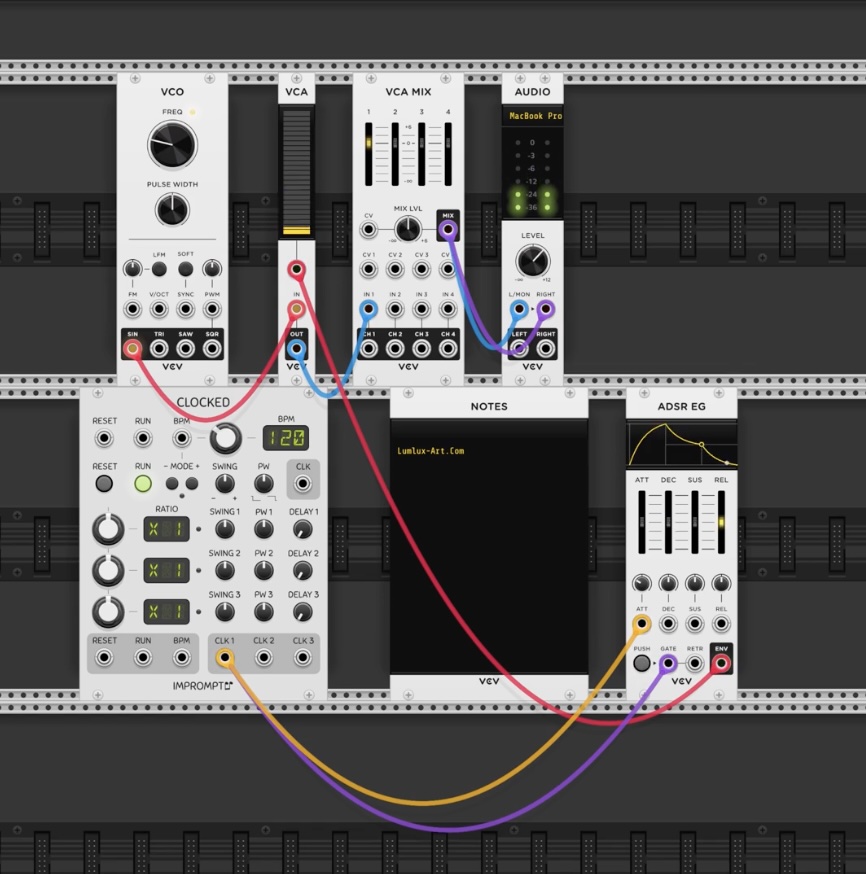
Een krachtige, gecontroleerde kick vormt de ruggengraat van veel elektronische stijlen. In dit korte stuk deel ik het geluid dat ik nastreef voor mijn eigen tracks: een diepe body op basis van een sinusgolf, een strakke envelope voor punch, en een subtiele pitch-dip die gewicht toevoegt zonder cartoony te worden. Alles is gebouwd in VCV Rack met alleen gratis modules uit de officiële Library, draaiend op 120 BPM: eenvoudig, herhaalbaar en klaar voor gebruik in een systeem.

Dit artikel is het startpunt en de luisterreferentie. In een vervolg toon ik de exacte patch, zodat je die in enkele minuten kunt nabouwen.

Wat je zult horen

  • Gefocust laag dat zelfverzekerd onder baslijnen en akkoorden zit.
  • Snelle, muzikale transient: helder op kleine speakers, stevig op grotere systemen.
  • Minimale processing, maximale vertaling naar verschillende ruimtes en afspeelsystemen.

Ontwerpfilosofie

Deze kick draait om vorm en beweging, eerder dan om zware processing:

  • Vorm: een sinusgolf houdt het spectrum zuiver; een korte amplitudecurve verandert de noot in een strakke, percussieve dreun.
  • Beweging: een heel snelle, heel kleine pitch drop creëert het gevoel van impact, alsof een drumvel ontspant na de aanslag. Je voelt het meer dan je het hoort.

Waarom VCV Rack?

Met VCV Rack kun je snel prototypes maken en op het gehoor leren. Met gratis modules kun je:

  • Elke fase van de kick controleren (oscillator, amplitude en optionele transient).
  • Headroom behouden en modderigheid vermijden vóór het mixen.
  • Variaties opslaan en veranderingen automatiseren voor performance.

Luisteraantekeningen

  • Hoofdtelefoon: let op de vloeiende sub en de micro-dip aan het begin.
  • Kleine speakers: de punch blijft helder zonder harde klik.
  • Grote systemen: het laag komt stevig binnen, terwijl er ruimte blijft voor bas en atmosfeer.

Waar dit geluid past

  • Minimale grooves met een ambient-inslag: werkt goed samen met eenvoudige hi-hatpatronen en subtiele akkoordstabs.
  • Live jams: slechts een paar knoppen om mee te spelen: lengte, diepte van de pitch-dip en algemeen volume.
  • Productie: een betrouwbaar startpunt dat minimale EQ en compressie nodig heeft.

§


ADSR Ambient Ambient Music Apollo Reverb Apple Music Art Artists Blues Call Me Classical Music Color contemporary Cubism Dance Digital Art EDM Electronic Music Exhibition Expressionism Fashion FDR-Sound Impressionism Jazz Kick London Minimalist Modules Music Painting Picasso Playlist Sound Soundscape Sounnay Trilogy Spotify Surrealism Travel UK USA VCA VCO VCV VCV Rack VJ Willy De Sauter

Similar Posts

  • | | |

    Orphic

    Orphic Orphic unfolds as a field of nine images, brought together within a strict square composition. Inside that frame appear scenes that mark our time: people in constant transit, war, a cemetery, polluted air, crumbling ice caps, the emptiness of public space during the Covid period, and a rubbish dump. Each image stands on its…

  • |

    Björk

    Björk Guðmundsdóttir, known as Björk, is a pioneering artist celebrated for her eclectic blend of musical genres including electronic, pop, and experimental sounds. Emerging from Iceland, her work reflects a deep connection to her cultural roots and the natural environment. Over her four-decade career, she has innovated music production, exemplified by her app-based album “Biophilia.” Björk’s distinctive visual style and bold fashion choices further enhance her influence in pop culture. As a vocal advocate for environmental issues, her artistry transcends music, embodying a multifaceted creative vision that continues to inspire others.

  • | |

    3D Cubes x Orphic Overlay — Creative Coding in p5.js

    This post covers a creative coding study in p5.js, where I combine two visual languages in one frame: a strict 3D structure of nested wireframe cubes and a flat 2D layer inspired by Sonia Delaunay and Orphism. I designed the result specifically for VJ projection and ambient music performance. Two Systems in One Image I…

  • Classical Music

    Classical music, spanning from the Middle Ages to the present, showcases a rich historical evolution and diverse styles. The Medieval period’s Gregorian chants and the emergence of polyphony laid foundations for Western music. The Renaissance brought intricate polyphony and secular themes, while the Baroque period emphasized contrast and expressiveness. The Classical era favored simplicity and balance. The Romantic period sought emotional expression, and the 20th century saw unprecedented experimentation. This living tradition continues to evolve in the 21st century, reflecting the complexities of the modern world. Classical music’s enduring influence extends beyond concert halls, permeating popular culture.

  • | |

    EDM

    Electronic Dance Music (EDM) has evolved from the late 1960s and 1970s experimental music, significantly influenced by disco, into a global phenomenon. Key subgenres like house, techno, trance, dubstep, and drum and bass emerged, becoming culturally significant through underground raves, mainstream success, and massive festivals like Ultra Music Festival. The genre’s commercial success impacts diverse facets of popular culture, including fashion and media, while technological advancements in production revolutionize how music is created and performed. Despite criticisms, EDM’s future remains bright as it continues to connect and inspire audiences worldwide.

  • |

    The Evolution of Music

    This content traces the evolution of music from the Classical era to modern times, highlighting key genres and influential artists. It discusses how the Classical period, characterized by composers like Mozart and Beethoven, laid foundational structures in music. The emergence of jazz in New Orleans, led by icons such as Louis Armstrong, showcased improvisation and cultural fusion. Rock ‘n’ roll, spearheaded by figures like Elvis Presley, transformed youth culture in the 1950s. The British Invasion further innovated music, paving the way for disco, funk, soul, and later digital transformations in the 2000s and 2010s.

Leave a Reply

Your email address will not be published. Required fields are marked *