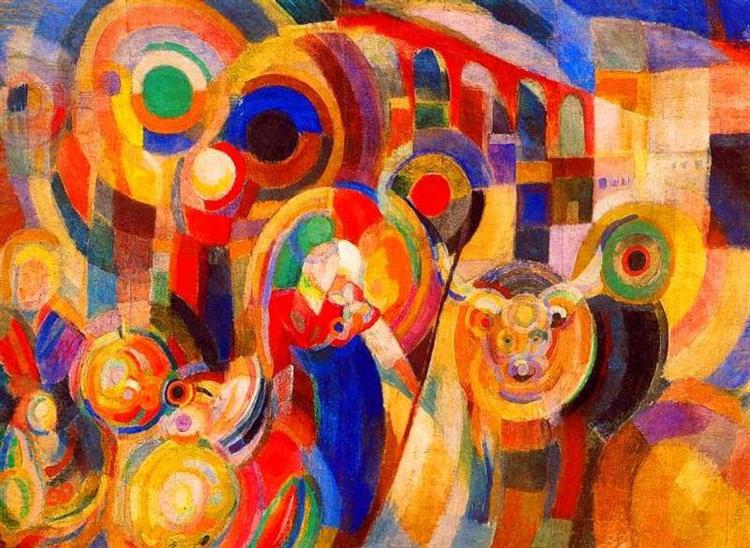
A Confluence of Color and Form
§

Introduction
Sonia Delaunay, born as Sarah Ilinitchna Stern on November 14, 1885, in Gradizhsk, Ukraine, and later known for her innovative contributions to art and design, was a trailblazer who shaped the trajectory of 20th-century modernism. Throughout her career, Delaunay worked in a variety of media and forms, spanning from painting and textiles to fashion and theater design. Along with her husband, Robert Delaunay, she developed a unique style known as Simultanism, which emphasized the interplay of colors and forms in abstract art. Sonia Delaunay’s multidisciplinary approach and fearless experimentation made her a pivotal figure in both the fine arts and applied arts. This essay explores her life, her artistic philosophy, her influence on art and fashion, and her legacy in the history of modern design.
Early Life and Influences
Sonia Delaunay was born into a modest Jewish family in Ukraine. When she was a young child, she was sent to live with her uncle, Henri Terk, and his wife Anna in St. Petersburg. Her uncle, a wealthy lawyer and art collector, provided her with a privileged upbringing, giving her access to a cultured environment. It was in St. Petersburg that Delaunay first became exposed to art, culture, and a sophisticated lifestyle that would deeply influence her future career.
Delaunay’s artistic potential was evident early on. Encouraged by her uncle, she was sent to study in Germany at the prestigious Karlsruhe Academy of Fine Arts. However, the true turning point in her artistic development came when she moved to Paris in 1905, at the age of 20, to study at the Académie de la Palette. Paris, at that time, was the center of the art world, and the city was buzzing with revolutionary ideas. The early 20th century was marked by artistic movements like Cubism, Fauvism, and the emergence of abstraction, all of which would have a significant impact on her work.
One of the key influences on Delaunay’s early work was the vibrant color and bold, non-naturalistic approaches of the Fauves, including artists like Henri Matisse and André Derain. The Fauves’ use of vivid color as a primary expressive tool left a lasting impression on her. However, it was not until she met and married Robert Delaunay in 1910 that her artistic style truly began to evolve into its distinctive form. Together, the Delaunays developed their own theoretical framework for understanding color and abstraction, and it would be the foundation of much of Sonia’s work for the rest of her life.
Simultanism and the Theory of Color
Sonia and Robert Delaunay’s shared artistic philosophy was based on the concept of Simultanism (or Orphism, as it was later termed by the poet and art critic Guillaume Apollinaire). This theory was largely inspired by the work of Michel-Eugène Chevreul, a 19th-century chemist who studied color theory, particularly the way that colors interact with each other when viewed in proximity. Chevreul’s idea of simultaneous contrast—that is, how two adjacent colors affect each other’s appearance—was central to the Delaunays’ approach to art. Rather than using color to depict realistic forms or objects, the Delaunays sought to use color as an autonomous force that could express motion, rhythm, and emotion.
Simultanism marked a radical departure from the traditional role of color in art. For the Delaunays, color was not secondary to line or form; rather, it was the primary building block of their compositions. Their work was a celebration of pure abstraction, where colors and shapes interacted to create a dynamic sense of movement and energy. In their art, color was not merely representational but expressive in its own right, capable of evoking sensations and moods.
While Robert Delaunay applied these principles primarily in painting, Sonia Delaunay extended them into the realm of design. Her early textile works, which incorporated bold geometric patterns and vibrant color contrasts, were directly informed by the principles of Simultanism. She believed that these principles could be applied to all areas of life and that art should not be confined to the canvas. This belief in the universality of color and form led her to experiment with fashion, interior design, and even theater sets, making her one of the first artists to fully integrate the fine and applied arts.
Transition to Fashion and Textile Design
Sonia Delaunay’s move into the world of fashion and textiles was a natural extension of her artistic philosophy. In the early 1910s, she began creating fabric designs based on the same abstract, geometric patterns that characterized her paintings. She saw the human body as a canvas for her designs, and clothing as a mobile work of art. Her approach to fashion was revolutionary, both in its emphasis on bold, abstract patterns and in its redefinition of what fashion could be.
Her first major success in fashion came in 1913 when she designed a patchwork quilt for her son, Charles, using bright, contrasting colors and geometric shapes. This quilt is often cited as one of the earliest examples of abstract textile art and marked the beginning of Delaunay’s long career in fashion design. Over the next several years, she continued to experiment with textiles, creating innovative patterns that broke with traditional notions of fashion. Instead of focusing on the cut or shape of the garment, Delaunay prioritized the relationship between the colors and forms that adorned the fabric.
Delaunay’s fashion designs were not just avant-garde in their aesthetic but also in their conceptual approach. She believed that clothing could enhance the experience of modern life, making the wearer feel more dynamic and attuned to the rhythm of the city. Her designs were often inspired by the urban landscape, with its constant movement, bright lights, and vibrant colors. For example, in her famous “Simultaneous Dresses,” she used bold patterns and vivid hues to create the illusion of movement, reflecting the energy of the modern metropolis.
By the 1920s, Delaunay had become a well-established figure in the fashion world. She opened her own boutique, Casa Sonia, in Paris, where she sold her designs to an international clientele. Her garments were worn by some of the most fashionable women of the time, including actresses, socialites, and artists. Her designs were also featured in prestigious fashion magazines, further cementing her reputation as a leading figure in modern fashion.

Artistic Innovations and Multidisciplinary Approach
One of the most striking aspects of Sonia Delaunay’s career was her ability to move seamlessly between different disciplines. While many artists of her time remained focused on painting or sculpture, Delaunay embraced a multidisciplinary approach, applying her artistic ideas to a wide range of media, including textiles, fashion, interiors, theater, and graphic design. Her work across these various fields reflected her belief that art should be integrated into every aspect of life, blurring the boundaries between the fine and applied arts.
In the realm of interior design, Delaunay applied the same principles of color theory that defined her paintings and textiles. She collaborated with architects and designers to create modern, functional living spaces that were visually stimulating. Her interiors featured bold, geometric patterns and vibrant colors, transforming ordinary spaces into immersive environments. For example, in her designs for the Bal Bullier nightclub in Paris, she used vivid, dynamic patterns to create a sense of movement and energy that matched the lively atmosphere of the venue.
Delaunay’s multidisciplinary approach was also evident in her work for the theater. Throughout the 1920s and 1930s, she designed costumes and sets for a number of avant-garde productions, including works by poets, dancers, and experimental playwrights. Her costumes, like her fashion designs, emphasized color and form over ornamentation, creating a bold visual language that complemented the avant-garde nature of the performances. Her collaborations with choreographers like Serge Diaghilev and dancers like Bronislava Nijinska were particularly notable, as they represented a fusion of visual art and performance that was groundbreaking for its time.
Collaboration and Relationship with Robert Delaunay
Sonia and Robert Delaunay’s partnership was one of the most significant artistic collaborations of the early 20th century. Their relationship was not only a personal union but also a creative one, as they shared a common vision for the future of art. Together, they developed the concept of Simultanism, which became the foundation of their work. While Robert’s contributions were primarily in painting and theoretical writing, Sonia’s work extended into a wider range of disciplines, including textiles, fashion, and design.
Their collaboration was marked by a shared interest in the relationship between color and form. While their styles were distinct, they often exhibited their work together, and their ideas influenced each other’s practice. Sonia’s background in design and her interest in applied arts helped to expand Robert’s understanding of how color theory could be applied beyond painting. Conversely, Robert’s work in abstract painting and his theoretical writings on color helped to inform Sonia’s approach to design.
Despite their close collaboration, Sonia Delaunay’s work was often overshadowed by that of her husband during their lifetimes. Robert Delaunay was seen as the more intellectual and theoretical of the two, while Sonia’s work was often dismissed as decorative or secondary. However, recent scholarship has re-evaluated Sonia’s contributions, recognizing her as an equally important figure in the development of modern art and design. In many ways, her multidisciplinary approach and her willingness to break down the boundaries between art and design make her one of the most forward-thinking artists of the 20th century.
Later Years and Legacy
In the years following Robert Delaunay’s death in 1941, Sonia Delaunay continued to work prolifically, producing art and designs that reflected her unwavering commitment to abstraction and color theory. Her later work included a series of paintings and lithographs that revisited the themes of Simultanism, as well as new experiments with geometric forms and vibrant colors. She also continued to design textiles, creating patterns for fabrics that were used in fashion and interior design.
One of the key aspects of Delaunay’s legacy is her role in breaking down the barriers between fine art and applied art. At a time when many artists saw design and fashion as lesser forms of artistic expression, Delaunay embraced these disciplines as integral parts of her practice. Her belief that art should be integrated into every aspect of life was revolutionary, and it helped to pave the way for future generations of artists and designers who sought to blur the boundaries between different creative fields.
Delaunay’s influence can be seen in a wide range of artistic and design movements, from the Bauhaus to contemporary fashion. Her use of geometric patterns and bold colors has been echoed in the work of countless designers, while her belief in the universality of color and form has influenced generations of abstract artists. Today, her work is celebrated for its innovative approach to color, its integration of different media, and its pioneering spirit.
§
Sonia Delaunay was a true pioneer of modern art and design. Her innovative use of color and form, her multidisciplinary approach, and her belief in the integration of art into everyday life make her one of the most influential figures of the 20th century. Whether in painting, textiles, fashion, or interior design, Delaunay’s work was characterized by a bold, dynamic vision that sought to break down the traditional boundaries between the fine and applied arts. Today, her legacy continues to inspire artists, designers, and creative thinkers around the world, reminding us of the transformative power of color and abstraction. Through her work, Sonia Delaunay redefined the role of the artist in modern society, leaving an indelible mark on the history of art and design.






Leave a Reply