From April 1 through September 18, 2023, the radiant heart of Venice will beat to a particularly vibrant rhythm, as it plays host to the much-anticipated exhibition, “Edmondo Bacci: Energy and Light” at the Peggy Guggenheim Collection. Curated by Chiara Bertola of the Fondazione Querini Stampalia, this vibrant display encapsulates the artistic fervor of the prolific Venetian painter Edmondo Bacci (1913–1978), a pioneer of post-war Italian art.
The exhibition, housed in the Guggenheim’s elegant setting, features approximately eighty of Bacci’s works, several of which have never been exhibited before. Paintings and unpublished drawings from the Archivio Edmondo Bacci, as well as international museums and private collections, bear testament to the artist’s profound creative journey. The show has the honor of being the first and most comprehensive retrospective dedicated to Bacci, shining a new light on this pivotal figure of Italian, post-war art, alongside luminaries such as Lucio Fontana, Giuseppe Capogrossi, and Tancredi Parmeggiani.
The spotlight of “Bacci: Energy and Light” rests on the 1950s, a decade that saw the artist at his most lyrical and innovative. As an established exponent of Spazialismo, Bacci rose to international acclaim during this period, captivating the art world with his fresh approach to painting. His disruptive use of color and space, as well as the unique rhythm of his brushstrokes, set him apart as an innovative force within the Italian art scene.
As one of the few Italian artists to grasp the possibilities of the latest abstraction trends, Bacci infused his work with a blend of contemporary European and American influences while maintaining his unique, personal style. Notably, the exhibition shares this journey through works that played a pivotal role in defining his language of color and light. Bacci’s “Avvenimento #13R”, acquired by Alfred H. Barr Jr, the director of the Museum of Modern Art in New York in 1953, is one such crucial piece that makes a special return to Italy for this event.

The exhibition unfolds in multiple chapters, beginning with a collection of Bacci’s black-and-white works titled “Cantieri and Fabbriche,” inspired by the Marghera industrial area near Venice and influenced by artists of the Fronte Nuovo delle Arti, notably Vedova and Armando Pizzinato. Here, the viewer confronts an austere, monochromatic world, where the contrast of black and white carves out an unpredictable geometry of spontaneous movements. This dramatic play of light and dark sets the stage for the explosion of color that follows.
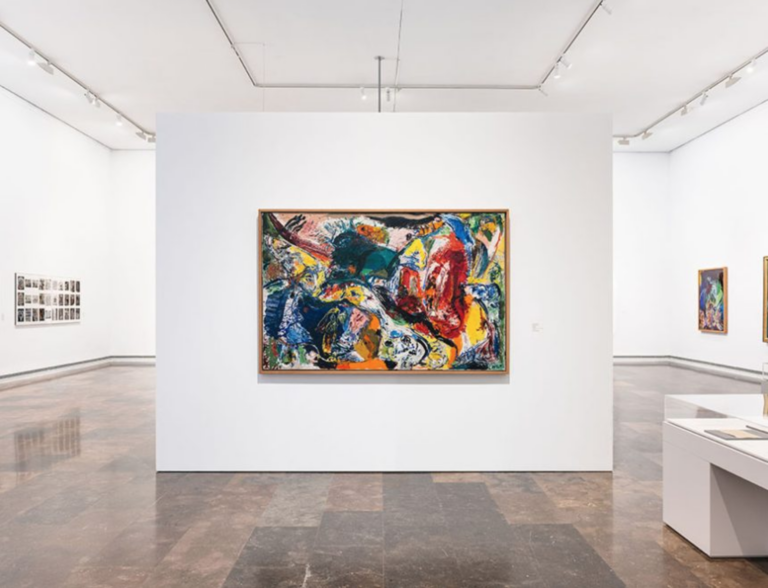
Bacci’s Albe series from 1954 marks a turning point in his exploration of space and color, featuring the rupture of chromatic planes. However, the soul of the exhibition lies within the vibrant walls of the Avvenimenti room, showcasing works from the 1950s and ’60s. In these, Bacci’s exploration of color culminates in a celebration of space, erasing the boundaries between surface and volume, dimension, and trajectory. These works are a testament to the artist’s most creative and productive years, where color transcends the material plane to become pure light.
As the journey continues, the visitor encounters the lesser-known aspect of Bacci’s artistry during the experimental period of the 1960s and ’70s, which marked the twilight years of his career. His Gessi, Sagome, and Teatrini series reflect the artist’s persistent research that ventured beyond painting to explore the essence of matter. Alongside these works, a dedicated section showcases his drawings and Carte Bruciate, allowing the audience to appreciate the artist’s exploration of color and form on paper.
The final section of the exhibition revisits Bacci’s solo room from the 29th Venice Biennale in 1958. The most celebrated Avvenimenti of the time, including Avvenimento #299 (1958) from Palm Springs Art Museum, are on display, offering viewers an immersive look into Bacci’s world. The exhibition concludes with a tribute to the Venetian masters of the past, featuring Giambattista Tiepolo’s impressive oil-on-canvas, The Final Judgment (ca. 1730–35), on loan from Intesa Sanpaolo and the Fondazione Querini Stampalia, Venice. This artwork underscores Bacci’s influences and his ongoing dialogue with the luminous chromatism of Giovanni Bellini, Giorgione, and the spatial qualities of Tiepolo’s frescoes.

The exhibition is accompanied by a comprehensive illustrated catalogue, with essays by Chiara Bertola, Martina Manganello, Barry Schwabsky, Toni Toniato, and Riccardo Venturi. This valuable resource adds another dimension to the visitor’s experience, creating a lasting connection to the vibrant world of Bacci.
The exhibition is made possible by Lavazza Group, the Institutional Patron of the Peggy Guggenheim Collection. This partnership, started in 2016, underscores the shared values of creativity, forward vision, and innovative spirit between Lavazza and the Guggenheim Collection, both established in their commitment to promoting the arts.
The Regione Veneto’s support has also been instrumental in bringing this ambitious project to fruition. “Edmondo Bacci: Energy and Light” promises an enlightening journey through Bacci’s transformative work, offering a fresh perspective on his artistic legacy and his place in the pantheon of post-war Italian art.

Peggy Guggenheim Collection, April 1 –September 18, 2023
Palazzo Venier dei Leoni
Dorsoduro 701
I-30123 Venice
https://www.guggenheim-venice.it/
§
§
Support Lumlux Art by sharing our posts on your social media. We appreciate your help. Thank you!