|

VCV Kick

A Dark Kick in VCV Rack (Free Modules, 120 BPM)

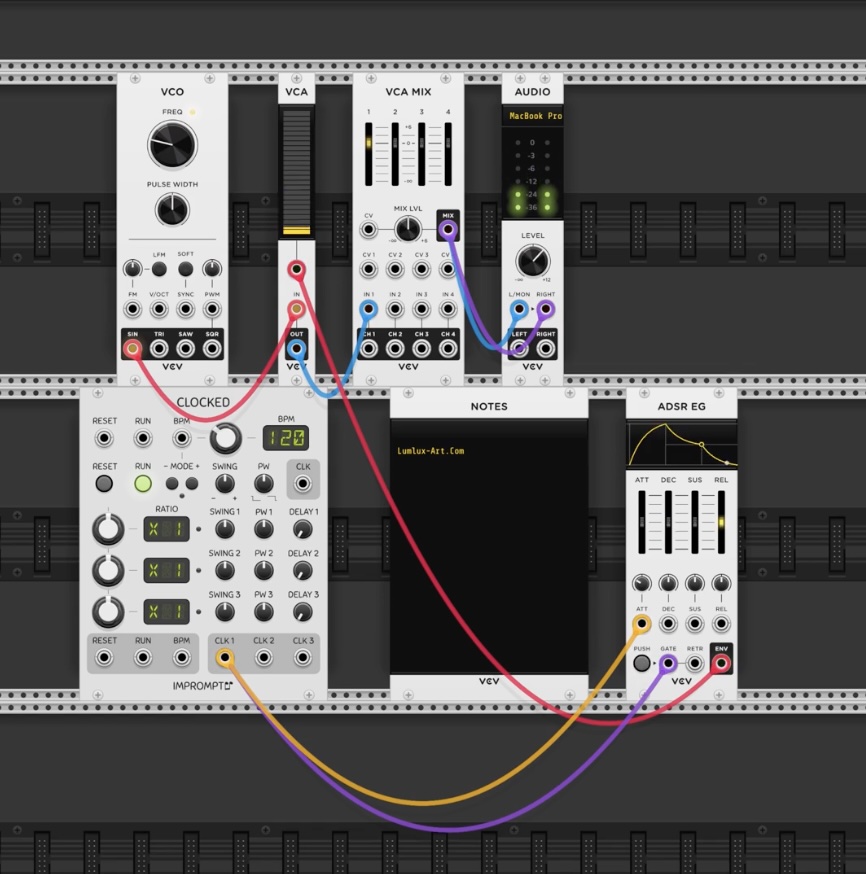
A powerful, controlled kick is the backbone of many electronic styles. In this short piece, I share the sound I chase for my own tracks: a deep sine-based body, a tight envelope for punch, and a subtle pitch dip that adds weight without turning cartoony. Everything is built in VCV Rack using only free modules from the official Library, running at 120 BPM—simple, repeatable, system-ready.

This article is the starting point and listening reference. In a follow-up, I’ll show the exact patch so you can rebuild it in minutes.

What you’ll hear

  • Focused low-end that sits confidently under basslines and chords.
  • Fast, musical transient—clean on small speakers, solid on larger systems.
  • Minimal processing, maximum translation across rooms and playback setups.

Design philosophy

This kick is about shape and movement rather than heavy processing:

  • Shape: a sine wave keeps the spectrum clean; a short amplitude curve turns the note into a tight, percussive thump.
  • Movement: a very quick, very small pitch drop creates the sensation of impact, like a drum head relaxing after the hit. It’s felt more than heard.

Why VCV Rack?

VCV Rack lets you prototype fast and learn by ear. With free modules you can:

  • Control every stage of the kick (oscillator, amplitude, and optional transient).
  • Preserve headroom and avoid mud before mixing.
  • Save variations and automate changes for performance.

Listening notes

  • Headphones: notice the smooth sub and the micro-dip at the start.
  • Small speakers: the punch stays clear without harsh click.
  • Large systems: the low end arrives solidly while leaving space for bass and atmosphere.

Where this sound fits

  • Minimal and ambient-leaning grooves: pairs well with simple hat patterns and subtle chord stabs.
  • Live jams: just a few controls to ride—length, depth of the pitch dip, and overall level.
  • Production: a reliable starting point that requires minimal EQ and compression.

§


Ambient Ambient Music Antwerp Apollo Reverb Apple Music Art Artists Belgium Carcassonne Color contemporary Creativity Cubism EDM Electronic Music Exhibition Expressionism FDR-Sound Food France Impressionism Inspiration Internet Italy Jazz Lifestyle London Mindfulness Music New York Painting Paris Playlist Renaissance Sound Soundscape Sounnay Trilogy Spotify Surrealism Techno Travel UK USA V&A Venice
????

  • ||||||

    Reflecting on 2023: A Year of Inspirational People, Groundbreaking Art, and Unforgettable Experiences

    Introduction As we stand at the threshold of a new year, it’s time to reflect on 2023 – a year that has been nothing short of a whirlwind of cultural and social evolution. In a world still grappling with the echoes of a global pandemic, 2023 emerged as a year of resurgence, reinvention, and remarkable…

  • |

    The Evolution of Music

    This content traces the evolution of music from the Classical era to modern times, highlighting key genres and influential artists. It discusses how the Classical period, characterized by composers like Mozart and Beethoven, laid foundational structures in music. The emergence of jazz in New Orleans, led by icons such as Louis Armstrong, showcased improvisation and cultural fusion. Rock ‘n’ roll, spearheaded by figures like Elvis Presley, transformed youth culture in the 1950s. The British Invasion further innovated music, paving the way for disco, funk, soul, and later digital transformations in the 2000s and 2010s.

  • Classical Music

    Classical music, spanning from the Middle Ages to the present, showcases a rich historical evolution and diverse styles. The Medieval period’s Gregorian chants and the emergence of polyphony laid foundations for Western music. The Renaissance brought intricate polyphony and secular themes, while the Baroque period emphasized contrast and expressiveness. The Classical era favored simplicity and balance. The Romantic period sought emotional expression, and the 20th century saw unprecedented experimentation. This living tradition continues to evolve in the 21st century, reflecting the complexities of the modern world. Classical music’s enduring influence extends beyond concert halls, permeating popular culture.

  • ||

    What’s In A Name

    Creating a soundscape that transports the listener to the heart of a rainforest can be a challenging task. However, with the help of electronic tools, it is possible to recreate the natural sounds of the jungle. We need to identify the different elements that make up a rainforest soundscape. The most obvious ones are the…

  • Experimental Music

    Experimental music is a genre that has continuously challenged and expanded music’s boundaries since its early influences in Medieval and Renaissance periods. It bloomed in the 20th century through movements like Musique Concrète and Free Jazz, driven by innovators such as John Coltrane and Ornette Coleman. The integration of disparate genres led to rock and electronic music crossovers exemplified by The Velvet Underground and David Bowie. Later, ambient and industrial movements further shaped experimental music’s landscape, with artists like Brian Eno and Throbbing Gristle pushing sonic boundaries. Today, experimental music continues to evolve in diverse forms, reflecting an ongoing exploration of sound and creativity.

????

???????????? ????? * ??